
TEST 2: Testing For Spark At The Ignition Coil Pack
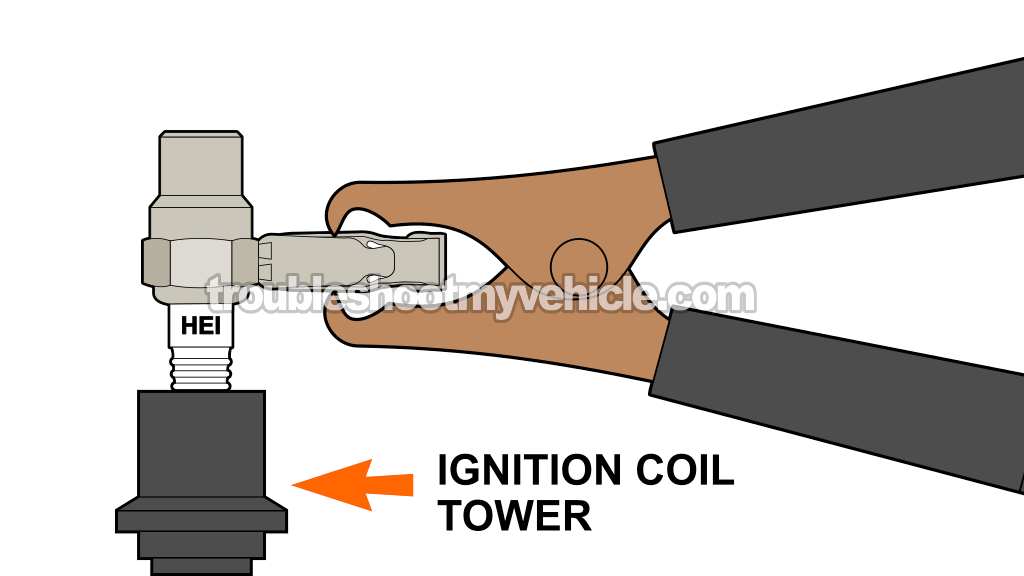
IMPORTANT: This test section only applies if one or two spark plug wires that are connected to non-paired cylinders did not fire spark in TEST 1.
In this test section, you're gonna test for spark directly on the ignition coil pack tower of the spark plug wire that did not spark in TEST 1.
We'll disconnect the spark plug wire that didn't fire spark (in TEST 1) from its ignition coil tower and insert the spark tester into the tower.
Once the spark tester is setup in the tower (and Grounded), we'll crank the engine to see if the tower is firing spark.
The result of this test will indirectly let us know if the spark plug wire is bad or if we need to keep on digging a little more.
Let's get started:
- 1
Remove the spark plug wire that did not fire off spark from the ignition coil pack.
- 2
Place the spark tester directly on the ignition coil tower of the spark plug wire you just removed (see photo above).
- 3
Connect the spark tester to the battery negative (-) terminal with a battery jump start cable.
- 4
Have your helper crank the engine. The engine may start, so be careful.
- 5
You're gonna get one of two results: spark or NO spark.
Let's take a look at what your test result means:
CASE 1: You got spark. This is the correct test result.
You can conclude that the spark plug wire is defective if you have:
- Confirmed that the spark tester did not spark when attached to the spark plug wire (TEST 1).
- In this test section, confirmed that the spark plug wire's tower does spark.
Replace all of the spark plug wires with a new set.
CASE 2: You got NO spark. The ignition coil is bad. Replacing the ignition coil will solve the misfire condition and the misfire code lighting up the check engine light (CEL) on the instrument cluster.
TEST 3: Testing For Spark At The Ignition Coil Pack
IMPORTANT: This test section only applies if two spark plug wires that are connected to paired cylinders (1 & 5, 2 & 6, or 3 & 4) did not fire spark in TEST 1.
You're gonna test one ignition coil tower at a time for spark. The best and safest way to accomplish this is by removing the spark plug wire that didn't spark from the ignition coil tower and then inserting the spark tester into the tower (as shown in the illustration above).
Then, you'll Ground the spark tester with a battery jump-start cable to the battery's negative (-) terminal. Finally, you'll crank the engine and see if the spark tester sparks.
Since we're testing two ignition coil towers, pick one to test first and then test the second one.
These are the test steps:
- 1
Remove one of the spark plug wires that did not fire off spark from the ignition coil pack.
- 2
Place the spark tester directly in the ignition coil tower (see photo above).
- 3
Connect the spark tester to the battery negative (-) terminal with a battery jump start cable.
- 4
Have your helper crank the engine.
- 5
The spark tester should spark as the engine cranks.
- 6
Repeat tests 1 thru' 5 on the other ignition coil tower whose spark plug wire did not fire off spark.
Let's take a look at what your test result means:
CASE 1: You got spark from only one tower. This result lets you know that the ignition coil is bad. Replace the ignition coil.
CASE 2 If you got spark from both towers. This result lets you know that the ignition coil is good and that the spark plug wires are bad. Replace all of the spark plug wires as a set.
CASE 3: You got NO spark from both towers. Generally, this test result tells you that the ignition coil bad.
To make sure that it's bad, I recommend that you confirm that the ignition coil is getting its activation signal.
If you got no spark from the towers that feed spark to cylinders 1 and 5 go to: TEST 5: Activation Signal For Cylinders 1 And 5.
If you got no spark from the towers that feed spark to cylinders 2 and 6 go to: TEST 6: Activation Signal For Cylinders 2 And 6.
If you got no spark from the towers that feed spark to cylinders 3 and 4 go to: TEST 7: Activation Signal For Cylinders 3 And 4.
TEST 4: Testing The Power (12 Volts) Circuit
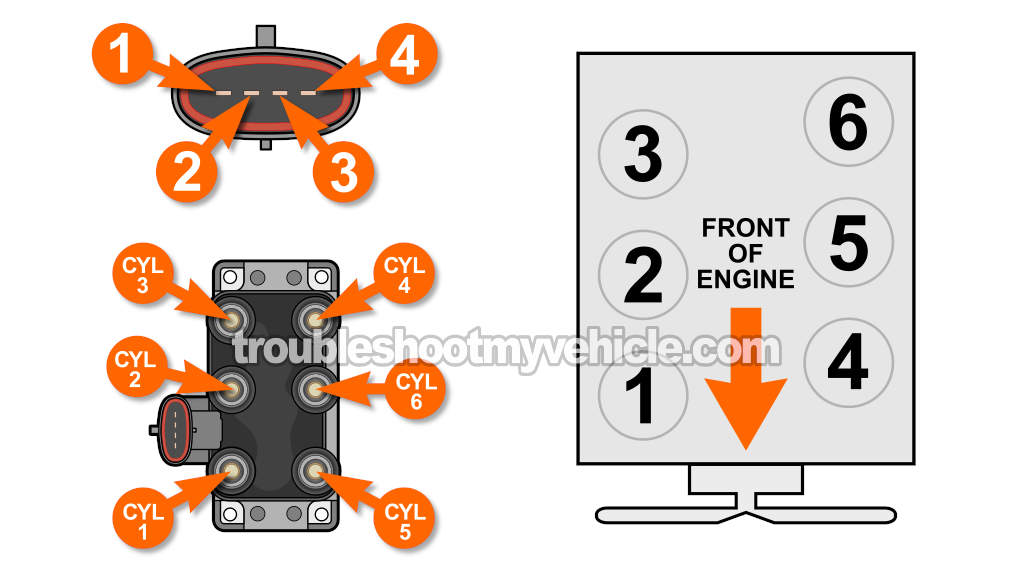
The ignition coil pack needs 10 to 12 Volts to function and it's the red with light green stripe (RED/LT GRN) that delivers them.
We'll do a simple multimeter voltage test to see if the RED/LT GRN wire is delivering them when the key on engine off (KOEO).
NOTE: Be careful when probing the front of the terminal with your multimeter test leads, or you could damage it (and then you'll need to replace the entire connector).
Let's get going:
- 1
Disconnect the ignition coil from its connector.
- 2
Put the multimeter in Volts DC mode.
- 3
Connect the black multimeter test lead to the battery negative (-) terminal.
- 4
Gently probe the front of the female terminal that connects to the RED/LT GRN wire with the red multimeter test lead (using an appropriate tool).
- 5
Have your helper turn the key to the ON position (no need to crank the engine).
- 6
You should see 10-12 Volts on your multimeter.
Let's find out what your test result means:
CASE 1: The multimeter registered 10 to 12 Volts DC. This is the correct test result.
Since you've reached this test section because none of the spark plug wires sparked, the next step is to check that the PCM is providing an activation signal to each of the 3 individual coils that make up the ignition coil pack. Go to: TEST 8: Checking The IC Activation Signals.
CASE 2: The multimeter DID NOT register 10 to 12 Volts DC. Re-check all of your connections and retest.
If still no voltage is present, this result exonerates the coil pack. Repairing the cause of this missing voltage will solve the 'no-spark no-start' condition of your Ford E150 or E250.