

Testing the fuel injectors on the E150/E250 with a 4.2L V6 can seem like a nightmare, since they're located underneath the intake manifold plenum.
I'm not gonna sugarcoated it, it's a challenge, but nothing impossible to do. In this tutorial, I'm gonna share with you the diagnostic process I use to diagnose a bad or clogged fuel injector with some basic tools.
Contents of this tutorial:
- The Two Main Types Of Fuel Injector Failures.
- Symptoms Of A Bad Or Clogged Fuel Injector.
- What Tools Do I Need To Test The Fuel Injectors?
- Start Here: Diagnostic Strategy.
- PART 1: The Fuel Injector Resistance Test.
- PART 2: Checking The Fuel Injector Spray Pattern.
- Important Tips For Installing A Fuel Injector.
- Important Tips For Removing And Installing The Intake Manifold Plenum.
- More 4.2L Ford E150 And E250 Test Tutorials.
APPLIES TO: This tutorial applies to the following vehicles:
- 4.2L V6 Ford E150: 1997, 1998, 1999, 2000.
- 4.2L V6 Ford E250: 1997, 1998, 1999, 2000.
The fuel injector tests for the 2001-2003 4.2L V6 Ford E150/E250 can be found here:
WIRING DIAGRAM: The fuel injector wiring diagram for this tutorial can be found here:
F-SERIES PICKUPS: The fuel injector troubleshooting tutorial for the 1997-2000 4.2L Ford F150/F250 vans can be found here:
- How To Test The Fuel Injectors (1997-2000 4.2L V6 Ford F150, F250) (at: easyautodiagnostics.com).
The Two Main Types Of Fuel Injector Failures
A fuel injector will fail in one of the following ways:
- Fuel Injector Suffers An Internal Electrical Failure: The fuel injector's internal winding suffers a short-circuit or open-circuit failure.
- Fuel Injector Gets Clogged: The fuel injector becomes clogged and doesn't atomize (spray) fuel in the correct conical pattern.
When the fuel injector suffers an internal electrical problem, it'll stop injecting fuel and its cylinder is gonna misfire. This type of issue can easily be confirmed with a simple multimeter resistance test.
On the other hand, if the fuel injector gets clogged, even if it's spraying fuel, its cylinder will also misfire. This happens because it isn't atomizing (spraying in a fine mist) the fuel it's injecting into the cylinder. This type of issue can be a little harder to pin-point.
Whether the fuel injector suffers and internal failure or gets clogged, it'll cause the engine to misfire and trigger the check engine light.
Knowing that the majority of fuel injector failures fall within these two categories is winning half the battle.
Symptoms Of A Bad Or Clogged Fuel Injector
As mentioned in the previous section, the most common symptom of a bad or clogged fuel injector is an engine cylinder misfire, but it's not the only one. Other symptoms include, but are not limited to:
- Lack of power.
- Bad gas mileage.
- Check engine light (CEL) is on.
Now, to go into more specifics of how a fuel injector can fail:
- The fuel injector suffers an internal electrical failure and won't spray any fuel.
- The fuel injector gets clogged and won't spray enough fuel or in the proper spray pattern.
- The fuel injector doesn't activate (spray) because it's not getting power.
- The fuel injector doesn't activate because the fuel injection computer doesn't activate it (although it may be getting power).
- PCM goes bad and activates the fuel injector as soon as the key is turned to the RUN position.
No matter what the root cause, a bad fuel injector will cause the engine to idle rough and miss when you accelerate the van down the road.
What Tools Do I Need To Test The Fuel Injectors?


Disclosure: As an Amazon Associate, I earn from qualifying purchases. If my tutorials help you, using these links is an easy way to support the site at no extra cost to you. Thank you!
To perform a fuel injector resistance test, you don't need a lot of stuff. Here's a basic list of tools you'll need:
- A multimeter.
- The multimeter will help you check the internal resistance (Ohms) of the fuel injector(s).
- If you need to upgrade or buy a multimeter, check out my recommendation: Tekpower TP8268 AC/DC Auto/Manual Range Digital Multimeter (Amazon affiliate link).
- Hand-held DIY fuel injector cleaning tool kit.
- This tool allows you to pulse (activate) the fuel injector while connected to a spray can of brake cleaner, making it super easy to visually check the injector's spray pattern and see if it's clogged.
- You can learn more about this tool and where to buy it in this section: PART 2: Checking The Fuel Injector Spray Pattern.
- A fuel injector pigtail connector.
- The pigtail connector comes in handy when testing the resistance of the injectors with the intake manifold plenum installed.
- OBD II scan tool or code reader.
- To actually test the fuel injectors, you don't need a scan tool (since a scan tool can't dynamically test the fuel injectors). But, having one makes the whole process easier since you're able to retrieve any diagnostic trouble codes (DTCs) stored in the PCM memory.
- Hand Tools.
- Since half of the fuel injectors are underneath the intake manifold plenum, you'll need hand tools like: socket wrench, extensions, sockets, etc. To remove it.
- Pen and Paper to write down your fuel injector resistance test results.
Start Here: Diagnostic Strategy
Testing the fuel injectors on the 4.2L V6 engine requires removing the intake manifold plenum to access them (yeah, I know, this sucks!).
To avoid replacing unnecessary parts (or removing the intake plenum when you don't have to), you need a solid diagnostic strategy.
So if you don't know where to start or just need a troubleshooting 'road map', here's the strategy to follow:
- Find out which cylinder is the one that's 'dead' first.
- Locating the 'dead' cylinder from the get-go is the most important/critical first step because it'll save you a ton of troubleshooting time, not to mention avoiding the frustration of replacing parts that don't solve the problem (since so many things can cause a cylinder to misfire besides a bad/clogged injector).
- In most cases, a cylinder misfire diagnostic trouble code (DTC) is enough to pin-point the 'dead' cylinder, but not always. When there's no misfire DTC identifying a specific cylinder, you may need to do a manual cylinder balance test.
- After locating the 'dead' cylinder, the next step is to eliminate the ignition system as the cause of the cylinder misfire.
- Eliminate the ignition system.
- This means that you need to make sure that the 'dead' cylinder is getting spark. You'll need to:
- Use a spark tester on the spark plug wire to check for spark.
- Inspect the spark plug wire for any signs of damage.
- Remove and inspect the spark plug for any signs of damage.
- The ignition system (by this I mean either the coil pack, spark plug wire, or the spark plug) is the most common culprit behind 90% of misfires (engine miss), so it's best to eliminate it right from the get-go.
- You can find the ignition system tests here: How To Test The Ignition Coils (1997-2000 4.2L V6 Ford E150, E250).
- If the cylinder is getting spark, the spark plug wire is OK, and the spark plug doesn't show any signs of damage, the next step would be to test that cylinder's compression. If you find that the cylinder isn't getting spark, then you've found the issue causing the cylinder misfire.
- This means that you need to make sure that the 'dead' cylinder is getting spark. You'll need to:
- Compression test the 'dead' cylinder.
- You don't have to test all 6 cylinders, just testing the 'dead' cylinder plus two others (to compare your compression test results to) is enough to get an idea of the internal health of that cylinder.
- You can find the test explained here: How To Test Engine Compression (1997-2000 4.2L V6 Ford E150, E250).
- If the 'dead' cylinder has good compression, the next step is to test the fuel injector's resistance. If it doesn't have compression, then you've found the cause of the cylinder misfire issue.
- Test the fuel injector.
- The first thing is to test the internal resistance of the fuel injector of the 'dead' cylinder.
- The second part of the test involves using brake cleaner spray with a special adapter tool to visually check whether the fuel injector is indeed spraying fuel.
I've used the above diagnostic strategy with a ton of success and I think it'll help you too.
PART 1: The Fuel Injector Resistance Test
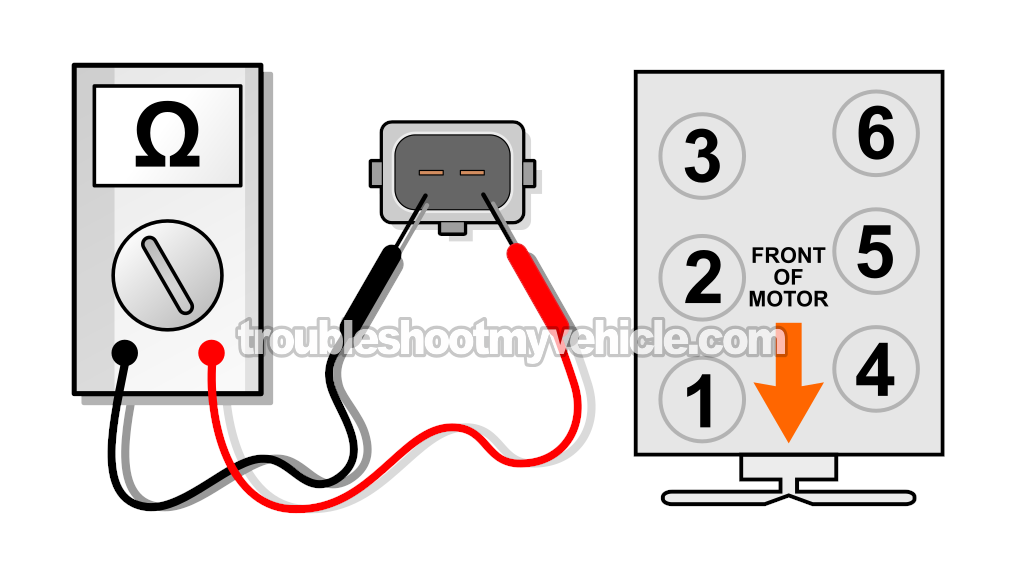
Once you've located the 'dead' cylinder and are sure that the problem isn't caused by an ignition system issue or low compression, the next step is to test the resistance of the fuel injector (that belongs to the 'dead' cylinder).
This is gonna require removing the intake manifold plenum from the engine to access the fuel injectors. I do want to tell you that even with the plenum removed, probing the male spade terminals of some fuel injectors directly with multimeter test leads can still be a challenge.
One way that I've overcome this access issue is by using a fuel injector pigtail connector (I bought it online). I plug it into the fuel injector and then probe its exposed wire ends with the multimeter leads. This approach makes testing them a breeze.
If the resistance of the fuel injector is within specification (11 to 18 Ohms), we'll move on to the next test section and visually check if the fuel injector is actually spraying in a correct way using a spray can of brake cleaner (with an inexpensive specialized tool).
NOTE: If you haven't removed the intake manifold plenum yet, take a look at the following section: Important Tips For Removing And Installing The Intake Manifold Plenum.
Alright, here's the test:
- 1
Remove the intake plenum.
IMPORTANT: After removing the intake manifold's plenum, place clean rags in the open intake runners. - 2
Disconnect the fuel injector that you're gonna test from its electrical connector.
- 3
Place your multimeter in Ohms mode.
- 4
Measure the resistance across the male spade terminals of the fuel injector with the multimeter test leads.
You should see a resistance value between 11 to 18 Ohms (with the engine completely cold).
Measure the resistance of the same fuel injectors several times so that you can be sure of your multimeter's Ohms result. - 5
Write this Ohms value down and record the number of the cylinder that fuel injector belongs to.
- 6
Repeat test steps on two other fuel injectors.
NOTE: The other two fuel injectors will give you a reading to compare to.
Alright, let's interpret your results:
CASE 1: The resistance value of the 'dead' cylinder's fuel injector is within specification. This result tells you that the fuel injector doesn't have an internal short-circuit or open-circuit problem.
Your next step is to check the fuel injector's spray pattern to see if it's clogged. Go to: PART 2: Checking The Fuel Injector Spray Pattern.
CASE 2: The 'dead' cylinder's fuel injector resistance is not within specification. Test this one injector again. If the injector registers the same Ohm value as before, this injector is defective.
PART 2: Checking The Fuel Injector Spray Pattern
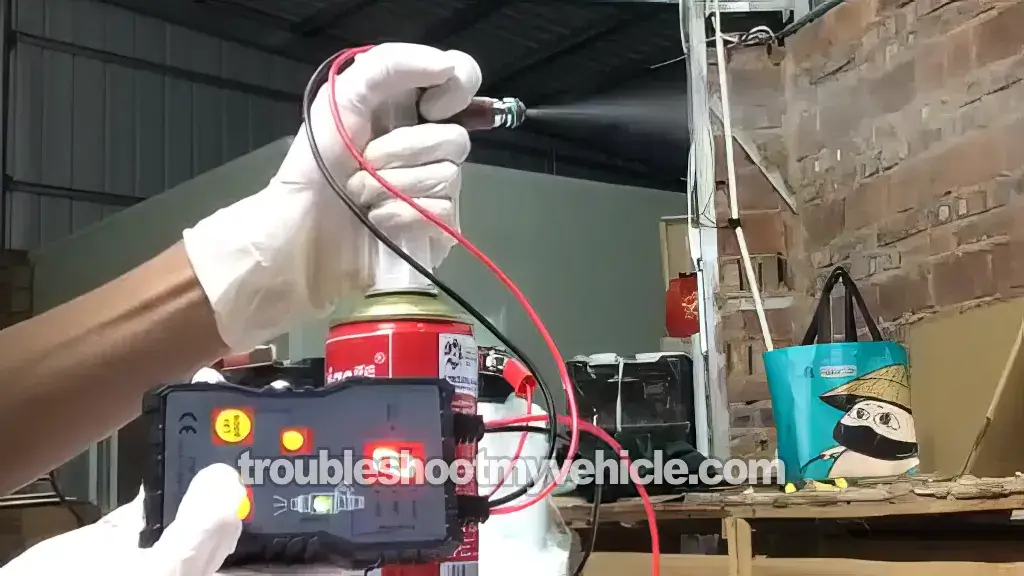
Up to this point, you've checked the fuel injector's internal resistance and it's within specification, which tells you that it hasn't suffered an internal open or short-circuit problem.
The next step is to remove the fuel injector. Then, using a specialized tool, connect the injector to its 12 Volt power module and to a spray can of brake cleaner with a special adapter. This setup will help you visually check if the fuel injector sprays fuel and atomizes it correctly.
The cool thing is that the power module allows you to activate the fuel injector in pulses (just like the fuel injection computer does), allowing the cleaner to flow through the fuel injector and out of its tip.
If the fuel injector isn't clogged, the brake cleaner fluid will get sprayed out and in a fine mist. If the fuel injector is clogged or faulty, it'll come out in a stream or squirt, or not at all.
This tool significantly simplifies the process of checking if the fuel injector can spray fuel correctly and it doesn't cost an arm and a leg. You can buy it here:
- QX Fuel Injector Tester & Adapter for Diagnosis and Cleaning of Injectors DIY Cleaning Tool Kit (Amazon affiliate link).
- EM276SET Fuel Injector Tester & Adapter DIY Cleaning Tool Kit Set (Amazon affiliate link)..
IMPORTANT: Before installing the same or new fuel injector back on the fuel injector rail, take a look at: Important Tips For Installing A Fuel Injector.
CAUTION: Use safety glasses when performing the fuel injector cleaning procedure.
Alright, these are the test steps:
- 1
Remove the fuel injector.
- 2
Connect the fuel injector to the plastic adapter.
NOTE: I've found that securing the fuel injector to the adapter with a thick rubber band helps to make the whole process easier and less messier. - 3
Connect the fuel injector to the tool's power module.
NOTE: Follow the tool's safety and recommended set-up instructions. - 4
Connect the cleaning kit's power module to your van's battery.
- 5
Connect the fuel injector/adapter to a spray can of brake cleaner and press them onto the spray can.
- 6
Activate the power module.
- 7
The fuel injector should spray fuel in a fine mist and in a conical shape.
Let's interpret your test result:
CASE 1: The fuel injector did not spray at all. This tells you that the fuel injector is bad and needs to be replaced.
CASE 2: The fuel injector sprayed the brake cleaner in a fine mist and in a conical pattern. This tells you that the fuel injector is OK.
CASE 3: The fuel injector sprayed the brake cleaner in a squirt or a stream (not in a fine mist). This tells you that the fuel injector is dirty/clogged.
Continue cleaning the fuel injector until it starts to spray in a fine mist. If the cleaning it doesn't restore the injector's spray pattern to that of a fine mist, you'll need to replace it.
Important Tips For Installing A Fuel Injector
When installing a fuel injector (whether it's the same one or a new one) on the fuel injector rail, keep in mind the following important suggestions to ensure everything runs smoothly and safely.
- Always use new fuel injector O-rings: If you're reinstalling the same fuel injector (a new fuel injector will come with new O-rings), it should never be installed with its old O-rings. This is crucial for creating a tight seal and preventing fuel and vacuum leaks.
- Lubricate the new fuel injector O-rings: Before installing the new O-rings on the fuel injector, make sure to lubricate both with a bit of clean (new) engine oil (don't use any silicone based grease or lubricant).
Lubricating the O-rings makes it easier to slide the fuel injector into the injector rail and into the intake manifold injector port without damaging them. A damaged O-ring can cause fuel or intake manifold leaks, which is exactly what you want to avoid. - Replace damaged connector: If the fuel injector's connector is damaged in any way, replace it with a new one. It's not uncommon for the locking tab of the fuel injector to break; if it's broken, replace the connector.
Also, avoid using butt connectors to join the new connector's wires to the engine wiring harness. Instead, solder the wires for a permanent repair, as butt connectors are infamous for becoming loose and causing false contact issues.
Remember, the whole idea here is to prevent gasoline leakage and avoid the risk of a fire. So take your time and ensure everything is properly seated and secure.
Important Tips For Removing And Installing The Intake Manifold Plenum
When removing the intake manifold plenum to access the injectors underneath, there are a few important things to consider:
- Disconnect the battery from its negative (-) cable before removing the intake manifold plenum and leave it disconnected during the entire fuel injector testing procedure.
- Be careful that no foreign object, like a bolt, a nut, or any metal piece/part, falls into the open manifold port runners or you run the risk of engine damage if you start the vehicle.
- Once the plenum has been removed, place a clean rag or rags on the open intake runners. This will keep things from falling into them.
- As you're removing bolts, nuts and stuff from the intake plenum to remove it, place them in a container and away from the engine compartment.
- Never crank the engine with the plenum removed from the lower intake manifold.
If anything falls into the open intake ports (runners) without you knowing it, and you crank and start the engine, you're gonna be in a world of pain!
If this happens, the only way to remove the object is to remove the cylinder head. So, stay alert and be careful. Removing the plenum isn't an out of this world thing that nobody can or shouldn't do; you just have to be careful (heck, even just crossing the street has risks!).
When installing the intake manifold plenum, keep in mind the following important suggestions:
- Don't reuse the gaskets. It's critical that you use new gaskets.
- Don't cover them in any type of sealant (like RTV Silicone).
- Tighten the intake manifold in sequence and to the correct torque specification. You can find this info here:
More 4.2L Ford E150 And E250 Test Tutorials
If this tutorial was helpful, be sure and take a look at all of the 4.2L V6 E150 and E250 diagnostic tutorials and wiring diagrams in this index:
Here's a sample of the tutorials you'll find there:
- How To Test The Throttle Position Sensor (1997-2000 4.2L V6 Ford E150, E250).
- How To Test Engine Compression (1997-2003 4.2L V6 Ford E150, E250).
- How To Test The Fuel Pump (1997-2000 4.2L V6 Ford E150, E250).
- How To Test The CKP Sensor With A Multimeter (1997-2003 4.2L V6 Ford E150, E250).

If this info saved the day, buy me a beer!
