
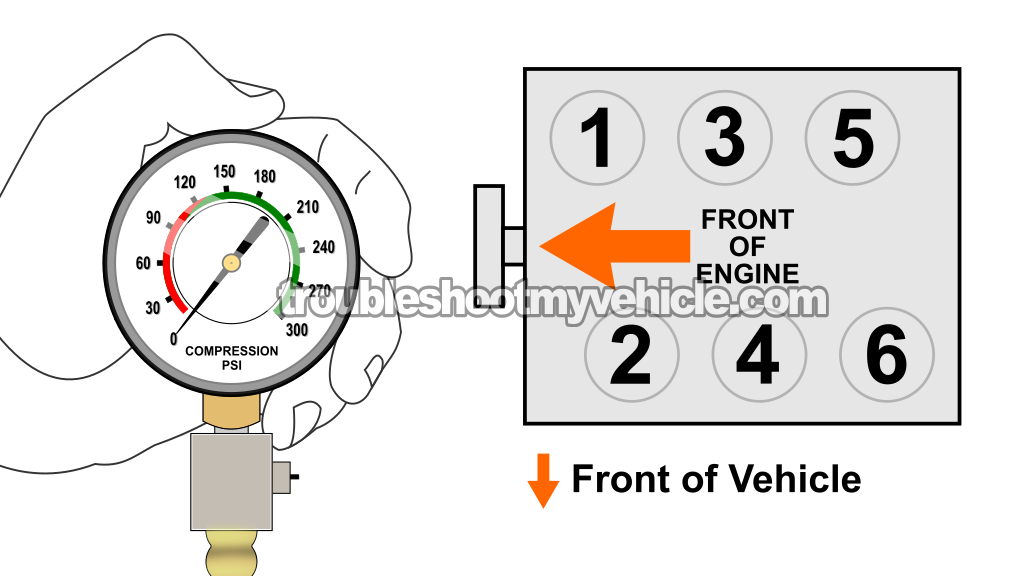
Testing the engine compression on the 3.1L V6 engine in your Buick Century can be a bit of a challenge, but it's definitely doable.
In this tutorial, I'm going to show you how to do it and, more importantly, how to interpret the test results so you can find out if you have a cylinder that's causing a misfire or an engine no-start problem.
You don't need any fancy or expensive diagnostic tools. All you'll need is a compression tester, and I'll show you where you can buy one.
Everything is explained in a step-by-step manner, so you can quickly and easily get to the source of the engine miss or misfire on your 1994-2005 3.1L V6 Buick Century.
Contents of this tutorial:
ES  You can find this tutorial in Spanish here: Cómo Probar La Compresión Del Motor (1994-2005 3.1L V6 Buick Century) (at: autotecnico-online.com).
APPLIES TO: This tutorial applies to the following vehicles:
- 3.1L V6 Buick Century: 1994, 1995, 1996, 1997, 1998, 1999, 2000, 2001, 2002, 2003, 2004, 2005.
ENGINE NO-START DIAGNOSTICS: Troubleshooting an engine cranks but does not start, this tutorial will help:
CYLINDER MISFIRE DIAGNOSTICS: Troubleshooting a cylinder misfire, check out this guide:
Symptoms Of Low Or No Engine Cylinder Compression
An engine compression problem is gonna cause one of two things.
- It's either gonna make the engine misfire and run rough.
- It's gonna make the engine not start.
To be a bit more specific, when an engine compression problem is causing a misfire (rough idle issue), you'll usually see one or more of the following symptoms:
- Bad gas mileage.
- Blue smoke coming out of the tailpipe.
- A heavier exhaust smell coming out of its tailpipe.
- Engine is not as peppy as it was once.
- Rough idle that goes away as soon as you accelerate the engine.
- The check engine light is illuminated on the instrument panel.
- On the 1996+ OBD II equipped Century, you'll see misfire trouble codes illuminating the check engine light. You many see one or more of the following:
- P0300: Random Cylinder Misfire.
- P0301: Cylinder #1 Misfire.
- P0302: Cylinder #2 Misfire.
- P0303: Cylinder #3 Misfire.
- P0304: Cylinder #4 Misfire.
- P0305: Cylinder #5 Misfire.
- P0306: Cylinder #6 Misfire.
The reason the engine is gonna misfire or not start (because of a compression problem) is that each cylinder needs four things to do its job: air (compression), spark, and fuel.
If any one of these is missing, that cylinder is gonna misfire. So if the cylinder can't compress the air/fuel mixture, it's definitely gonna misfire.
If three or more cylinders have little or no compression, the engine usually isn't gonna start.
Which Compression Tester Should I Buy?
There are lot of engine compression testers to choose from and many places to buy them. I'm gonna' make some recommendations to you:


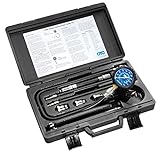
Disclosure: As an Amazon Associate, I earn from qualifying purchases. If my tutorials help you, using these links is an easy way to support the site at no extra cost to you. Thank you!
TEST 1: Finding The Dead Cylinders
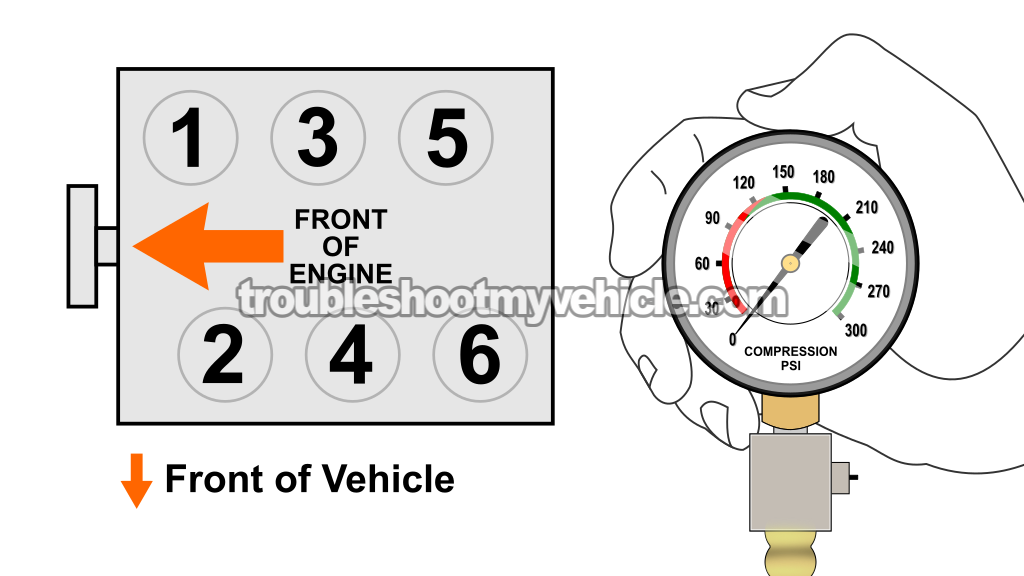
Before we begin, I recommend testing the compression on all six cylinders. This will give you a complete picture of the overall health of the engine. After all, we're dealing with a high-mileage engine that's been on the road for quite a while.
If you're diagnosing an engine no-start problem, then you should test the compression on all six cylinders. This is important because the engine can have multiple cylinders with low or no compression, and you'll need the compression readings from all six cylinders to accurately diagnose the problem.
If you're diagnosing a cylinder misfire, then you don't necessarily have to test all six cylinders. If you already have a misfire trouble code or you suspect a specific cylinder is the problem, you can test that cylinder and at least two others that you know are not misfiring.
The reason for testing those two good cylinders is that you'll need something to compare your compression readings against. Once you have those readings, it'll be much easier to tell if the suspect cylinder has normal compression or if it has a compression problem that's causing the misfire.
So, if you're dealing with a no-start condition, test all six cylinders. If you're chasing a misfire, you can usually get the information you need by testing the suspect cylinder and at least two known-good cylinders.
If you don't have a compression tester, you can borrow one or buy one from your local auto part store. If you'd like to save a few bucks, check out my recommendations here: Which Compression Tester Should I Buy?
IMPORTANT: If the engine has been running for any length of time, let it cool down completely before removing the spark plugs.
OK, these are the test steps:
- 1
Disable the ignition system by disconnecting the ignition coil pack from its electrical connector.
This will prevent the ignition coil from sparking during the test. - 2
Remove the spark plugs. Remember, the engine can not be hot!
When removing the spark plugs, be careful not to drop any on the floor, or you run the risk of having the spark plug's porcelain insulator crack and then you'll have a misfire on your hands. - 3
Thread the engine compression gauge into the spark plug hole for the number 1 engine cylinder.
NOTE: Hand tighten the compression gauge only! Do not use any type of tool to get it tight. - 4
Have your helper crank the engine till the needle on the compression gauge stops climbing.
- 5
Record the value at which the needle stopped and the number of the engine cylinder on a piece of paper.
- 6
Release the pressure on the gauge and repeat step 4 and 5 one more time.
- 7
Repeat test steps 3 - 5 on the remaining cylinders.
Let's examine your test results:
CASE 1: One or more cylinders had a much lower compression value than the others. Up to a certain range, this could be normal.
To further interpret these test results go to: Interpreting The Compression Test Results.
CASE 2: 3 or more cylinders had almost no compression or 0 PSI compression. This low or zero compression on all cylinders will cause the engine to not start.
Having a compression value close to 0 PSI or 0 PSI is usually due one of the following problems:
- A busted timing chain.
- Blown head gasket.
- The engine threw a rod.
CASE 3: The compression value of all six cylinders was similar and above 120 PSI. This test result lets you know that an engine compression problem is not behind the misfire condition and/or engine no-start problem you're troubleshooting.
Interpreting The Compression Test Results
It's not uncommon for the compression readings to vary a bit, especially on a Buick Century that's been on the road for quite a while.
Up to a certain point, that difference is perfectly normal. But once the difference becomes too great, it can cause a cylinder misfire or engine miss.
The good news is that you and I can figure out if that's what's happening by doing a little bit of math.
Once we do the calculation, we'll be able to determine whether the lower compression reading you got is still within an acceptable range or if it's low enough to be causing a misfire problem.
The rule of thumb is that the lowest compression value can not vary more than 15% of the highest value (that you wrote down in TEST 1). If any value is lower by more than 15%, then that engine cylinder is going to misfire. This misfire will cause your Buick Century's engine to idle rough or misfire.
How do you figure this out? You can find out by using my online low compression calculator here: Online Low Engine Compression Calculator (at: easyautodiagnostics.com) or by calculating this 15% difference manually.
To understand how to figure out this 15% thing manually, I'll use the following compression test results:
- Cylinder #1 → 175 PSI.
- Cylinder #2 → 165 PSI.
- Cylinder #3 → 160 PSI.
- Cylinder #4 → 120 PSI.
- Cylinder #5 → 160 PSI.
- Cylinder #6 → 170 PSI.
The next step is to do the following math:
- Multiply .15 (15%) by the highest value: 175 x 0.15. This gives us 26.25, but we'll round it out to 26.
- Next, we subtract 26 from 175: 175 - 26 = 144.
- So now we know that the lowest possible compression value is: 144 PSI.
This means that cylinder #4, which has a compression value of 120 PSI, is the one causing the misfire because it's below the 144 PSI minimum.
Once we've found the 'dead' cylinder, the next step is to find out what's causing the low compression value. For this step, go to: TEST 2: Wet Engine Compression Test.
TEST 2: Wet Engine Compression Test
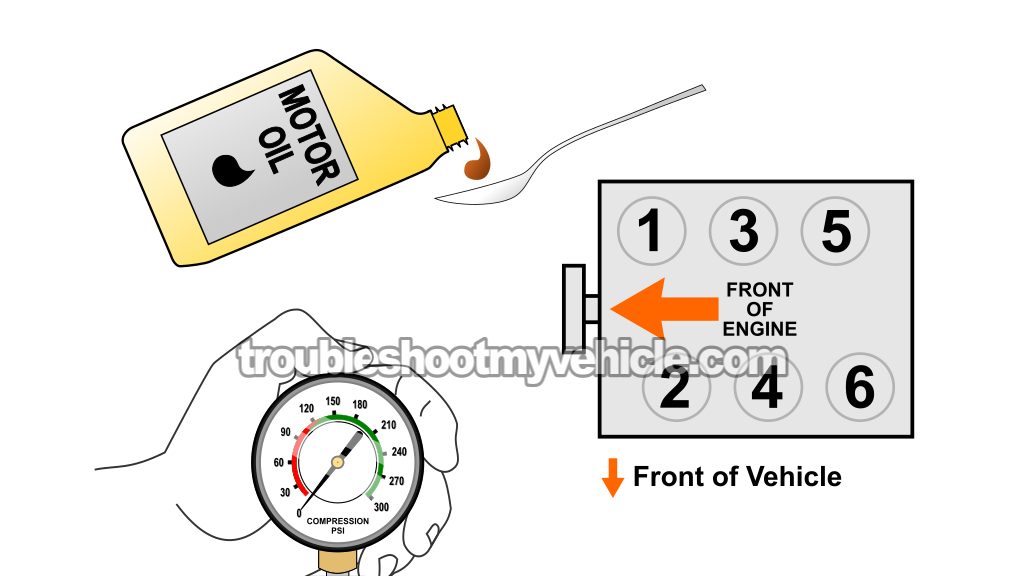
In most cases, a low or zero compression reading is caused by one of two things:
- The piston rings in that cylinder are worn out or damaged.
- The intake or exhaust valves in that cylinder are burnt, bent, or not sealing properly.
The good news is that you can usually tell which one is causing the problem without having to tear the engine apart.
All you need to do is perform a wet compression test. This test is done by adding about two tablespoons of clean engine oil to the low-compression cylinder and then repeating the compression test.
Now, getting the oil into the cylinder can be a bit of a challenge. The method I've found that works every time is to use a hand pump oiler can and a piece of translucent vacuum hose. I insert one end of the vacuum hose into the spark plug hole and then use the hand pump oiler can to pump the oil through the hose and into the cylinder.
I like using translucent vacuum hose because I can actually see the oil traveling through the hose, since it lets me verify that the oil is going into the cylinder. It's a simple trick, but it makes performing a wet compression test a whole lot easier.
If you don't have one (a hand pump oiler can), here are the links to the hand pump oiler can:
- Hand Pump Oiler Can Professional Level 8 oz. (Amazon affiliate link)
This is what we're looking for with the wet compression test:
- If the compression reading goes up, you can conclude that the piston rings are worn or damaged.
- If the compression reading stays the same (or increases very little), then the compression loss is coming from the intake or exhaust valves in that cylinder.
These are the test steps:
- 1
Add a couple of squirts of engine oil in the cylinder you need to retest.
NOTE: What'll make adding the oil to the cylinder a breeze is using a hand pump oiler can with a long piece of vacuum hose that you can insert into the spark plug hole of the cylinder you're testing. Then, simply pump the oil into the cylinder through the hose. As I mentioned earlier, I prefer using a clear (translucent) vacuum hose so I can actually see the oil traveling through the hose and into the cylinder. This lets me confirm that the oil is actually entering the cylinder. - 2
Install the compression gauge on the cylinder you just added oil to.
- 3
Have your helper crank the engine till the needle stops climbing on the compression gauge.
- 4
You'll see one of two results:
1.) The needle will climb higher than the previous compression number you recorded for this specific cylinder.
2.) The needle will not move at all or stay at the same number you recorded earlier.
What ever value your compression tester reads, write it down again. - 5
Repeat steps 1 thru' 4 on any other cylinder you need to check.
Let's examine your test results:
CASE 1: The compression value of the cylinder you added oil to increased. This test result tells you that the low or near 0 PSI compression value is due to worn out piston rings of that specific cylinder.
CASE 2: The compression value of the cylinder you added oil to DID NOT increase. This test result confirms that the cylinder head valves of that cylinder are worn-out or damaged.
More 3.1L V6 Buick Century Diagnostic Tutorials
You can find a complete list of diagnostics tutorials for your 3.1L V6 Buick Century in this index:
Here's a small sample of the tutorials you'll find:
- How To Test The 24X Crankshaft Position Sensor (1994-2005 3.1L V6 Buick Century)..
- How To Test The TPS With A Multimeter (1997-2005 3.1L V6 Buick Century).
- Common Causes Of Spark Plug Failure (1994-2005 3.1L V6 Buick Century).
- How To Test For A Blown Head Gasket (1994-2005 3.1L V6 Buick Century).

If this info saved the day, buy me a beer!
