
TEST 8: Checking The IC Activation Signals
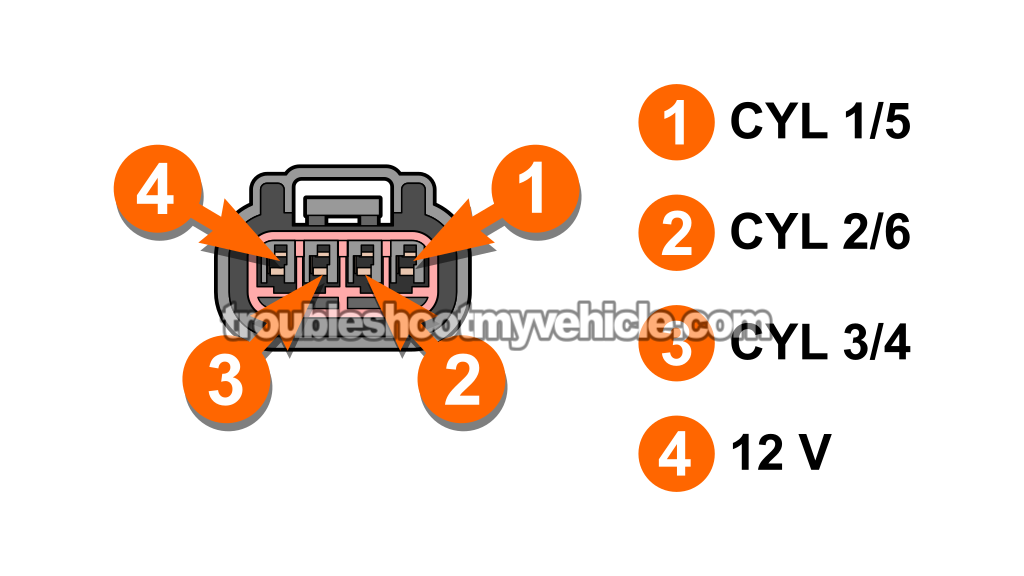
Up to this point in your coil pack diagnostic test —TEST 1 and TEST 4— you've confirmed the following two conditions:
- None of the six spark plug wires are sparking.
- The coil pack is getting 10 to 12 Volts.
For our last diagnostic test, we're going to check that the PCM is sending the coil pack the three activation signals it needs to fire spark to all six cylinders. This test is done with a basic non-powered 12-Volt automotive test light —the type that uses an incandescent bulb.
We'll be checking for each activation signal at the coil pack connector. These are the terminals we're going to be testing:
- Terminal 1: Yellow with black stripe (YEL/BLK) —activation signal for cylinders 1 and 5.
- Terminal 2: Yellow with white stripe (YEL/WHT) —activation signal for cylinders 2 and 6.
- Terminal 3: Yellow with red stripe (YEL/RED) —activation signal for cylinders 3 and 4.
IMPORTANT: Be careful when probing the female terminal of the connector with your test light's metal probe. If the terminal or the connector gets damaged, you'll need to replace the whole connector.
CAUTION: To check the activation signal, you're going to need to crank the engine. So be careful, stay alert, and take all necessary safety precautions while working around a cranking engine.
NOTE: If you don't own a regular incandescent type 12-Volt test light, this is the one that I use and recommend: Lisle 28400 Heavy Duty 12 Volt Test Light (Amazon affiliate link).
Alright, let's start:
- 1
Disconnect the coil pack from its 4-wire electrical connector.
- 2
Connect the 12V test light's alligator clip to the battery positive (+) post.
- 3
With the test light's probing tip, gently probe terminal number 1.
- 4
Have your helper crank the engine.
- 5
The 12V test light should flash ON and OFF the whole time the engine is cranking.
- 6
Repeat steps 2 thru 5 on female terminals 2 and 3.
Let's find out what your test result means:
CASE 1: The 12V test light flashed ON and OFF at all three terminals while cranking. Seeing the light pulse at every terminal confirms that the PCM is sending all three activation signals to the ignition coils inside the coil pack.
The ignition coil pack is defective, but only if all of the following have been confirmed:
- None of the six spark plug wires are firing spark (TEST 1).
- The coil pack is receiving power (TEST 4).
- All three activation signals are present at the connector (this test section).
When you're ready to replace the coil pack, these are the ones I recommend:
- Standard Motor Products FD-498T Ignition Coil Pack (Amazon affiliate link).
- Motorcraft - Coil Pack Assy (DG532) (Amazon affiliate link).
CASE 2: The 12V test light did NOT flash ON and OFF at any terminal while cranking. When none of the terminals show a pulsing signal, it usually points to a problem with the crankshaft position (CKP) sensor.
Your next step is to test the CKP sensor:
Other Things That Can Cause A Misfire
One thing that can really complicate the diagnostic process is that plenty of other problems —not just a bad ignition coil pack— can cause an engine to misfire.
So, if your tests have confirmed that the coil pack is doing its job —meaning it's generating and delivering spark to all six cylinders— then take a look at the suggestions in this test section. Some of these tips and diagnostic tests will help you further narrow down what's actually causing the engine to misfire.
- Check for carbon tracks:
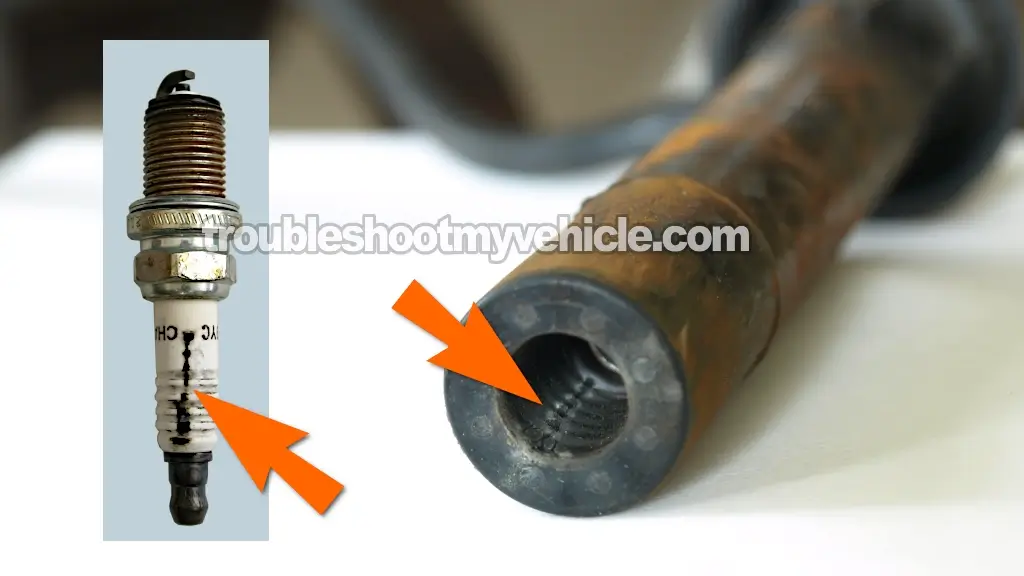
- Carbon tracks can form on the porcelain insulator of the spark plug or inside the spark plug wire boot. They're often the result of engine oil leaking from the valve covers.
- Inspect the inside of each spark plug wire boot and the ceramic insulator on the spark plug. If you spot any carbon tracking on either part, replace whatever's affected.
- The orange arrows in the photo above point out exactly what a carbon track looks like.
- For a real-world example, here's a case study that walks you through an actual carbon-track misfire issue: Carbon Tracks Are A Common Cause Of Ignition Misfires (at: easyautodiagnostics.com).
- Check for damaged spark plug wires:
- A very common issue is a torn or cracked spark plug boot. The boot's job is to cover the wire and the spark plug's metal terminal connection point, and when it's damaged, the connection becomes exposed. When that happens, the spark can jump to the exhaust manifold instead of being channeled thru the spark plug.
- Another problem I've seen over and over is a spark plug wire that's missing its metal terminal completely. This is super common on the 3.0L V6 and usually happens when the wire is pulled off by hand instead of using spark plug wire pullers.
- Replace any spark plug wire that has a damaged boot or is missing its metal terminal.
- Look for burned or cut spark plug wires:
- When spark plug wires aren't routed the way they're supposed to be, they can wind up touching the exhaust manifold or rubbing against a sharp edge on the engine. Heat or friction can burn through or cut the wire, and once the insulation is compromised, the spark will jump to Ground at that exact spot instead of reaching the spark plug —instant misfire.
- Replace any spark plug wire that shows signs of heat damage or physical wear.
- Check for low cylinder compression:
- A compression test is one of the most commonly overlooked diagnostic tests when trying to pinpoint the true cause of a misfire.
- The compression values between cylinders shouldn't vary by more than 15%.
- How To Do And Interpret An Engine Compression Test (1990-2007 3.0L V6 Ford Taurus, Mercury Sable).
- Check for a bad or clogged fuel injector:
- There are several ways to check fuel injectors, but the method I've had the most consistent success with is measuring each injector's internal resistance using a multimeter set to Ohms. What I'm really looking for is an injector that shows an internal open-circuit. In those cases, the multimeter will either display a reading in the infinite-Ohms range or show "OL", which tells you the injector is open internally.
- Sometimes an injector won't show an open-circuit, but its resistance value will be way out of line compared to the others. When that happens, that injector usually has an internal problem and is probably bad.
- Another method that's worked extremely well for me —especially when I suspect a clogged injector but its resistance checks out fine— is to remove the injector and test its spray pattern using a DIY injector-cleaning tool. The injector hooks up to a can of brake cleaner through a handheld adapter, and a small power module is used to pulse the injector so you can see the spray for yourself. This setup has been a total game changer for diagnosing clogged injectors that cause cylinder misfires.
More 3.0L V6 Ford Taurus And Mercury Sable Diagnostic Tutorials
If this tutorial was helpful, be sure and take a look at all of the 3.0L V6 Ford Taurus and Mercury Sable diagnostic tutorials and wiring diagrams in this index:
Here's a sample of the tutorials you'll find there:
- How To Test The MAF Sensor (1996-1999 3.0L V6 Ford Taurus, Mercury Sable).
- How To Test The TPS With A Multimeter (1996-2007 3.0L V6 Ford Taurus, Mercury Sable).
- How To Test For A Blown Head Gasket (1990-2007 3.0L V6 Ford Taurus, Mercury Sable).
- How To Do And Interpret An Engine Compression Test (1990-2007 3.0L V6 Ford Taurus, Mercury Sable).

If this info saved the day, buy me a beer!
