

The crankshaft position (CKP) sensor on the 2001-2007 3.0L V6 Ford Taurus or Mercury Sable is a simple 2-wire sensor that can be easily tested with a multimeter.
In this tutorial, I'm gonna to show you how to check whether it has suffered an internal electrical problem, and I'm also going to show you how to check whether it's producing a viable AC voltage signal while cranking the engine.
All of the test steps are explained in a step-by-step manner so that you can quickly and easily find out if the CKP sensor is good or if it's bad and needs to be replaced.
Contents of this tutorial:
APPLIES TO: This tutorial applies to the following vehicles:
- 3.0L V6 (OHV) Ford Taurus: 2000, 2001, 2002, 2003, 2004, 2005, 2006, 2007.
- 3.0L V6 (OHV) Mercury Sable: 2000, 2001, 2002, 2003, 2004, 2005.
CKP SENSOR CIRCUIT WIRING DIAGRAM:
IGNITION COIL PACK TESTS:
ENGINE NO-START DIAGNOSTICS:
Symptoms Of A Bad CKP Sensor
The CKP sensor is a component the PCM uses to figure out engine RPM and crankshaft position. Because of that, it's the one component it relies on to activate the coil pack (to generate spark), and start triggering the fuel injectors.
When your Ford Taurus or Mercury Sable's CKP sensor fails, you're going to see one or more of the following engine performance issues.
- The engine cranks but does not start.
- The engine stalls out of the blue while driving and often restarts after it's cooled down.
- Extended engine cranking.
- Engine misfires or runs rough.
- Check engine light is illuminated with CKP sensor related codes.
How Does The Crank Sensor Work
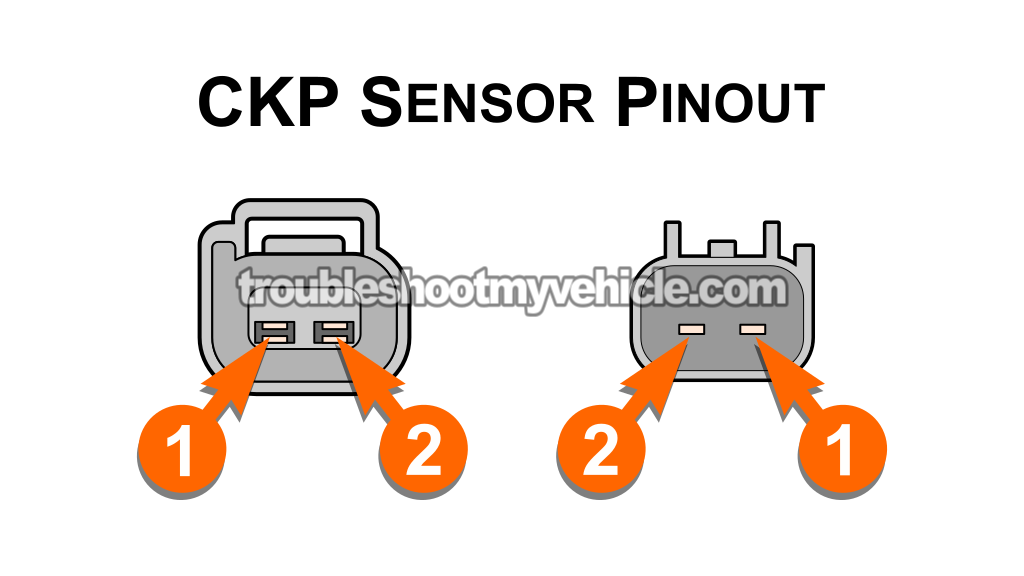
The crankshaft position (CKP) sensor on your Ford Taurus or Mercury Sable is a very simple reluctor-type position sensor. In the Ford service literature, it's called a magnetic transducer type.
The core idea behind this type of sensor is that it produces an AC voltage signal when the engine is cranking or running.
In a nutshell, this is what happens when you turn the key and start the engine:
- As your turn the key and crank the engine, the trigger wheel mounted on behind the front crankshaft pulley starts to rotate.
- The trigger wheel has a total of 35 teeth spaced 10 degrees apart, with one empty space for a missing tooth.
- As this trigger wheel's teeth pass under the crank sensor, they induce the crank sensor to create an A/C voltage. This A/C voltage signal is sent directly to the powertrain control module (PCM).
- When the PCM receives the CKP sensor signal, it knows the engine is turning over, and it now starts activating the coil pack (to fire) spark and the injectors (to begin spraying fuel into their cylinders).
- The primary indicator of the crankshaft speed and piston position is the missing teeth on the trigger wheel.
The most important thing to take away from all of this is that the CKP sensor signal is critical for the ignition coil pack to start firing spark and for the fuel injectors to activate. If the CKP sensor fails, the engine isn't going to start due to a lack of spark and fuel injection.
INTERMITTENT ENGINE NO-START: It's common for the CKP sensor to fail intermittently. In other words, it'll work fine most of the time, but every now and then it doesn't. The engine may start and run, then stall, or it may not start after it's been driven for a while. If you're troubleshooting an intermittent engine no-start issue, you'll need to wait for the engine to not start in order to test the CKP sensor. Otherwise, if even one spark plug wire sparks, the CKP sensor is working correctly at that point in time.
Where To Buy The CKP Sensor And Save
The CKP sensor is a pretty inexpensive component, and you can buy it pretty much anywhere. I want to recommend the following two sensors, which are from well-known automotive aftermarket brands that won't break the bank and that I've personally used myself over the years:


Disclosure: As an Amazon Associate, I earn from qualifying purchases. If my tutorials help you, using these links is an easy way to support the site at no extra cost to you. Thank you!
NOTE: Not sure if the CKP sensor fits your particular Taurus or Sable? Don't worry, once you get to the site they'll make sure it fits by asking you the specifics of your particular Ford vehicle. If it doesn't fit, they'll find you the right CKP sensor.
TEST 1: Checking The CKP Sensor's Resistance
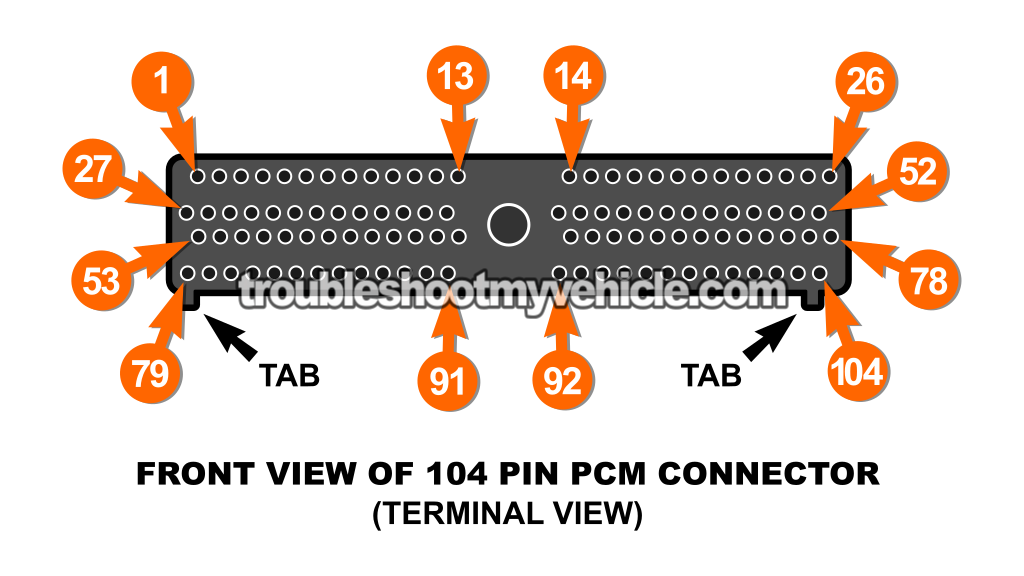
For our first diagnostic test, we're going to check that the resistance of the CKP sensor —and the wiring between it and the PCM connector— is within a specification of 300 to 800 Ohms. This is a pretty simple test that's done with a multimeter in Ohms mode.
This involves disconnecting the PCM's 104-pin connector and checking the resistance across pins 21 and 22 of the connector with our multimeter test probes.
Checking the resistance of the entire circuit —which includes the wiring between the sensor and the PCM connector— lets us make sure the whole circuit is OK and free of electrical problems.
Before you begin this resistance test, be sure to take a look at this guide: How To Safely Probe The PCM Connector -Without Damaging It (1991-2007 3.0L V6 Ford Taurus, Mercury Sable).
NOTE: If you don't have a multimeter or you're wanting to upgrade to one you've got, this is the one that I use and recommend: Tekpower TP8268 AC/DC Auto/Manual Range Digital Multimeter (Amazon affiliate link).
All right, let's get started:
- 1
Disconnect the battery's negative cable.
NOTE: This step is important. Don't move on to the next step without first disconnecting the negative battery cable from the battery. - 2
Disconnect the PCM from its 104-pin connector.
- 3
Locate PCM pins 21 and 22. You can use the PCM connector pinout above to identify the correct terminals.
- 4
Set your multimeter to Ohms mode.
- 5
Measure the resistance across pins 21 and 22.
- 6
Your multimeter should read between 300 and 800 Ohms.
Let's figure out what your test result means:
CASE 1: The multimeter reports the specified resistance range. This confirms that the CKP sensor itself and the wiring between it and the PCM connector are OK.
Having confirmed the integrity of the sensor and its wiring, we need to move on to our next test, which is checking to see if the sensor is producing a viable AC voltage signal. For this test, head over to: TEST 2: Checking The CKP Sensor's AC Voltage Output.
CASE 2: The multimeter reports a resistance way outside the specified range. This test result confirms that there's an electrical issue either with the CKP sensor itself or with the wires connecting the sensor to the PCM.
Your next step is to visually inspect the CKP sensor connector and the two wires coming out of it. It's not uncommon for the wires (at the connector) to have the insulation peel off and the copper strands short together.
If the connector and its wires are shorted together, you've found the cause of the engine no-start. Replace the connector with a new one, making sure to solder the wires together instead of using compression butt connectors.
If after inspecting the CKP sensor you find it's fine, your next step is to remove the sensor from the engine and check its resistance directly at its male terminals. If the sensor's resistance is still not within the specified 300 to 800 Ohms, then the sensor itself is bad and needs to be replaced. If you do need to replace it, these are the ones I recommend:
- Standard Motor Products PC434 Crankshaft Sensor (Amazon affiliate link).
- Delphi SS12212 Engine Crankshaft Position Sensor (Amazon affiliate link).
TEST 2: Checking The CKP Sensor's AC Voltage Output
The CKP sensor is designed so that as the engine is cranking or running, it produces an AC voltage signal.
For our testing purposes, we're going to check the CKP sensor's signal output with the engine cranking but not running, since we'll be checking its signal right at pins 21 and 22 of the PCM's 104-pin connector.
We can expect one of two results:
- Good sensor: You should see an AC voltage between 0.4 and 1 Volts AC as the engine turns over.
- Bad CKP sensor: You'll see 0 AC Volts on your multimeter as the engine cranks.
I want to point out one very important thing: to get the most accurate test result, you've got to make sure your Ford Taurus or Mercury Sable's battery is fully charged. The faster the engine turns over, the stronger the AC voltage output of the sensor will be. So if the battery is low, be sure to fully charge it before beginning this test.
Alright, let's get going.
- 1
Reconnect the battery's negative (-) cable.
- 2
Connect your multimeter test leads to female terminals 21 and 22 of the 104-pin PCM connector.
NOTE: It doesn't matter which multimeter test lead goes where, since polarity does not matter. The important thing to keep in mind is to use the appropriate probes to avoid damaging the female terminals of the PCM connector. - 3
Set your multimeter to Volts AC mode.
- 4
Have your helper crank the engine while you watch the multimeter.
- 5
Your multimeter should show an AC voltage that fluctuates between 0.4 and 1 Volts AC.
NOTE: You'll only see this AC voltage fluctuating between 0.4 and 1 Volts AC while the engine is cranking. When the engine isn't cranking, you should see 0 Volts AC.
Let's see what your result means:
CASE 1: The sensor is producing an AC voltage within the indicated range. This test result lets us know that the CKP sensor is OK and doing its job.
We can rule out the sensor itself as the cause of the engine no-start, since up to this point we've confirmed that the entire CKP sensor circuit is within the specified 300 to 800 Ohms range, and that the sensor is producing a viable AC voltage signal that's reaching the PCM.
CASE 2: The multimeter shows 0 Volts AC as the engine cranks. This test result confirms that the CKP sensor is fried and is the cause of the engine no-start issue you're troubleshooting. Once you've replaced the CKP sensor, the engine should start and run again.
When you're ready to replace the CKP sensor on your Ford Taurus or Mercury Sable, I want to recommend the following two sensors from known automotive brands. They're reliable, and they won't break the bank:
- Standard Motor Products PC434 Crankshaft Sensor (Amazon affiliate link).
- Delphi SS12212 Engine Crankshaft Position Sensor (Amazon affiliate link).
More 3.0L V6 Ford Taurus And Mercury Sable Tutorials
You can find a complete list of diagnostics tutorials and wiring diagrams for the 3.0L V6 Ford Taurus and Mercury Sable in this index:
Here's a small sample of the tutorials you'll find:
- How To Test The MAF Sensor (1996-1999 3.0L V6 Ford Taurus, Mercury Sable).
- How To Test The TPS With A Multimeter (1996-2007 3.0L V6 Ford Taurus, Mercury Sable).
- How To Test For A Blown Head Gasket (1990-2007 3.0L V6 Ford Taurus, Mercury Sable).
- How To Do And Interpret An Engine Compression Test (1990-2007 3.0L V6 Ford Taurus, Mercury Sable).

If this info saved the day, buy me a beer!
