
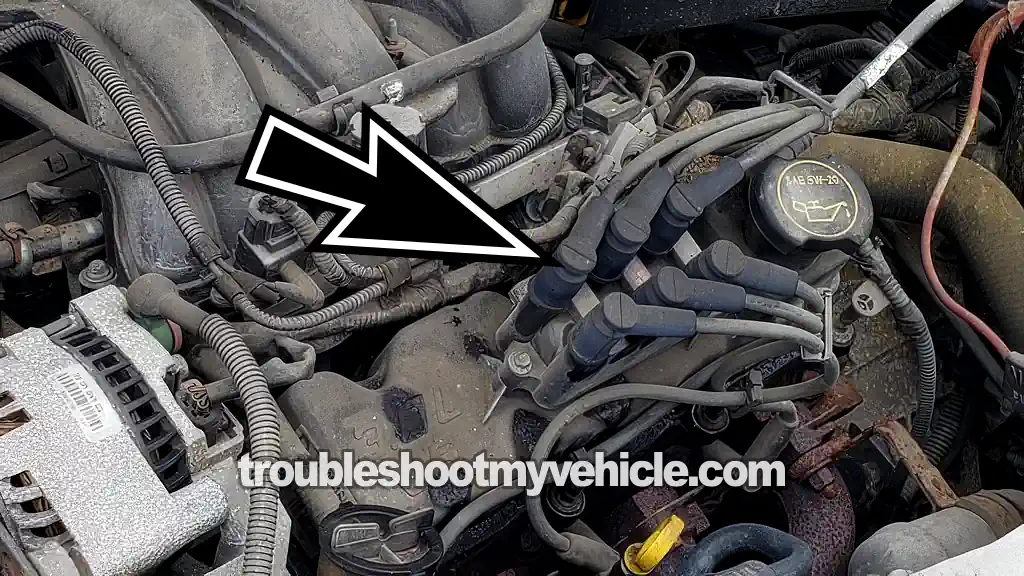
The 2001-2007 3.0L V6 Ford Taurus and Mercury Sable come equipped with a coil pack ignition system. And I can tell you from personal experience that testing the coil pack isn't that difficult.
In this tutorial, I'm going to show you my method for testing the coil pack. With your test results, you'll quickly and easily find out if the coil pack is behind a cylinder misfire issue or an engine no-start problem.
All of the test steps are explained in a step-by-step manner and the best part is that you don't need any expensive diagnostic tools to get them done.
Contents of this tutorial:
- Symptoms Of A Bad Ignition Coil Pack.
- What Tools Do I Need To Test The Ignition Coil?
- Circuit Descriptions Of The Ignition Coil Pack.
- Ignition Coil Pack Basic Operating Theory.
- Where To Buy The Ignition Coil And Save.
- TEST 1: Testing For Spark At The Spark Plug Wire.
- TEST 2: Testing For Spark At The Ignition Coil Pack.
- TEST 3: Testing For Spark At The Ignition Coil Pack (Paired Cylinders).
- TEST 4: Testing The Power (12 Volts) Circuit.
- TEST 5: Activation Signal For Cylinders 1 And 5.
- TEST 6: Activation Signal For Cylinders 2 And 6.
- TEST 7: Activation Signal For Cylinders 3 And 4.
- TEST 8: Checking The IC Activation Signals.
- Other Things That Can Cause A Misfire.
- More 3.0L V6 Ford Taurus And Mercury Sable Diagnostic Tutorials.
APPLIES TO: This tutorial applies to the following vehicles:
- 3.0L V6 (OHV) Ford Taurus: 2001, 2002, 2003, 2004, 2005, 2006, 2007.
- 3.0L V6 (OHV) Mercury Sable: 2001, 2002, 2003, 2004, 2005.
COIL PACK CIRCUIT WIRING DIAGRAM:
- Ignition Coil Pack Wiring Diagram (2000-2001 3.0L V6 Ford Taurus, Mercury Sable).
- Ignition Coil Pack Wiring Diagram (2002-2003 3.0L V6 Ford Taurus, Mercury Sable).
- Ignition Coil Pack Wiring Diagram (2004-2007 3.0L V6 Ford Taurus, Mercury Sable).
CKP SENSOR DIAGNOSTIC TESTS:
CYLINDER MISFIRE DIAGNOSTICS:
Symptoms Of A Bad Ignition Coil Pack
As you're probably already aware, the coil pack on your Ford Taurus or Mercury Sable is made up of three individual ignition coils. Each one fires spark to two paired cylinders in what's known as the waste-spark method.
Sooner or later, one of those individual ignition coils in the assembly is going to fail. And when it does, you're going to see one or more of the following engine performance problems:
- Misfire Codes: You'll see one or more of the following codes:
- P0300: Random Cylinder Misfire.
- P0301: Cylinder 1 Misfire.
- P0302: Cylinder 2 Misfire.
- P0303: Cylinder 3 Misfire.
- P0304: Cylinder 4 Misfire.
- P0305: Cylinder 5 Misfire.
- P0306: Cylinder 6 Misfire.
- Engine Performance Issues: You may see one or more of the following:
- The engine idles rough and wants to stall.
- When you accelerate the van, it has no power.
- Bad Gas Mileage: Since the engine isn't running all six cylinders, it has to work harder, thus consuming more fuel.
- Engine No-Start: The engine will crank but not start (if more than 3 ignition coil towers are not firing spark).
- Rotten egg smell: You'll notice a rotten egg smell coming out of the tailpipe from the unburned fuel overloading the catalytic converter.
CYLINDER MISFIRE DIAGNOSTICS: This tutorial explains how to troubleshoot a cylinder misfire: How To Troubleshoot A Cylinder Misfire (1996-2007 3.0L V6 Ford Taurus, Mercury Sable).
What Tools Do I Need To Test The Ignition Coil?
As I'd mentioned earlier in the tutorial, the cool thing about testing the coil pack is that you don't need expensive diagnostic equipment. As a matter of fact, you don't even need a scan tool to diagnose the coil pack.
You'll need a couple of things, but trust me, it's nothing that's going to break the bank. Here's a list of what you'll need to follow this tutorial:
- A multimeter: The multimeter will help you check that the ignition coil is getting power.
- A 12 Volt automotive test light: We'll use the test light to check for the ignition coil activation signals while cranking the engine. Don't have one? You can buy one here: Lisle 28400 Heavy Duty 12 Volt Test Light (Amazon affiliate link).
- A spark tester: This the most critical tool to have and use to check the condition of the ignition coil pack. Any spark tester will do. The one I use and recommend is the OTC 6589 Spark Tester and you can buy it here:
- OTC 6589 Electronic Ignition Spark Tester (at: amazon.com).
- Battery jump start cables: We'll be using a battery jump start cable to Ground the spark tester.
- Spark plug wire pullers: This tool will help you remove the spark plug wires from the spark plugs and help you avoid the very common hassle of having the spark plug wire's metal terminal stay stuck on the spark plug: Performance Tool W80519 Adjustable Spark Plug Boot And Wire Remover (Amazon affiliate link).
Disclosure: As an Amazon Associate, I earn from qualifying purchases. If my tutorials help you, using these links is an easy way to support the site at no extra cost to you. Thank you!
Alright, before we move on, I do want to point out that you'll need a helper to crank the engine for some of the tests in this tutorial. And lastly, I want to emphasize that the most important tool you'll need is a spark tester. Any spark tester will work —I recommend the HEI spark tester only because I've been using it my entire automotive repair career, and I can tell you from personal experience that it's an accurate and simple way to check for spark.
The thing to remember here is that the wrong tool or method can lead you to an incorrect diagnostic conclusion —and that'll have you chasing ghosts, spending time and money on parts that won't solve the issue.
Circuit Descriptions Of The Ignition Coil Pack
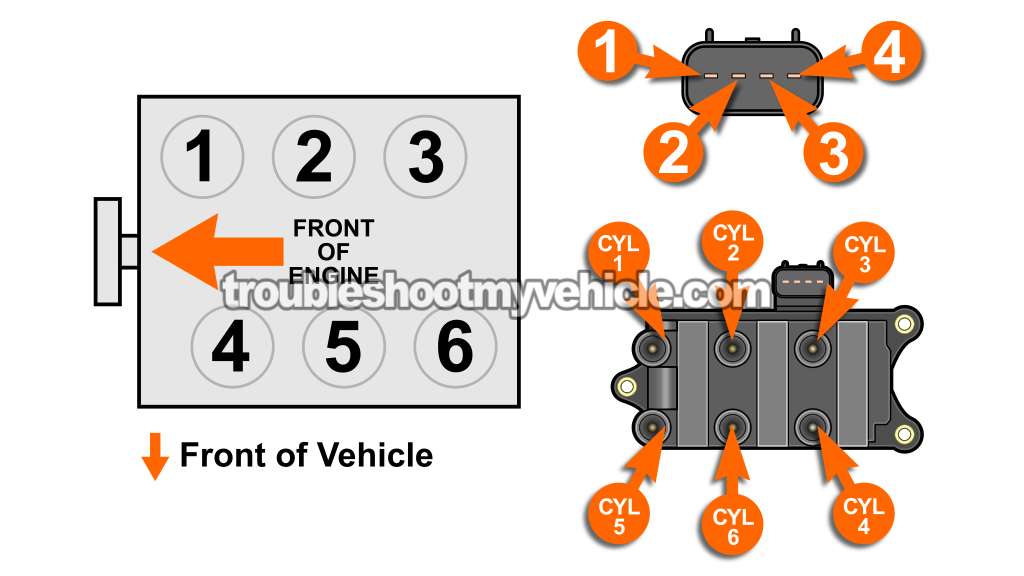
Each of the ignition coils that make up the coil pack assembly needs power and an activation signal, which comes from the powertrain control module (PCM) on your Ford Taurus or Mercury Sable.
This is the reason why the coil pack connector has four wires (1 power circuit and 3 activation signal circuits). In the table below, you'll find a brief description of what each wire (circuit) does —information that's going to come in handy during our diagnostic tests:
| Pin | Wire | Description |
|---|---|---|
| 1 | Yellow with black stripe (YEL/BLK) | Activation Signal Cylinders 1 & 5 |
| 2 | Yellow with white stripe (YEL/WHT) | Activation Signal Cylinders 2 & 6 |
| 3 | Yellow with red stripe (YEL/RED) | Activation Signal Cylinders 3 & 4 |
| 4 | Red (RED) | 12 Volts (in START/RUN) |
Ignition Coil Pack Basic Operating Theory
In this section, I'm going to briefly describe how the coil pack works to create and supply spark to all six cylinders.
I'm not going to get too technical. I mean, after all, we're not trying to reverse-engineer the coil pack. But I'll go over the information that's going to help us successfully and efficiently diagnose it on your Ford Taurus or Mercury Sable.
Alright, here's what happens when you turn the key and crank the engine to get it running:
- The ignition coil pack gets battery voltage:
- Even though there's only one wire delivering this voltage to the coil pack, this battery power is shared by all three individual ignition coils inside the pack.
- In automotive terms, these 12 Volts are known as the ignition coil's primary current.
- As the engine is turning over to start, the crankshaft position (CKP) sensor starts generating its signal, which gets sent directly to your Ford Taurus or Mercury Sable's powertrain control module (PCM).
- Now that the PCM is receiving a CKP signal —along with other sensor input— it begins activating each ignition coil by switching the ignition coil's primary current ON and OFF.
- This switching ON and OFF the primary current (by the PCM) is accomplished by interrupting its Ground path.
- This turning ON and OFF of the primary current is what that makes the ignition coil fire spark and is what I refer to as the ignition coil's activation signal.
- Each ignition coil within the coil pack gets its own activation signal from the PCM.
- Since each ignition coil has two towers (that's why the ignition coil pack has six towers), when an individual coil gets its activation signal, it fires spark to two "paired cylinders" at the exact same time —in what's known as the Waste Spark method.
- Cylinders 1 and 5 get spark simultaneously from coil 1.
- Cylinders 2 and 6 get spark simultaneously from coil 3.
- Cylinders 3 and 4 get spark simultaneously from coil 2.
The most important thing to take away from this basic operating theory of the ignition coil pack is that it's made up of three individual ignition coils. Each one has two towers, so as each individual ignition coil is activated by the PCM, that coil fires spark simultaneously to two "paired cylinders". And in this tutorial, you're gonna see the term "paired cylinders" quite a bit.
Keep in mind, as we test the coil pack in the next sections of this tutorial, that the "paired cylinders" are the following:
- Cylinders 1 and 5.
- Cylinders 2 and 6.
- Cylinders 3 and 4.
Where To Buy The Ignition Coil And Save
When you're ready to buy the coil pack —and if you're planning on buying it online— I want to recommend the following two coil packs. They're from well-known automotive brands that I've used throughout my entire automotive repair career:

Disclosure: As an Amazon Associate, I earn from qualifying purchases. If my tutorials help you, using these links is an easy way to support the site at no extra cost to you. Thank you!
NOTE: The coil packs listed above will fit the 2001-2007 3.0L V6 (OHV) Ford Taurus or Mercury Sable. Still, once you get to the site, they'll double-check fitment by asking for your specific vehicle info.
TEST 1: Testing For Spark At The Spark Plug Wire
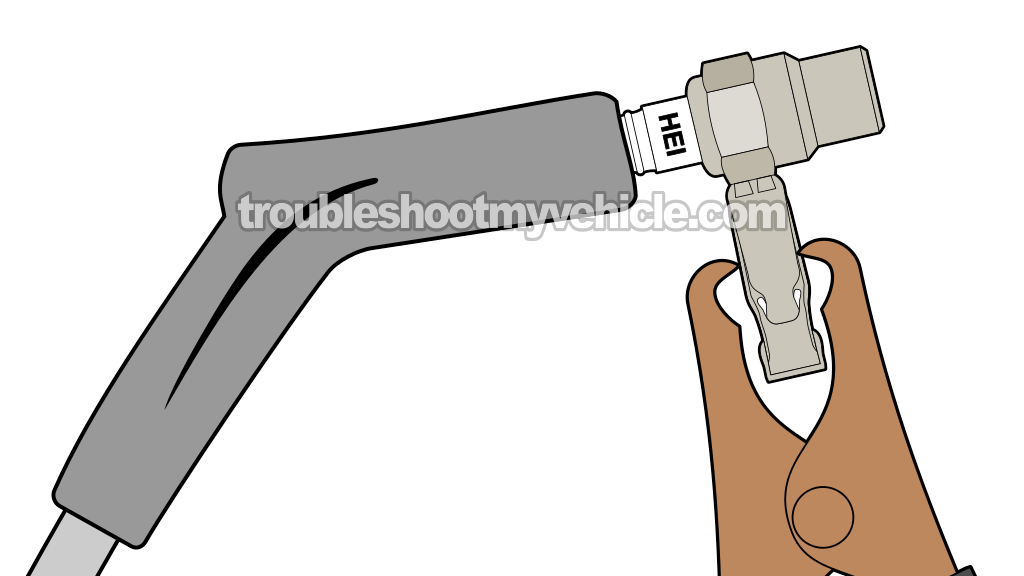
The first thing we need to do —and the most important step to get our coil pack diagnostic underway— is check all six spark plug wires for spark.
Of course, you don't have to test all six; you can test the ones you want if you've got specific cylinder misfire codes. But if I were in your shoes, and for the accuracy of your diagnostic results, I'd check all six spark plug wires for spark.
NOTE: I want to make you aware of one of the most common issues with removing the spark plug wires from the spark plugs, especially if you pull them off by hand. The metal terminal has a bad habit of staying stuck on the spark plug when you yank the wire off. To avoid this headache, you should use spark plug wire pullers to disconnect the high-tension wires from the plugs.
Now, you don't have to use the tool, but if the metal terminal does stay stuck on the spark plug, make sure you reattach it to the spark plug wire when you're done (with all your testing). Otherwise, you're going to have a cylinder misfire on your hands for that specific cylinder.
If you don't have a pair of spark plug wire pliers and need to buy one, this is the set I use and recommend —and you can purchase them here: Performance Tool W80519 Adjustable Spark Plug Boot And Wire Remover (Amazon affiliate link)
One more important thing I want to talk about —you need to use a spark tester to check for spark. Any spark tester will do. Using any other method that doesn't involve a spark tester will have you chasing ghosts and probably wasting time and money on parts that won't fix the issue.
The one I've used my entire automotive repair career, mainly because of its simplicity and accuracy, is the OTC HEI Spark Tester. If you're interested in buying one, you can check it out and buy it here: OTC 6589 Electronic Ignition Spark Tester (Amazon affiliate link).
These are the test steps:
- 1
Remove the spark plug wire (high tension cable) from the spark plug.
- 2
Attach your spark tester to high tension wire.
- 3
Connect the spark tester to the battery negative (-) terminal with a battery jump start cable.
- 4
Have your helper crank the vehicle as you stand at a safe distance from the engine.
The engine may or may not start, either way be careful. - 5
As the vehicle cranks or starts, observe the spark tester.
- 6
You're gonna get one of two results: Spark or NO spark.
- 7
Now repeat this test on the other spark plug wires.
IMPORTANT: Read the following options carefully to interpret your NO SPARK result or results. Remember that some cylinders get spark from the same ignition coil within the coil pack (since the coil pack is made up of 3 individual ignition coils that have two towers each). So if you get a NO SPARK result from two spark plug wires, you need to verify if they're from paired cylinders or from unpaired cylinders.
CASE 1: You got spark from all six spark plug wires. With this test result, you can rule out the coil pack and the spark plug wires as the cause of the engine no-start issue or a cylinder misfire problem. For more troubleshooting tips and suggestions, head over to: Other Things That Can Cause A Misfire.
CASE 2: You got NO spark from only one spark plug wire. The next step is to check for spark directly on the coil pack tower that feeds that spark plug wire with spark. Go to: TEST 2: Testing For Spark At The Ignition Coil Pack.
CASE 3: Spark plug wires that connect to "paired" cylinders 1 and 5 DID NOT spark. The next step is check for spark directly on both towers (one at a time of course).
For this test go to: TEST 3: Testing For Spark At The Ignition Coil Pack (Paired Cylinders).
CASE 4: Spark plug wires that connect to "paired" cylinders 2 and 6 DID NOT spark. The next step is check for spark directly on both towers (one at a time of course).
For this test go to: TEST 3: Testing For Spark At The Ignition Coil Pack (Paired Cylinders).
CASE 5: Spark plug wires that connect to "paired" cylinders 3 and 4 DID NOT spark. The next step is check for spark directly on both towers (one at a time of course).
For this test go to: TEST 3: Testing For Spark At The Ignition Coil Pack (Paired Cylinders).
CASE 6: You got NO spark from two spark plug wires and they DO NOT connect to paired cylinders. The next step is to test each coil pack tower directly for spark one at a time.
For this test go to: TEST 2: Testing For Spark At The Ignition Coil Pack.
CASE 7: You got NO spark from none of the spark plug wires. This usually indicates that power is missing from the power circuit or that the crankshaft position sensor is bad.
To find out, go to: TEST 4: Testing The Power (12 Volts) Circuit.
TEST 2: Testing For Spark At The Ignition Coil Pack

IMPORTANT: This test section only applies if one or two spark plug wires that are connected to non-paired cylinders did not fire spark in TEST 1.
It's not unusual for spark plug wires to wear out and stop transmitting spark. So even if the coil pack is OK and doing its job to generate spark, an old or worn-out spark plug wire just isn't going to transmit that spark.
The cool thing is that we can easily figure out whether the spark plug wire is bad or if the coil pack tower (that the non-sparking wire connects to) is the one that's not firing.
To sort this out, what we're going to do in this test section is check the coil pack tower of the non-sparking spark plug wire with our spark tester.
We're going to see one of two things:
- Coil tower sparks. This tells us the spark plug wire itself is the cause of the no-spark result in TEST 1.
- Coil tower does NOT spark. This test result tells us the coil pack itself is bad and is the reason the high-tension wire didn't spark in TEST 1.
Alright, here's what we need to do:
- 1
Remove the non-sparking spark plug wire from its tower on the ignition coil pack.
- 2
Place the spark tester directly on the ignition coil tower of the spark plug wire you just removed (see illustration above).
- 3
Connect the spark tester to the battery negative (-) terminal with a battery jump start cable.
- 4
Have your helper crank the engine. The engine may start, so be careful.
- 5
You're gonna get one of two results: Spark or NO spark.
- 6
Remove the spark tester and reconnect the spark plug wire to the ignition coil tower.
- 7
Repeat steps 1 thru 6 on the other ignition coil tower of the other non-sparking spark plug wire (if applicable).
Let's take a look at what your test result means:
CASE 1: The coil pack tower sparked while cranking the engine. This spark test result lets us know, without a doubt, that the spark plug wire connected to this tower is bad.
To resolve the no-spark issue, replace all of the spark plug wires with a new set.
CASE 2: The coil pack tower did NOT spark while cranking the engine. This no-spark result tells us the coil pack itself on your Ford Taurus or Mercury Sable is bad.
Replace the coil pack with a new one to solve the problem.
- Standard Motor Products FD-498T Ignition Coil Pack (Amazon affiliate link).
- Motorcraft - Coil Pack Assy (DG532) (Amazon affiliate link).
TEST 3: Testing For Spark At The Ignition Coil Pack (Paired Cylinders)
IMPORTANT: This test section only applies if two spark plug wires that are connected to paired cylinders 1 & 5, or cylinders 2 & 6, or cylinders 3 & 4 did not fire spark in TEST 1.
It's not uncommon to have two paired cylinders not getting spark, and it usually boils down to one of two things:
- The coil pack itself is bad.
- The spark plug wires that connect to the coil pack are worn out and no longer transmit spark to the plugs.
We can easily figure this out by checking each of the coil pack towers (that belong to those non-sparking spark plug wires) for spark. We can expect one of two results:
- The coil tower sparks. This confirms the spark plug wire itself is bad and no longer able to transmit spark.
- The coil tower does NOT spark. This means the coil pack itself is bad and is the reason for the no-spark result in TEST 1.
NOTE: Keep in mind that this test section only applies if you got spark from two spark plug wires that connect to paired cylinders. Paired cylinders are 1 & 5, 2 & 6, or 3 & 4.
OK, let's get to it:
- 1
Remove one of the spark plug wires that did not fire off spark from the ignition coil pack.
- 2
Place the spark tester directly in the ignition coil tower (see photo above).
- 3
Connect the spark tester to the battery negative (-) terminal with a battery jump start cable.
- 4
Have your helper crank the engine.
- 5
The spark tester should spark as the engine cranks.
- 6
Remove the spark tester and reconnect the spark plug wire to the ignition coil tower.
- 7
Repeat tests 1 thru' 5 on the other ignition coil tower whose spark plug wire did not fire off spark.
Let's take a look at what your test result means:
CASE 1: Only one coil pack tower sparked. This test result is a solid indicator that the coil pack itself is bad. Replace the coil pack to fix the cylinder misfire problem being caused by the missing spark.
CASE 2: Both coil pack towers sparked. If both towers are firing spark, then the spark plug wires connected to those towers are bad. They're no longer able to carry spark and need to be replaced.
Installing a new set will take care of the cylinder misfire and the misfire trouble codes that are lighting up the check engine light on your Ford Taurus or Mercury Sable.
CASE 3: Neither coil pack tower sparked. When both towers don't fire spark, you can generally conclude you've got a bad coil pack —but before we replace it, there's one last thing we need to verify.
To be completely sure the coil pack has failed, we need to confirm that the ignition coil (the one tied to those two dead towers) is receiving its activation signal from your Ford Taurus or Mercury Sable's powertrain control module (PCM).
If you got no spark from the towers that feed spark to cylinders 1 and 5 go to: TEST 5: Activation Signal For Cylinders 1 And 5.
If you got no spark from the towers that feed spark to cylinders 2 and 6 go to: TEST 6: Activation Signal For Cylinders 2 And 6.
If you got no spark from the towers that feed spark to cylinders 3 and 4 go to: TEST 7: Activation Signal For Cylinders 3 And 4.