
In this tutorial, I'm going to show you how to test and adjust the idle switch portion of the throttle position sensor on the 1996-1998 3.0L V6 Nissan Quest or Mercury Villager.
All of the test steps are explained in a step-by-step manner so you can quickly and easily find out if the idle switch portion of the TPS sensor assembly is toast or if it's just out of adjustment.
Both procedures —the idle switch test and the adjustment— are done with a multimeter, and I'll walk you through everything step by step.
NOTE: In the Nissan service literature, the idle switch is referred to as the Closed Throttle Position Switch. For simplicity's sake, I'll just be calling it the idle switch.
Contents of this tutorial:
APPLIES TO: This tutorial applies to the following vehicles:
- 3.0L V6 Nissan Quest: 1993, 1994, 1995.
- 3.0L V6 Mercury Villager: 1993, 1994, 1995.
TPS Sensor Diagnostic Tests:
TPS/IDLE SWITCH CIRCUIT DIAGRAM:
- TPS And Idle Switch Circuit Wiring Diagram (1996-1997 3.0L V6 Nissan Quest).
- TPS And Idle Switch Circuit Wiring Diagram (1998 3.0L V6 Nissan Quest).
Idle Switch Continuity Tests
The idle switch has just one basic function: to inform the PCM when the throttle plate is closed and when the throttle plate is wide open. It does this by opening and closing two specific internal circuits, depending on the position of the throttle plate.
Since the idle switch is, at its core, a simple ON/OFF switch, testing it isn't that difficult. All we need to do is check continuity —with the multimeter set to Ohms mode— between two specific terminals while rotating the throttle plate between two positions:
- Closed throttle.
- Wide open throttle (WOT).
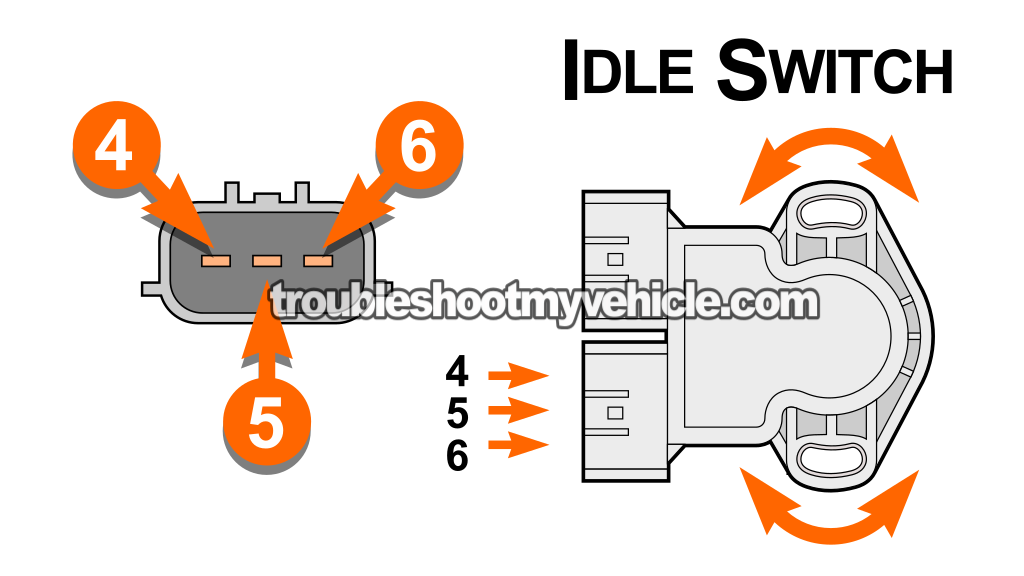
Before we begin, I do want to point out that the throttle position sensor assembly on your 1996-1998 3.0L V6 Nissan Quest or Mercury Villager has two connectors, and each connector has three wires coming out of it.
To be a bit more specific:
- Brown connector: This connector belongs to the throttle position sensor portion of the TPS/idle switch sensor assembly.
- Gray connector: This connector is the one that connects to the idle switch portion of the TPS/idle switch sensor assembly.
Using the illustration above, the idle switch terminals we'll be testing are labeled 4, 5, and 6.
NOTE: All continuity checks are performed directly on the male spade terminals of the idle switch, not on the gray engine wiring harness connector that connects to them.
| Idle Switch Closed Throttle Specifications | ||
|---|---|---|
| Throttle Angle | Pins | Ohms |
| Closed Throttle | 4 and 5 | Continuity |
| Open Throttle | 4 and 5 | No Continuity |
| Idle Switch Wide Open Throttle Specifications | ||
|---|---|---|
| Throttle Angle | Pins | Ohms |
| Closed Throttle | 5 and 6 | No Continuity |
| Wide Open Throttle | 5 and 6 | Continuity |
If the throttle switch on your Nissan Quest (Mercury Villager) doesn't pass any of the above pin continuity tests, then, before replacing it, you need to make sure that it's not misadjusted. The next subheading will help you with this procedure.
Adjusting The Throttle Position Sensor Assembly

The throttle position sensor (TPS) assembly needs to be adjusted any time it's replaced, or if testing shows that the idle switch's closed-throttle or wide-open-throttle continuity is out of specification. The good news is that this adjustment is very straightforward and easy to do.
Here's what you'll need to do to properly adjust the TPS/idle switch assembly:
PART 1:
- Disconnect the TPS/idle switch assembly from its two connectors.
- At the throttle body, open the throttle and place a 0.012" (0.3mm) feeler gauge between the throttle linkage stop and the throttle adjustment screw (the arrow in photo 2, in the image viewer above, points to this exact spot).
- Place your multimeter in Ohms mode check that:
- Idle switch pins 4 and 5 should have continuity (0 Ohms) at closed throttle plate position.
PART 2:
- Place a 0.016" (0.4mm) feeler gauge between the throttle adjustment screw and the throttle linkage stop (see photo 2 in the image viewer above).
- Place your multimeter in Ohms mode check that:
- Idle switch pins 4 and 5 should NOT HAVE continuity (multimeter should read "OL" or infinite Ohms) at closed throttle plate position.
PART 3:
- If the results of steps 3 and/or 5 aren't as specified, loosen the TPS/idle switch assembly retaining bolts and adjust the assembly until you achieve the correct results.
- Once you've got it set, tighten the TPS/idles switch assembly retaining bolts and then repeat Steps 3 and 5 two or three times to make sure the "continuity" and "no continuity" specs are present.
- Reconnect the TPS/idle switch sensor assembly connectors, start the engine, and let it warm up to normal operating temperature.
Where To Buy Your TPS/Idle Switch Sensor And Save
If you need to replace the TPS/idle switch sensor assembly, I want to recommend the following two brands: Standard Motor Products and Hitachi. These are well-known automotive brands that won't let you down, and they don't cost an arm and a leg:


Disclosure: As an Amazon Associate, I earn from qualifying purchases. If my tutorials help you, using these links is an easy way to support the site at no extra cost to you. Thank you!
Not sure if the above TP sensor fits your particular 3.0L Nissan Quest or Mercury Villager? Don't worry, once you get to the site, they'll make sure it fits by asking you the particulars of your vehicle. If it doesn't fit, they'll find you the right one.
More 3.0L V6 Nissan Quest Diagnostic Test Tutorials
You can find a complete list of diagnostic tutorials and wiring diagrams in this index:
Here's a small sample of the tutorials you'll find in the index:
- How To Test The Fuel Pump (1993-1998 3.0L V6 Nissan Quest).
- How To Troubleshoot A Cylinder Misfire (1993-1998 3.0L V6 Nissan Quest).
- How To Test For A Blown Head Gasket (1993-1998 3.0L V6 Nissan Quest).
- How To Test The Fuel Injectors (1993-1995 3.0L V6 Nissan Quest).

If this info saved the day, buy me a beer!
