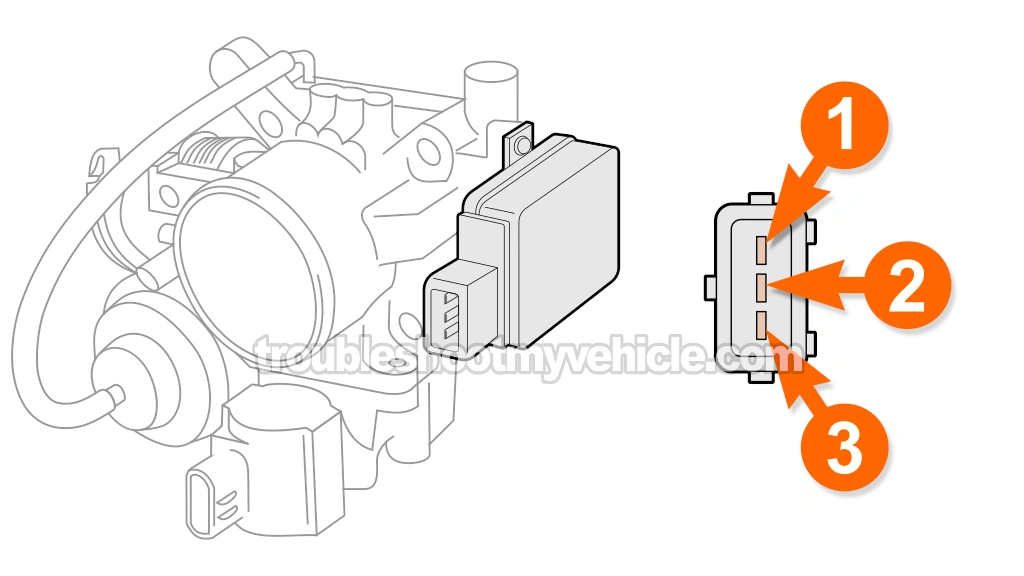
The throttle position sensor (TPS) on the 1987-1991 2.0L Toyota Camry with a manual transmission is just a 3-wire TPS sensor.
In this tutorial, I'll explain how to test the throttle position sensor with a multimeter to find out if it's good or bad. All of the test steps are explained in a step by step manner.
Contents of this tutorial:
- Symptoms Of A Bad Throttle Position Sensor.
- How The TPS Works.
- Circuit Descriptions Of The TPS.
- Where To Buy The TPS And Save.
- TEST 1: Making Sure The TPS Is Getting Power.
- TEST 2: Making Sure The TPS Is Getting Ground.
- TEST 3: TPS Continuity Tests - Part 1.
- TEST 4: TPS Continuity Tests - Part 2.
- TEST 5: TPS Continuity Tests - Part 3.
- More 2.0L Toyota Camry Tutorials.
APPLIES TO: This tutorial applies to the following vehicles:
- 2.0L Toyota Camry: 1997, 1988, 1989, 1990, 1991.
Symptoms Of A Bad Throttle Position Sensor
The throttle position sensor (TPS) provides the fuel injection computer with a voltage signal that reflects the exact position of the throttle plate.
The fuel injection computer uses this information is essential for tasks like fine-tuning fuel delivery and adjusting ignition timing.
When the TPS isn't functioning correctly, it can lead to several problems, including:
- OBD I Trouble Code: Diagnostic trouble code 41 may appear, indicating an issue with the TPS signal.
- Hesitation: The engine may hesitate or stumble during acceleration.
- Power Loss: A defective TPS can cause a noticeable drop in engine performance.
- Poor Fuel Efficiency: Incorrect fuel delivery can result in reduced gas mileage.
How The TPS Works
On the 1987-1991 2.0L Toyota Camry with a manual transaxle, the throttle position sensor (TPS) is a 3-wire sensor (unlike the automatic transaxle model).
Unlike variable resistor-type TPS sensors, this TPS includes two switches:
- IDL (Idle Switch): Signals the ECU when the throttle plate is fully closed (idle position).
- PSW (Power Switch): Activates at approximately two-thirds throttle, signaling the ECU that the throttle is significantly open.
The primary role of this TPS is to detect specific throttle positions and relay that information to the fuel injection computer. The computer then uses this data to adjust:
- Fuel injection timing.
- Ignition timing.
- Other engine parameters for optimal performance under various driving conditions.
Circuit Descriptions Of The TPS
| Terminal | Wire | Description |
|---|---|---|
| 1 | Black with red stripe (BLK/RED) | Power Switch (PSW) Signal |
| 2 | Brown (BRN) | Chassis Ground |
| 3 | Blue (BLU) | Idle Switch (IDL) Signal |
Where To Buy The TPS And Save
The following links will help you to comparison shop for a new 2.0L Camry TPS. I think they'll save you a few bucks:


Disclosure: As an Amazon Associate, I earn from qualifying purchases. If my tutorials help you, using these links is an easy way to support the site at no extra cost to you. Thank you!
Not sure if the above TPS fits your particular 2.0L Toyota Camry? Don't worry, once you get to the site they'll make sure it fits by asking you the specifics of your particular Toyota vehicle. If it doesn't fit, they'll find you the right one.
TEST 1: Making Sure The TPS Is Getting Power
For our first test, we're gonna make sure that:
- The blue (BLU) wire is delivering 10 to 12 Volts DC.
- The black with red stripe wire (BLK/RED) wire is delivering 4.5 to 5 Volts DC.
If the indicated voltages are present in the BLU and BLK/RED wires, we'll move on to TEST 2 and make sure that the BRN wire is providing Ground.
NOTE: We'll be checking for the presence of these voltages on the TPS 3-wire connector. This connector has female terminals.
Here are the steps:
- 1
Turn the key to the ON position but don't start the engine.
- 2
Place your multimeter in Volts DC mode.
- 3
Disconnect the TPS from its 3-wire connector.
- 4
Ground the black multimeter test lead on the battery negative (-) terminal.
- 5
Probe the female terminal that corresponds to the BLU wire of the TPS 3-wire connector with the red multimeter test lead.
NOTE: This test is done on the TP sensor's 3-wire connector that has female terminals. - 6
Your multimeter should report a voltage between 10 to 12 Volts DC.
- 7
Probe the female terminal that corresponds to the BLK/RED wire of the TPS 3-wire connector with the red multimeter test lead.
NOTE: This test is done on the TP sensor's 3-wire connector that has female terminals. - 8
Your multimeter should report a voltage between 4.5 to 5 Volts DC.
Let's take a look at your test results:
CASE 1: The indicated voltage values were present. This is the correct and expected test result.
Your next step is to go to: TEST 2: Making Sure The TPS Is Getting Ground.
CASE 2 The indicated voltage values WERE NOT present. This test result usually indicates one of the following issues:
- There's an open-circuit issue in the wire between the TPS connector and the fuel injection computer.
- The fuel injection computer isn't getting power on pin 1 of the computer's 14-wire connector.
- The fuel injection computer is bad (very rare).
Although beyond the scope of this tutorial, your next step is to find out why power is missing in the terminal you just tested.
TEST 2: Making Sure The TPS Is Getting Ground
So far, your tests have confirmed:
- The BLU wire is delivering 10 to 12 Volts DC (TEST 1).
- The BLK/RED wire is delivering 4.5 to 5 Volts DC (TEST 1).
In this test section, we're going to make sure that the sensor is getting Ground. This Ground is a chassis Ground and is available at all times (this only applies to the manual transaxle equipped 2.0L Camry).
The wire that delivers this chassis Ground to the sensor is the brown (BRN) wire of the TPS 3-wire connector.
The check for the presence of Ground in the BRN, we'll do a simple multimeter voltage test on the female terminal that connects to the BRN wire.
- 1
Disconnect the TP sensor from its 3-wire connector.
- 2
Place your multimeter in Volts DC mode.
- 3
Connect the red multimeter test lead to the battery positive (+) terminal.
- 4
With the black multimeter test lead, probe the female terminal of the connector that connects to the BRN wire.
- 5
Your multimeter should read 10 to 12 Volts DC.
Let's take a look at what your test results mean:
CASE 1: The multimeter registered 10 to 12 Volts. This is the correct and expected test result.
Your next step is to go to: TEST 3: TPS Continuity Tests - Part 1.
CASE 2: The multimeter register DID NOT 10 to 12 Volts. Double check your connections and make sure that you're testing the correct wires.
If your multimeter still does not show Ground, you can conclude that there's an open-circuit problem in the wiring between the TP sensor harness connector and the vehicle's chassis.
TEST 3: TPS Continuity Tests - Part 1
Now that you've checked the basics in the previous two tests, in this section, we'll check that the TPS is signaling that the throttle plate is closed.
This is a very simple test that involves checking the continuity of TPS terminals 1 and 2 with the throttle plate closed.
NOTE: This test is done on the male spade terminals of the throttle position sensor itself.
Here are the steps:
- 1
Disconnect the TPS from its 3-wire connector.
- 2
Place your multimeter in Ohms mode.
- 3
Insert a 0.020 inch (0.50 mm) feeler gauge between the throttle lever and the idle stop stop.
- 4
Measure the resistance between male spade terminals 2 and 3.
Terminals 2 and 3 are the Idle Switch (IDL) circuit of the TP sensor.
Terminal 2 should correspond to the BRN wire of the 3-wire connector.
Terminal 3 should correspond to the BLU wire of the 3-wire connector. - 5
Continuity should exist between terminals 2 and 3.
- 6
Measure the resistance between male spade terminals 1 and 2.
Terminals 1 and 2 are the Power Switch (PSW) circuit of the TP sensor.
Terminal 1 should correspond to the BLK/RED wire of the 3-wire connector.
Terminal 2 should correspond to the BRN wire of the 3-wire connector. - 7
Continuity SHOULD NOT exist between terminals 1 and 2.
Let's take a look at your test results:
CASE 1: The indicated terminals have continuity and no continuity. This is the correct and expected test result.
Your next step is to go to: TEST 4: TPS Continuity Tests - Part 2.
CASE 2: Terminals 2 and 3 have NO continuity. This usually points a misadjusted throttle position sensor.
Your next step is to adjust the TPS. The following tutorial will help you adjust the TPS:
CASE 2: Terminals 1 and 2 have continuity. This usually points a misadjusted or a bad TP sensor.
Your next step is to adjust the TPS. The following tutorial will help you adjust the TPS:
TEST 4: TPS Continuity Tests - Part 2
In this part of the continuity tests, we're gonna substitute the feeler gauge (from the previous test section) with a thicker one.
NOTE: This test is done on the male spade terminals of the throttle position sensor itself.
Here are the steps:
- 1
Disconnect the TPS from its 3-wire connector.
- 2
Place your multimeter in Ohms mode.
- 3
Insert a 0.035 inch (0.90 mm) feeler gauge between the throttle lever and the idle stop stop.
- 4
Measure the resistance between male spade terminals 2 and 3.
Terminals 2 and 3 are the Idle Switch (IDL) circuit of the TP sensor.
Terminal 2 should correspond to the BRN wire of the 3-wire connector.
Terminal 3 should correspond to the BLU wire of the 3-wire connector. - 5
Continuity SHOULD NOT exist between terminals 2 and 3.
- 6
Measure the resistance between male spade terminals 1 and 2.
Terminals 1 and 2 are the Power Switch (PSW) circuit of the TP sensor.
Terminal 1 should correspond to the BLK/RED wire of the 3-wire connector.
Terminal 2 should correspond to the BRN wire of the 3-wire connector. - 7
Continuity SHOULD NOT exist between terminals 1 and 2.
Let's take a look at your test results:
CASE 1: The indicated terminals have no continuity. This is the correct and expected test result.
Your next step is to go to: TEST 5: TPS Continuity Tests - Part 3.
CASE 2: Terminals 2 and 3 have continuity. This usually points a misadjusted throttle position sensor.
Your next step is to adjust the TPS. The following tutorial will help you adjust the TPS:
CASE 2: Terminals 1 and 2 have continuity. This usually points a misadjusted or bad throttle position sensor.
Your next step is to adjust the TPS. The following tutorial will help you adjust the TPS:
TEST 5: TPS Continuity Tests - Part 3
In this last test section, we're gonna make sure that the Power Switch (PWS) circuit closes (activates) when open the throttle plate to its wide open position.
NOTE: This test is done on the male spade terminals of the throttle position sensor itself.
Here are the steps:
- 1
Disconnect the TPS from its 3-wire connector.
- 2
Place your multimeter in Ohms mode.
- 3
Open the throttle plate to its fully open position (wide open throttle -WOT).
- 4
Measure the resistance between male spade terminals 2 and 3.
Terminals 2 and 3 are the Idle Switch (IDL) circuit of the TP sensor.
Terminal 2 should correspond to the BRN wire of the 3-wire connector.
Terminal 3 should correspond to the BLU wire of the 3-wire connector. - 5
Continuity SHOULD NOT exist between terminals 2 and 3.
- 6
Measure the resistance between male spade terminals 1 and 2.
Terminals 1 and 2 are the Power Switch (PSW) circuit of the TP sensor.
Terminal 1 should correspond to the BLK/RED wire of the 3-wire connector.
Terminal 2 should correspond to the BRN wire of the 3-wire connector. - 7
Continuity should exist between terminals 1 and 2.
Let's take a look at your test results:
CASE 1: The indicated terminals have continuity and no continuity. This is the correct and expected test result.
You can conclude that the TPS is good (not defective), if you have:
- The TPS passed the continuity tests in TEST 1.
- The TPS passed the continuity tests in TEST 2.
- The TPS passed the continuity tests in this test section.
CASE 2: Terminals 2 and 3 have continuity. This usually points a misadjusted or bad throttle position sensor.
Your next step is to adjust the TPS. The following tutorial will help you adjust the TPS:
CASE 3: Terminals 1 and 2 have NO continuity. This usually points a misadjusted or bad throttle position sensor.
Your next step is to adjust the TPS. The following tutorial will help you adjust the TPS:
More 2.0L Toyota Camry Tutorials
You can find a complete list of 2.0L Toyota Camry tutorials and wiring diagrams in this index:
Here's a sample of the tutorials you'll find there:
- TPS Idle Switch Multimeter Test (1987-1991 2.0L Toyota Camry).
- How To Test For A Blown Head Gasket (1987-1991 2.0L Toyota Camry).
- How To Test The Engine Compression (1987-1991 2.0L Toyota Camry).
- How To Test The MAF Sensor (1987-1991 2.0L Toyota Camry).

If this info saved the day, buy me a beer!