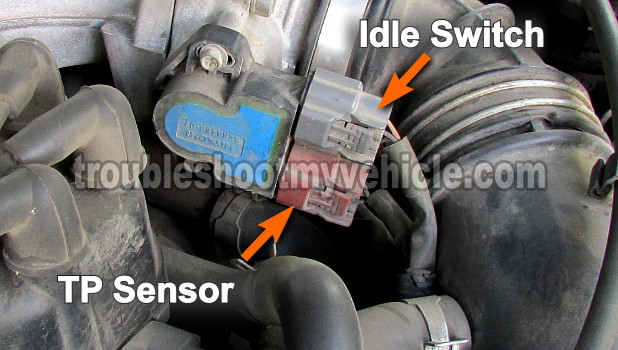
As you're probably already aware, the throttle position sensor on your Nissan is two sensors in 1. One part of the assembly is the actual TP sensor and the other part is the idle switch.
Testing the throttle position sensor (TPS) to see if it has failed and causing a TPS diagnostic trouble code (DTC) is not hard.
In this tutorial, I'm gonna' show you how to troubleshoot the throttle position sensor (TPS) on your Nissan 3.3L Pathfinder (Frontier, XTerra or QX4), with a multimeter and in a step-by-step way.
I'm also gonna' show you how to adjust it after removing and replacing it (you can find these instructions on the last page of this tutorial).
Contents of this tutorial:
- Symptoms Of A Bad Throttle Position Sensor (TPS).
- How The Throttle Position Sensor Works.
- Circuit (Wire) Descriptions Of The TPS.
- Where To Buy Your TP Sensor And Save.
- START HERE: Troubleshooting The TP Sensor.
- TPS TEST 1: Testing The TPS Voltage Signal.
- TPS TEST 2: Verifying The TPS Has Power.
- TPS TEST 3: Verifying The TPS Has Ground.
- How To Adjust The Throttle Position Sensor Assembly.
- More Nissan 3.3L Test Tutorials.
If you need to test the idle switch part of the TP sensor assembly, the following tutorial will help: How To Test The Idle Switch (Nissan 3.3L Pathfinder, Xterra, Frontier).
ES  You can find this tutorial in Spanish here: Cómo Probar El Sensor TPS (Nissan 3.3L Pathfinder, Xterra, Frontier) (at: autotecnico-online.com).
Symptoms Of A Bad Throttle Position Sensor (TPS)
Since the throttle position sensor is one of several sensors that your Nissan's fuel injection computer uses to calculate how much much fuel to inject, when it fails, you're going to see several symptoms.
- Check engine light (CEL) shining nice and bright.
- Diagnostic trouble codes (DTC) stored in the PCM's memory:
- P0120: TP Sensor A Circuit Malfunction.
- Your Nissan Pathfinder (Xterra, Frontier) fails the state mandated emissions test.
- Bad gas mileage.
- Hard start and/or extended cranking time (after shut off).
- Black smoke coming out of the tailpipe.
- Hesitation when accelerating your Pathfinder down the road.
How The Throttle Position Sensor Works
As you're probably already aware, the throttle position sensor (TPS) on your 3.3L equipped Nissan Pathfinder (Frontier, Xterra or QX4) is attached to the throttle body and its job is to measure throttle plate angle.
In layman's terms, this means that the TPS is tasked with the job of measuring how much you step on or step off the accelerator pedal as you're driving the down the road.
This throttle plate angle information is then sent to your Nissan's fuel injection computer as a voltage DC signal.
To give you a few more specifics:
- As you step on the accelerator pedal,
- The throttle plate opens and the TP sensor measures how much and relays this to the PCM.
- The fuel injection computer injects more fuel.
- As you let your foot off the accelerator pedal,
- The throttle plate closes and the TP sensor measures how much and relays this to the PCM.
- The fuel injection computer injects less fuel.
Circuit (Wire) Descriptions Of The TPS
The throttle position sensor (TPS) on your 3.3L equipped Nissan Pathfinder (Frontier, Xterra or QX4) is located on the side of the throttle body.
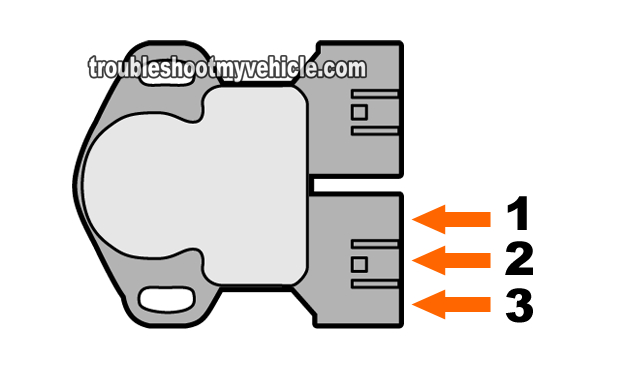
As you can see in photo 2 of 2 (in the image viewer) the TP sensor has 2 connectors for a total of 6 wires coming out of both. This is due to the fact that the throttle position sensor is two sensors in one. One part of the assembly is the idle switch and the other part is the throttle position sensor itself.
The bottom brown connector connects to the TP sensor part and supplies it with power, Ground, and relays the throttle angle voltage signal to the PCM. The gray connector connects to the idle switch part of the assembly.
To better understand how we're gonna' test the throttle position sensor (TPS), in this tutorial, I'm going to briefly describe each wire's job and how the sensor works.
TP sensor brown 3-wire connector:
- Pin 1 wire:
- Provides Ground to the TP sensor.
- This Ground is supplied internally by the PCM.
- Pin 2 wire:
- Delivers the throttle angle voltage signal to the PCM.
- This signal varies as you open and close the throttle plate.
- Pin 3 wire:
- Provides power to the TP sensor.
- This power is 5 Volts DC and is present with Key On Engine Off (KOEO) and Key On Engine Running (KOER).
- Power is supplied directly by the PCM.
REMEMBER: The throttle position sensor (TPS), at closed throttle, produces a low voltage signal of around 0.5 Volts DC. As the throttle plate starts to open (as you step on the accelerator pedal and accelerate the engine), this 0.5 Volt signal starts to increase. At wide open throttle, the TP sensor will output about 4.5 Volts DC.
With this bit of information, let's move on to the next subheading,
Where To Buy Your TP Sensor And Save
Just recently one of my cousins needed to buy a TP sensor for her 1998 Nissan Pathfinder and I was shocked and how much paid for it at our local auto parts store! After all, the TP sensor she bought is a no-name brand Chinese knock-off that she paid over $100 (US) for.
I didn't have the heart to tell her that she could've bought it a whole lot cheaper online, but I'll tell you and I'll show you where to buy it. You can buy it here:


Disclosure: As an Amazon Associate, I earn from qualifying purchases. If my tutorials help you, using these links is an easy way to support the site at no extra cost to you. Thank you!
Not sure the TP sensor listed fits your particular Nissan? Don't worry, they'll make sure it fits your Honda, once you get to the TP sensor site, or they'll find the right one for you.
START HERE: Troubleshooting The TP Sensor
The key to diagnosing the your 3.3L equipped Nissan Pathfinder (Frontier, Xterra or QX4)'s throttle position sensor (TPS) is to remember that:
- The TP sensor's voltage signal increases when the throttle plate opens.
- The TP sensor's voltage decreases when the throttle plate closes.
So, the absolute best way to find out if the TPS has failed on your Nissan is by manually testing the TP sensor with a multimeter (while it's still on the throttle body and connected to its electrical connector).
Here's a summary of the 3 tests in this tutorial:
- Check the TP sensor's voltage signal with a multimeter.
- You'll be connecting your multimeter to the TP sensor connector's middle wire and then manually opening and closing the throttle to see if the TP sensor produces a varying DC voltage signal.
- TPS TEST 1: Testing The TPS Voltage Signal.
- Verify that the TP sensor is getting power (if TEST 1 is failed).
- This is a simple multimeter test too.
- TPS TEST 2: Verifying The TPS Has Power.
- Verify that the TP sensor is getting Ground (if TEST 1 is failed).
- This is a simple multimeter test too.
- TPS TEST 3: Verifying The TPS Has Ground.
TPS TEST 1: Testing The TPS Voltage Signal
The very first thing that we're going to do is connect a multimeter to the wire that connects to the TPS pin labeled with the number 2 (this is the middle wire of the brown connector).
Once the multimeter is connected, we'll manually rotate the throttle plate to see if the throttle position sensor is creating a throttle angle signal.
While we're verifying the throttle angle voltage, we're gonna' gently tap the TP sensor with a screwdriver's handle to see if it affects the voltage output.
I'll explain everything in a step-by-step manner in the following instructions.
NOTE: To ensure the accuracy of your test, it's best to test the throttle position sensor (TPS) with the engine warmed up.
IMPORTANT: The throttle position sensor connector must remain connected to the sensor assembly to access the TP signal within the wire. So you'll need to either back-probe the connector or use a wire-piercing probe on the wire. If you don't have one of these tools, this is the one I use and recommend: Goupchn 4mm Banana to Banana Plug Test Leads Kit (Amazon affiliate link).
OK, let's start:
Part 1
- 1
Place your multimeter in Volts DC mode.
If you don't have a multimeter or need to upgrade yours, this is the one I use and recommend: Tekpower TP8268 AC/DC Auto/Manual Range Digital Multimeter (Amazon affiliate link). - 2
Connect the black multimeter test lead to the battery negative (-) terminal.
- 3
Turn the key to the ON position but don't crank or start the engine.
- 4
Connect the red multimeter test lead to the wire that connects to the TP sensor pin labeled with the number 2 in the image. This is the circuit that supplies the TP Signal to the PCM.
NOTE: The throttle position sensor has to remain connected to its connector for this test to work. - 5
Your multimeter should report 0.4 to 0.9 Volts DC. If your multimeter doesn't, don't worry about it just yet, continue with the other steps.
Part 2
- 6
Now, slowly open the throttle (by hand and from the engine compartment) while you observe the change in voltage numbers on your multimeter.
For this test result to be accurate, you need to open the throttle by hand and not from inside the vehicle. - 7
As the throttle opens, the voltage numbers will increase.
This increase in voltage should be smooth and without any gaps or skips.
Once the throttle is wide open, your multimeter should read somewhere between 3.5 to 4.9 Volts DC. - 8
Now, slowly close the throttle.
As the throttle is closing, you should see the voltage decrease smoothly and without any gaps or skips, to the exact same voltage you noticed in step 4.
Part 3
- 9
Lightly tap on the throttle position sensor with the handle of a screw-driver (or something similar.
I want to emphasize the words 'lightly tap' as you slowly open and close the throttle and observe the multimeter.
If the TPS is bad, the tapping will cause the voltage numbers to skip or go blank. If the TPS is OK, the tapping will have no effect on the voltage numbers. - 10
Repeat step 9 several times to make sure of your multimeter test results.
Let's take a look at your test results:
CASE 1: The multimeter registered a smooth increase or decrease in voltage with no gaps. This test result tells you that the TP sensor on your 3.3L Nissan Pathfinder (Xterra, Frontier, QX4) is working correctly and that it's not malfunctioning at this time.
This test result also let's you know that the problem causing the P)120 trouble code is intermittent and not present at this point in time.
CASE 2: The voltage reading skip or glitched when tapping the TPS. This means that the throttle position sensor (TPS) is bad. Replace the throttle position sensor.
You can check out my recommendations here: Where To Buy Your TP Sensor And Save.
NOTE: After replacing the TPS, you'll need to adjust it. For the TPS adjustment instructions, go to: How To Adjust The Throttle Position Sensor Assembly.
CASE 3: The multimeter DID NOT register any voltage or stayed stuck in one value. This test result doesn't condemn the TPS as bad just yet.
Why? Because, the TPS may be missing either power or Ground. So the next step is to check that the TPS is getting power, go to: TPS TEST 2: Verifying The TPS Has Power.
TPS TEST 2: Verifying The TPS Has Power
If you've reached this point, it's because in TEST 1 your 3.3L Nissan Pathfinder's (Xterra, Frontier, QX4) TP sensor did not produce a throttle angle signal.
There's a good chance that the cause of this test result is that the TP sensor is either missing power or Ground.
So in this test, we're going to check to see if the TP sensor is being fed with power on the wire that connects to the TP sensor pin labeled with the number 3.
As stated earlier, this power is in the form of 5 Volts DC and is feed to the TP sensor by the PCM.
NOTE: You can test for these 5 Volts DC with the TP sensor connected or disconnected to the TPS. I personally prefer to do this test with the TP sensor's connector unplugged.
This is what you'll need to do:
- 1
Disconnect the TPS from its 3-wire connector.
NOTE: See the illustration above to identify the correct 3-wire connector. - 2
Set your trusty multimeter's dial to Volts DC mode.
- 3
Connect the black multimeter test lead directly on the negative (-) battery terminal.
- 4
Turn the key to the ON position, but don't start the engine.
- 5
With your red multimeter test lead, probe male terminal number 3 of the TP sensor itself (see the illustration above).
IMPORTANT If you probe the front of the TPS connector, be careful and don't damage the terminal. Damaging the terminal will require that you replace the connector. - 6
Your multimeter should display 4.5 to 5 Volts on its screen.
OK, now let's interpret your test results below:
CASE 1: The multimeter registered 4.5 to 5 Volts. This confirms that the TP sensor is being fed with power (4.5 to 5 Volts DC).
The next step is to test the Ground circuit of the throttle position sensor, go to: TPS TEST 3: Verifying The TPS Has Ground.
CASE 2: The multimeter DID NOT register 4.5 to 5 Volts. Recheck your connections and repeat the test. If your multimeter still doesn't register the 4.5 to 5 Volts DC, then you've just eliminated the TP sensor itself as bad.
The two most likely reasons for this are: 1) an open-circuit problem in the circuit or 2) the PCM may be fried (although a bad PCM is very rare).
Although it's beyond the scope of this article to test these two conditions, you have now eliminated the throttle position sensor (TPS) on your Honda as being the cause of the problem and/or the TPS diagnostic trouble code (DTC) lighting up the check engine light (CEL).
TPS TEST 3: Verifying The TPS Has Ground
So far you've confirmed that the TP sensor:
One: Is not producing a throttle angle voltage signal in TPS TEST 1.
Two: That it's getting power on the wire that connects to the TP sensor pin labeled with the number 2 of the brown connector in TPS TEST 2.
, the next step (and the purpose of this last test) is to see if it's being fed with Ground by the wire that connects to TP sensor pin labeled with the number 1, in the illustration in the image viewer.
IMPORTANT: Remember, the PCM is the one that provides this Ground internally, so be careful and don't accidentally or intentionally apply power (12 Volts) to this circuit or you'll fry the PCM.
OK, here are the test steps:
- 1
Disconnect the TPS from its 3-wire connector.
NOTE: See the illustration above to identify the correct 3-wire connector. - 2
Set your trusty multimeter's dial to Volts DC mode.
- 3
Connect the red multimeter test lead directly on the positive (+) battery terminal.
- 4
Turn the key to the ON position, but don't start the engine.
- 5
With the black multimeter test lead, probe male terminal number 1 of the TP sensor itself (see illustration above).
IMPORTANT If you probe the front of the TPS connector, be careful and don't damage the terminal. Damaging the terminal will require that you replace the connector. - 6
Your multimeter should display 10 to 12 Volts on its screen.
Let's take a look at what your test results mean:
CASE 1: The multimeter showed 11 to 12 Volts. This confirms that the PCM and the wire/circuit (that supply this Ground) are OK.
All three test have confirmed that:
- Your 3.3L Pathfinder's (Frontier, Xterra, QX4) TPS is not providing a throttle plate angle signal when manually opening the throttle plate (TPS TEST 1).
- The TPS is being fed 5 Volts DC (TPS TEST 2).
- The TPS is being fed Ground.
Therefore, you can conclude that the TP Sensor is bad and needs to be replaced. The new TPS will need to be adjusted before you take your Nissan on the road and the following tutorial will show you how: How To Adjust The Throttle Position Sensor Assembly.
CASE 2: The multimeter DID NOT show 11 to 12 Volts. Recheck your connections and repeat the test. If your multimeter still doesn't show the indicated voltage, then this indicates a problem with either the PCM (internal fault/problem) or an open in the wire between the TPS and the PCM itself.
Although testing these two conditions are beyond the scope of this article, you have now eliminated the throttle position sensor (TPS) on your Honda as being the cause of the problem and/or the TPS Diagnostic Trouble Code (DTC) lighting up the check engine light (CEL).
How To Adjust The Throttle Position Sensor Assembly
If you have removed the throttle position sensor (TPS) and have replaced it, you'll need to adjust it to the correct specification.
Thankfully, adjusting the TPS isn't hard and can be done with the same multimeter you used to test it in the previous pages. In this section, I'll show you how.
NOTE: The TP sensor assembly needs to be connected to its connectors for this adjustment to take place.
This is what you'll need to do:
- Turn the ignition switch to its Off position and make sure the TP sensor assembly is connected to its connectors.
- Turn the ignition switch to its On position but don't start the engine.
- Place your multimeter in Volts DC mode and:
- Connect the red multimeter test lead to the wire that connects to the pin labeled with the number 2 (see the illustration in the image viewer above).
- Ground the black multimeter test lead on the battery negative (-) terminal.
- NOTE: Remember the throttle position sensor assembly must remain connected to its connectors through the entire adjustment. So you'll need to back-probe the connector or use a wiring piercing probe on the connector. See: Goupchn 4mm Banana to Banana Plug Test Leads Kit (Amazon affiliate link).
- Adjust the TPS sensor by rotating it until the output voltage is within specification:
- Specification: 0.3 to 0.7 Volts DC.
- Once the output voltage has reached the above voltage specification, tighten the TP sensor assembly mounting bolts.
- Once you're done, recheck the output voltage to make sure the TP sensor didn't move on you when you tightened the two bolts.
More Nissan 3.3L Test Tutorials
If this tutorial was helpful/informative, you can find a complete list of tutorials here: Nissan 3.3L Index Of Articles.
Here's a sample of the tutorials you'll find there:
- How To Troubleshoot A No Start (Nissan 3.0L, 3.3L, 3.5L).
- How To Test Engine Compression (Nissan 3.0L, 3.3L, 3.5L).
- Mass Air Flow (MAF) Sensor Test 3.3L Frontier, Quest, Pathfinder, XTerra (at: easyautodiagnostics.com).
- How To Bench Test A Starter Motor (Step By Step) (at: easyautodiagnostics.com).

If this info saved the day, buy me a beer!