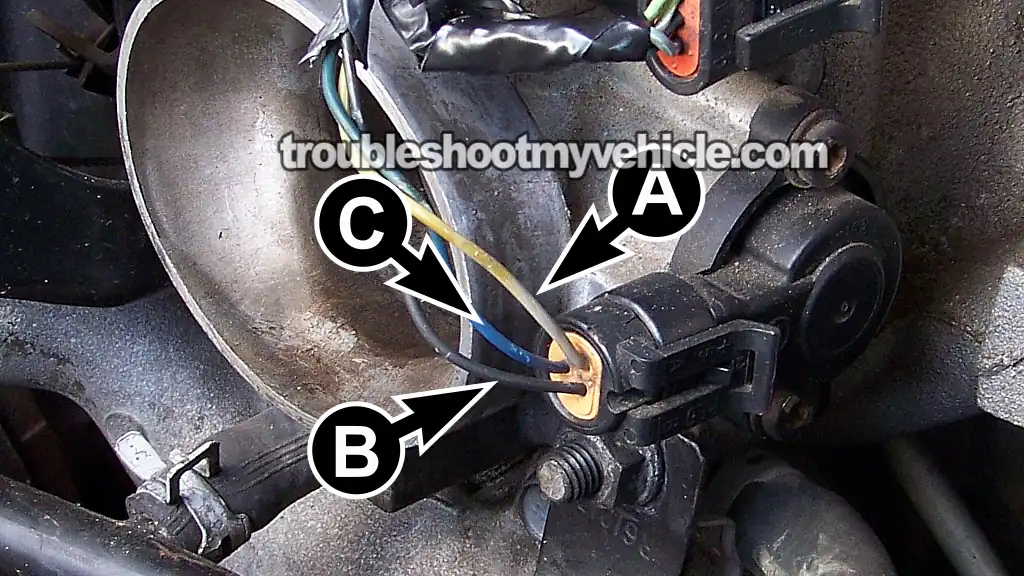
The throttle position sensor is a simple 3-wire engine management component, as such it's super easy to test!
In this tutorial, I'll show you how to test it. You'll easily be able to find out if it's bad or not.
Contents of this tutorial:
- Symptoms Of A Bad Throttle Position Sensor.
- Throttle Position Sensor (TPS) Circuit Descriptions.
- Where To Buy The TPS And Save.
- TEST 1: Testing The TPS Voltage Signal.
- TEST 2: Making Sure The TPS Is Receiving 5 Volts.
- TEST 3: Making Sure That The TPS Is Receiving Ground.
- More 3.4L V6 Buick, Oldsmobile Tutorials.
APPLIES TO: This tutorial applies to the following vehicles:
- 3.4L V6 Buick Rendezvous: 2002, 2003, 2004, 2005.
- 3.4L V6 Oldsmobile Alero: 1999, 2000, 2001, 2002, 2003, 2004.
- 3.4L V6 Oldsmobile Silhouette: 1996, 1997, 1998, 1999, 2000, 2001, 2002, 2003, 2004.
Symptoms Of A Bad Throttle Position Sensor
Being that the throttle position sensor is such a critical component of the engine management system, when it fails, engine performance will suffer.
In the majority of throttle position sensor failures, you'll see the check engine light illuminated by one of the following trouble codes.
- Code P0121: Throttle Position Sensor Performance Problem.
- Code P0122: Throttle Position Sensor Signal Voltage Low.
- Code P0123: Throttle Position Sensor Signal Voltage High.
- Code P1121: Throttle Position Sensor Intermittent High Voltage.
- Code P1122: Throttle Position Sensor Intermittent Low Voltage.
Besides the check engine light illuminated by a TPS diagnostic trouble code, you'll see one or more of the following symptoms:
- Engine hesitates when you step on the accelerator pedal.
- Lack of power when accelerating the vehicle.
- Bad gas mileage.
- Engine idle either too high or too low.
- Rough engine idle.
- The engine may start and immediately stall.
- The engine cranks but does not start.
You can find out more about the throttle position sensor here: What Does The Throttle Position Sensor Do? (3.4L V6 Buick, Oldsmobile).
Throttle Position Sensor (TPS) Circuit Descriptions
To successfully test the throttle position sensor, we need to know what each of the three wires sticking out of its connector do.
In this section, you'll find a brief description of each wire:
| Terminal | Wire | Description |
|---|---|---|
| A | Grey (GRY) | 5 Volts |
| B | Blue (BLU) | TPS Signal |
| C | Black (BLK) | Ground |
Where To Buy The TPS And Save
The following links will help you to comparison shop for the throttle position sensor (of known professional automotive brands- NO knockoffs) for your 3.4L V6 Buick (Oldsmobile).


Disclosure: As an Amazon Associate, I earn from qualifying purchases. If my tutorials help you, using these links is an easy way to support the site at no extra cost to you. Thank you!
NOTE: The TPS above fits all of the 3.4L V6 Buick and Oldsmobile vehicles covered by this tutorial.
TEST 1: Testing The TPS Voltage Signal
The very first thing that we're going to do, is to check the throttle position sensor's signal with a multimeter.
Specifically, we need to make sure that the TPS voltage signal increases as the throttle plate is opened and that the TPS voltage signal decreases as the throttle plate is returned to its closed position.
If the throttle position sensor is bad, the TPS voltage signal will not increase/decrease as you open/close the throttle plate.
If your test results confirm that the TPS voltage signal is stuck in one voltage value, as you open/close the throttle plate, you'll need to make sure that the sensor is receiving 5 Volts and Ground (TEST 2, TEST 3).
IMPORTANT: The throttle position sensor must remain connected to its connector to be able to access the signal inside the wire. You'll need to use either a wire piercing probe or a back probe. You can check out what this tool looks like, and where to buy it, here (this is the one I use): Goupchn 4mm Banana to Banana Plug Test Leads Kit (Amazon affiliate link)..
Let's get started:
- 1
Place your multimeter in Volts DC mode.
- 2
Connect the red multimeter test lead to the blue (BLU) wire of the TP sensor harness connector.
The BLU wire is identified with the letter C in the photo above.
NOTE: The TPS must remain connected to its connector to test the TPS voltage signal. - 3
Connect the black multimeter test lead directly on the battery negative (-) post.
- 4
Turn the key on but don't crank or start the engine.
- 5
Manually rotate the throttle plate.
You'll get the best results by opening and closing the throttle plate directly on the throttle body instead of stepping on the accelerator pedal. - 6
The multimeter should show an increasing voltage as you (or your helper) open up the throttle plate.
- 7
The multimeter should show a decreasing voltage as you begin to close the throttle plate.
- 8
Using a screwdriver's handle, gently tap the TP sensor as you open and close the throttle plate and observe the multimeter.
The purpose (of tapping the TP sensor with the screwdriver's handle) is to see if the TP sensor shows gaps in the voltage signal. Why? Because a good TP sensor will show a continuous increasing or decreasing voltage signal even while getting tapped by the screw-driver's handle.
Let's analyze your test results:
CASE 1: The TPS voltage signal increased/decreased as you opened/closed the throttle plate. This is the correct and expected test result and it lets you know that the throttle position sensor is functioning correctly.
You can also conclude, with this test result, that the TP sensor is receiving 5 Volts and Ground from the fuel injection computer.
CASE 2: The TPS voltage signal DID NOT increase/decrease as you opened and closed the throttle plate. This is a test results usually tells you that the throttle position sensor is bad and needs to be replaced.
Before you replace the sensor, it's important that you make sure that it's getting 5 Volts DC and Ground.
The next step is to make sure the TPS is getting power. Go to: TEST 2: Making Sure The TPS Is Receiving 5 Volts.
CASE 3: The multimeter DID NOT register any voltage. This usually means that the sensor isn't getting power or Ground.
The next step is to make sure that the TPS is getting 5 Volts. For this test go to: TEST 2: Making Sure The TPS Is Receiving 5 Volts.
TEST 2: Making Sure The TPS Is Receiving 5 Volts
If you've reached this point, then your TEST 1 results have confirmed that the TPS voltage signal is not increasing/decreasing as you open/close the throttle plate.
There's a good chance that this is the result of the throttle position sensor not receiving 5 Volts from the fuel injection computer.
So, in this test section, we're going to test the wire labeled with the letter A and see if it's supplying 5 Volts with the key on but engine off.
The wire that supplies 5 Volts to the TPS, and which is labeled with the letter A in the photo above, is the gray (GRY) wire of the TPS 3-wire connector.
Let's get testing:
- 1
Place your multimeter in Volts DC mode.
- 2
Disconnect the TPS from its electrical connector.
- 3
Turn the key on but don't start the engine.
- 4
With the red multimeter test lead (using the appropriate tool), gently probe the female terminal that connects to the wire labeled with the letter A.
- 5
Connect the black multimeter test lead to the negative (-) battery terminal.
- 6
Your multimeter should read 4.5 to 5 Volts DC.
Let's analyze your test results:
CASE 1: The GRY wire is feeding the TPS with 5 Volts. This is the correct test result and it confirms that the TPS is receiving power.
Now that you have confirmed that your 3.4L V6 Buick (Oldsmobile)'s TPS is getting 5 Volts, the next step is to make sure it's getting Ground. Go to: TEST 3: Making Sure That The TPS Is Receiving Ground.
CASE 2: The GRY wire IS NOT feeding the TPS with 5 Volts. Without these 5 Volts the TPS, on your 3.4L V6 Buick (Oldsmobile), will not function.
These missing 5 Volts are usually the result of an open-circuit problem in the GRY wire between the TPS sensor's connector and the fuel injection computer's connector.
TEST 3: Making Sure That The TPS Is Receiving Ground
So far the previous two tests have confirmed:
- That the TPS signal voltage is not increasing/decreasing as you open/close the throttle plate (TEST 1).
- That the TPS is receiving 5 Volts DC (TEST 2).
For our last test, we're going to make sure that the wire labeled with the letter B is supplying Ground to the throttle position sensor.
To check for the presence of Ground in this wire, we're going to do a simple multimeter voltage test.
IMPORTANT: Be careful and don't short the Ground wire to battery power or you'll fry the fuel injection computer. The multimeter voltage test suggested below (for testing the presence of Ground in the wire) is a safe and accurate test.
This is what you'll need to do:
- 1
Place your multimeter in Volts DC mode.
- 2
Disconnect the TPS from its electrical connector.
- 3
Turn the key on but don't start the engine.
- 4
With the black multimeter test lead (using the appropriate tool), gently probe the terminal that connects to the wire labeled with the letter B.
- 5
Connect the red multimeter test lead to the positive (+) battery terminal.
- 6
Your multimeter should read 10 to 12 Volts DC.
Let's analyze your test results:
CASE 1: The BLK wire is feeding Ground to the TPS. This is the correct test result.
You can correctly conclude that the TPS is defective if you have:
- Confirmed that the TPS voltage signal does not increase/decrease as you opened/closed the throttle plate (TEST 1).
- Confirmed that the TPS is getting 5 Volts (TEST 2).
- Confirmed, in this test section, that the TPS is getting Ground.
CASE 2: The BLK wire IS NOT feeding Ground to the TPS. Without Ground the TPS will not function.
This missing Ground is usually caused by an open-circuit problem in the BLK wire between the throttle position sensor's connector and the fuel injection computer's connector.
More 3.4L V6 Buick, Oldsmobile Tutorials
You can find a complete list of 3.4L V6 Buick (Oldsmobile) tutorials in this index:
Here's a small sample of the tutorials you'll find in the index:
- How To Test Engine Compression Test (3.4L V6 Buick, Oldsmobile).
- How To Test A Blown Head Gasket (3.4L V6 Buick, Oldsmobile).
- What Does The CKP Sensor Do? (3.4L V6 Buick, Oldsmobile).
- What Do The Spark Plugs Do? (3.4L V6 Buick, Oldsmobile).

If this info saved the day, buy me a beer!