

Sooner or later, the throttle position sensor (TPS) is gonna fail. When it does, your 2.2L Buick Century may turn on the check engine light and store a TPS-related trouble code.
On 1993-1995 models, you're usually looking at an OBD I TPS code, such as a high or low TPS signal code. On the 1996 model, which is OBD II-equipped, you'll usually see a code like P0121, P0122, or P0123.
In this tutorial, I'm going to show you how to test the TPS with a multimeter. No scan tool is needed.
We'll check the TPS signal voltage and also make sure the sensor is getting power and Ground. All the test steps are explained step by step so you can quickly find out if the TPS is bad or if the problem is somewhere else.
Contents of this tutorial:
- Symptoms Of A Bad Throttle Position Sensor.
- Throttle Position Sensor (TPS) Circuit Descriptions.
- Where To Buy The TPS And Save.
- TEST 1: Testing The TPS Voltage Signal.
- TEST 2: Making Sure The TPS Is Receiving 5 Volts.
- TEST 3: Making Sure That The TPS Is Receiving Ground.
- More 2.2L Buick Century Diagnostic Tutorials.
APPLIES TO: This tutorial applies to the following vehicles:
- 2.2L Buick Century: 1993, 1994, 1995, 1996.
TPS CIRCUIT WIRING DIAGRAMS:
- TPS Sensor Circuit Wiring Diagram (1993 2.2L Buick Century).
- TPS Sensor Circuit Wiring Diagram (1994-1995 2.2L Buick Century).
- TPS Sensor Circuit Wiring Diagram (1996 2.2L Buick Century).
Symptoms Of A Bad Throttle Position Sensor
As you probably already know, the throttle position sensor's (TPS) job is to tell the computer (PCM → Powertrain Control Module) how far the throttle plate is opening as you press down or let up on the accelerator pedal.
Since the PCM relies on this information to control fuel delivery and ignition timing, a failing TPS can create some pretty noticeable driveability problems.
If your Buick Century is a 1996 model (OBD II-equipped), the check engine light will usually come on and one or more of the following trouble codes will be stored:
- P0121: Throttle Position (TP) Sensor 1 Performance.
- P0122: Throttle Position (TP) Sensor 1 Circuit Low Voltage.
- P0123: Throttle Position (TP) Sensor 1 Circuit High Voltage.
- P1121: TP Sensor Inconsistent With MAP Sensor.
If your Buick Century is a 1993-1995 model (OBD I-equipped), you'll usually find one of these TPS trouble codes instead:
- 21: Throttle Position Sensor Signal Voltage High.
- 22: Throttle Position Sensor Signal Voltage Low.
Regardless of the model year, a bad TPS can cause one or more of the following symptoms:
- Engine hesitation: The engine hesitates when you step on the accelerator pedal.
- Lack of power: The engine lacks power when accelerating the vehicle.
- Bad gas mileage: Your gas mileage is gonna drop noticeably.
- High or low idle: The engine idles either too high or too low.
- Rough idle: The engine runs rough at idle.
- Starts then stalls: The engine starts but immediately stalls.
- Cranks but won't start: The engine cranks but does not start.
Throttle Position Sensor (TPS) Circuit Descriptions
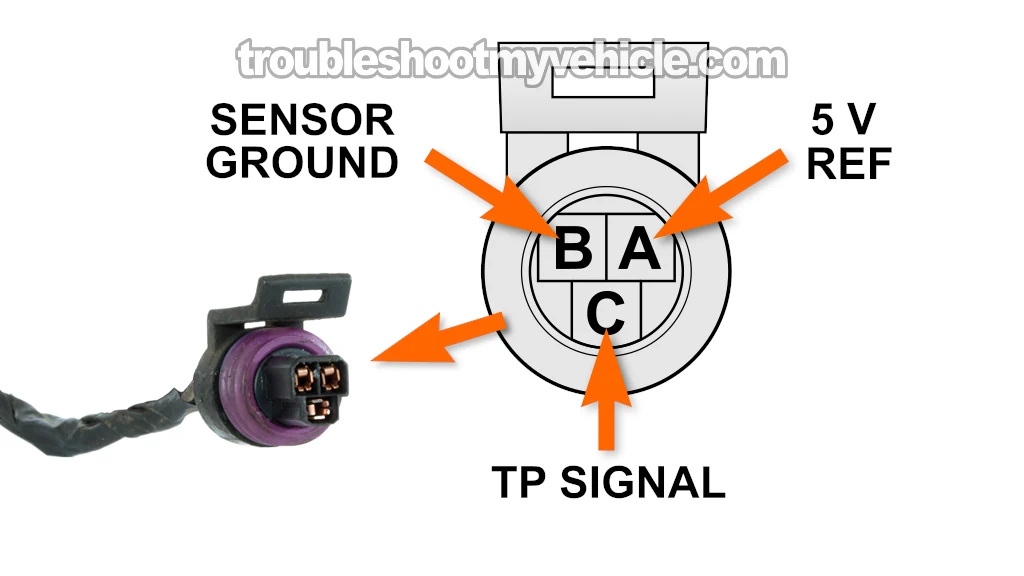
If you take a look at the throttle position sensor, you'll notice that its electrical connector has three wires coming out of it.
Each one serves a specific purpose. The table below gives a brief description of what each wire does:
| Terminal | Wire | Description |
|---|---|---|
| A | Grey (GRY) | 5 Volts |
| B | Dark Blue (DK BLU) | TPS Signal |
| C | Black (BLK) | Ground |
Where To Buy The TPS And Save
The following links will let you comparison shop for a throttle position sensor from two well-known professional automotive brands.
These are quality, direct-fit replacement sensors —not cheap knockoff parts that may only last a few weeks. Both are designed to fit the 1993-1996 2.2L Buick Century.


Disclosure: As an Amazon Associate, I earn from qualifying purchases. If my tutorials help you, using these links is an easy way to support the site at no extra cost to you. Thank you!
TEST 1: Testing The TPS Voltage Signal
The first thing we're going to do is verify that the throttle position sensor is producing a smooth voltage signal that increases as the throttle plate opens and decreases as it closes.
Here's what you should see:
- With the throttle plate completely closed, the TPS signal should be around 0.4 to 0.9 Volts DC.
- With the throttle plate fully open, the signal should smoothly increase to about 4.5 to 5.0 Volts DC.
When the TPS goes bad, it'll usually fail in one of two ways:
- The voltage stays fixed: The TPS signal remains at the same voltage regardless of how far the throttle plate opens.
- The signal drops out: The voltage glitches, skips, or momentarily drops out as you slowly open and close the throttle plate.
To check the TPS signal, we're going to connect a multimeter to the dark blue (DK BLU) wire of the TPS's 3-wire connector.
The DK BLU wire connects to the female terminal identified by the letter C in the photo above.
IMPORTANT: Leave the throttle position sensor connected to its electrical connector while testing it. The easiest way to access the signal is with a wire-piercing probe or a back probe. If you don't have one, you can see what these tools look like and where to buy them here: Goupchn 4mm Banana to Banana Plug Test Leads Kit (Amazon affiliate link).
Let's get started:
- 1
Place your multimeter in Volts DC mode.
- 2
Connect the black multimeter test lead directly on the battery negative (-) post.
- 3
Turn the key to the ON position but don't crank or start the engine.
- 4
Connect the red multimeter test lead to the dark blue (DK BLU) wire of the TP sensor harness connector.
The DK BLU wire connects to the terminal labeled with the letter C in the photo above.
NOTE: The TPS must remain connected to its connector to test the TPS voltage signal. - 5
Manually rotate the throttle plate to its open position.
You'll get the best results by opening and closing the throttle plate directly on the throttle body instead of stepping on the accelerator pedal. - 6
At this point, your multimeter should register a voltage between 0.4 to 0.9 Volts DC.
- 7
Slowly open up the throttle plate.
The multimeter should show an increasing voltage reading.
At wide open throttle (WOT), you should see a value between 4.5 to 5 Volts DC. - 8
Slowly close the throttle plate as you observer the multimeter.
The multimeter should show a decreasing voltage reading.
At the closed throttle position, you should see the same voltage value you observed in STEP 6. - 9
Using a screwdriver's handle, gently tap the TP sensor as you open and close the throttle plate and observe the multimeter.
The purpose (of tapping the TP sensor with the screwdriver's handle) is to see if the TP sensor shows gaps in the voltage signal. Why? Because a good TP sensor will show a continuous increasing or decreasing voltage signal even while getting tapped by the screw-driver's handle.
Let's analyze your test results:
CASE 1: The TPS voltage increased and decreased smoothly as the throttle plate was opened and closed. This is the correct test result and confirms that the throttle position sensor is working properly.
It also confirms that the sensor is receiving both its 5-Volt reference signal and Ground from your 2.2L Buick Century's PCM.
CASE 2: The TPS voltage stayed fixed or glitched as the throttle plate was opened and closed. This usually indicates a problem with the throttle position sensor. Before replacing it, however, we need to perform two more tests to make sure the problem isn't in the sensor's power or Ground circuits.
Your next step is to verify that the GRY wire is supplying the sensor with 5 Volts. Go to: TEST 2: Making Sure The TPS Is Receiving 5 Volts.
CASE 3: The multimeter didn't register a TPS voltage signal. This usually points to a problem with the throttle position sensor or one of its electrical circuits.
Before condemning the sensor, we'll verify that the GRY wire is supplying the required 5-Volt reference signal from the PCM. For that test, go to: TEST 2: Making Sure The TPS Is Receiving 5 Volts.
TEST 2: Making Sure The TPS Is Receiving 5 Volts
For the throttle position sensor (TPS) to work correctly, it has to receive both a 5-Volt reference signal and Ground. Fortunately, checking for the 5-Volt supply is quick and easy.
In this section, we're going to verify that the TPS is receiving its 5-Volt reference signal from the PCM. This voltage is supplied through the gray (GRY) wire, which connects to the female terminal identified by the letter A in the illustration above.
The PCM only provides this 5-Volt reference when the ignition switch is in the ON or START position. For this test, turn the ignition key to the ON position, but don't start the engine.
Let's get started:
- 1
Disconnect the TPS from its electrical connector.
- 2
Place your multimeter in Volts DC mode.
- 3
Connect the black multimeter test lead to the negative (-) battery terminal.
- 4
Turn the key the ON position but don't start the engine.
- 5
With the red multimeter test lead, gently probe the female terminal labeled with the letter A.
Terminal A connects to the GRY wire of the connector. - 6
Your multimeter should read 4.5 to 5 Volts DC.
Let's analyze your test results:
CASE 1: The GRY wire is supplying 5 Volts. This is the expected test result and confirms that the PCM is providing the TPS with its 5-Volt reference signal.
With the 5-Volt reference signal verified, the next step is to make sure the TPS is receiving a good Ground. Head over to: TEST 3: Making Sure That The TPS Is Receiving Ground.
CASE 2: The GRY wire is not supplying 5 Volts. Without this 5-Volt reference signal, the throttle position sensor can't generate a throttle position signal.
In most cases, this is caused by an open in the GRY wire somewhere between the TPS connector and the PCM connector.
Your next step is to find and repair the open in the circuit. Once the 5-Volt reference signal is restored, the TPS will be able to operate normally again.
TEST 3: Making Sure That The TPS Is Receiving Ground
At this point, your multimeter tests have already told us two important things about the TPS on your 2.2L Buick Century:
- The TPS voltage signal didn't respond correctly as the throttle plate was opened and closed (TEST 1).
- The PCM is supplying the TPS with its 5-Volt reference signal (TEST 2).
That leaves us with one final check. We need to verify that the black (BLK) wire connected to the terminal labeled B is providing the TPS with a good Ground.
The PCM only provides this Ground when the ignition switch is in the ON or START position. So, for this test, turn the ignition key to the ON position, but don't start the engine.
IMPORTANT: Be careful not to accidentally apply battery voltage to the Ground circuit, or you could damage the PCM. The multimeter voltage test outlined below is a safe and accurate way to verify that the Ground circuit is working properly.
These are the test steps:
- 1
Disconnect the TPS from its electrical connector.
- 2
Place your multimeter in Volts DC mode.
- 3
Connect the red multimeter test lead to the positive (+) battery terminal.
- 4
Turn the key the ON position but don't start the engine.
- 5
With the black multimeter test lead, gently probe the terminal labeled with the letter B.
Terminal B connects to the BLK wire of the connector. - 6
Your multimeter should read 10 to 12 Volts DC.
Let's analyze your test results:
CASE 1: The BLK wire is providing Ground. This is the correct test result.
At this point, you can confidently conclude that the throttle position sensor is bad if you've verified all three of the following:
- The TPS voltage signal didn't increase and decrease smoothly as the throttle plate was opened and closed (TEST 1).
- The TPS is receiving its 5-Volt reference signal from the PCM (TEST 2).
- The TPS is receiving a good Ground through the BLK wire (this test).
If all three conditions are true, then replacing the TPS will solve the problem.
When you're ready to replace the throttle position sensor, these are two quality, direct-fit replacements from well-known automotive brands that I recommend:
- Dorman 977-030 Throttle Position Sensor (Amazon affiliate link).
- ACDelco Gold 213-4668 (88864359) Throttle Position Sensor (Amazon affiliate link).
CASE 2: The BLK wire is NOT providing Ground. Without this Ground circuit, the throttle position sensor can't generate a throttle position signal.
In most cases, the missing Ground is caused by an open in the BLK wire somewhere between the TPS connector and the PCM connector.
Your next step is to locate and repair the open in the circuit. Once the Ground path is restored, the TPS will operate normally again.
More 2.2L Buick Century Diagnostic Tutorials
You can find a complete list of diagnostic tutorials for the 2.2L Buick Century in this index:
Here's a sample of the tutorials you'll find there:
- How To Test For A Blown Head Gasket (1993-1996 2.2L Buick Century).
- How To Test Engine Compression (1993-1996 2.2L Buick Century).
- Common Causes Of Spark Plug Failure (1993-1996 2.2L Buick Century).
- How To Test The MAP Sensor (1993-1996 2.2L Buick Century).

If this info saved the day, buy me a beer!
