
Testing the upstream oxygen sensors (O2S11 and O2S21), on your OBD II equipped 4.0L Ford Aerostar, Explorer, Ranger, or Mountaineer, can be accomplished in a few easy steps and in this article, I'll show you how.
As you might already be aware, if you've done some research, quite a few things can cause the PCM (Powertrain Control Module = fuel injection computer) to think that the oxygen sensor or sensors have failed when they haven't. So testing them before replacing them is a good idea.
Contents of this tutorial:
- Important Suggestions And Tips.
- Symptoms Of A Bad Oxygen Sensor.
- Oxygen Sensor Trouble Code Basics.
- Oxygen Sensor Basics.
- Where Are 02S11 And O2S21 Located?
- O2 SENSOR TEST: Inducing A Rich Condition.
- Oxygen Sensor Codes Keep Coming Back.
- More 4.0L V6 Ford Explorer And Mercury Mountaineer Diagnostic Tutorials.
ES  You can find this tutorial in Spanish here: Cómo Probar Los Sensores De Oxígeno Delanteros (4.0L Ford) (at: autotecnico-online.com).
APPLIES TO: This tutorial applies to the following vehicles:
- 4.0L V6 Ford Aerostar: 1996, 1997.
- 4.0L V6 Ford Explorer: 1996, 1997, 1998, 1999, 2000, 2001, 2002, 2003.
- 4.0L V6 Mercury Mountaineer: 1998, 1999, 2000, 2001, 2002, 2003.
Important Suggestions And Tips
TIP 1: To test the O2 sensors, with the test info in this article, you'll need a scan tool that has Live Data capability.
You don't need an expensive $2K to $5K (US) scan tool to do it. I have written this article so that you can accomplish the O2 sensor tests with a generic scan tool.
If you don't have a scan tool. Check out my recommendation: ZM301 OBD2 Scanner Diagnostic Tool (Amazon affiliate link).
TIP 2: The test info in this article will show you how to test the oxygen sensors in action and on the car, no need to remove them.
Symptoms Of A Bad Oxygen Sensor
A failed or failing upstream oxygen sensor does not cause sever drive-ability issues. For the most part, your 4.0L equipped Ford vehicle will run pretty good. This doesn't mean you won't see or feel some symptoms. Here are the most common symptoms:
- The check engine light (CEL) will be illuminated and one or several of the following diagnostic trouble codes will be stored in the PCM's memory:
- P0131 Upstream Heated Oxygen Sensor (HO2S11) Circuit Out Of Range Low voltage (Bank 1).
- P0133 Upstream Heated Oxygen Sensor (HO2S11) Circuit Slow Response (Bank 1).
- P0151 Upstream Heated Oxygen Sensor (HO2S21) Circuit Out Of Range Low voltage (Bank 2).
- P0153 Upstream Heated Oxygen Sensor (HO2S21) Circuit Slow Response (Bank 2).
- Bad gas mileage.
- Won't pass state mandated emission testing.
Oxygen Sensor Trouble Code Basics
If you've been wondering exactly what the heck each diagnostic trouble code means in plain English, this is the section for you:
P0131: upstream Heated Oxygen Sensor (HO2S11) Circuit Out Of Range Low voltage (Bank 1).
- This DTC is telling you that the PCM is seeing the upstream oxygen sensor, for Bank 1, produce a negative voltage number. This negative voltage number is usually between 0 and -1 Volt.
P0133: upstream Heated Oxygen Sensor (HO2S11) Circuit Slow Response (Bank 1).
- This code results when the upstream O2 sensor for Bank 1 is responding too slowly to the changes in the air/fuel mixture the PCM is commanding. In other words, the O2 sensor is getting a bit lazy.
P0151: upstream Heated Oxygen Sensor (HO2S21) Circuit Out Of Range Low voltage (Bank 2).
- This DTC is telling you that the PCM is seeing the upstream oxygen sensor, for Bank 2, produce a negative voltage number. This negative voltage number is usually between 0 and -1 Volt.
P0153: upstream Heated Oxygen Sensor (HO2S11) Circuit Slow Response (Bank 2).
- This code results when the upstream O2 sensor for Bank 2 is responding too slowly to the changes in the air/fuel mixture the PCM is commanding. In other words, the O2 sensor is getting a bit lazy.
The oxygen sensor test, in this article, will help you to diagnose any of the above diagnostic trouble codes.
Oxygen Sensor Basics
You're probably in a hurry to get testing, but I recommend you read this section first. Here you'll find out how the upstream oxygen sensors work. This info will help you to see the 'why' and 'how' of the test at the bottom of this page.
In a nutshell, the oxygen sensor's purpose in life is to monitor the exhaust to see if the PCM is injecting too much fuel or not enough (into the engine).
If the PCM is injecting too much fuel, this is considered a rich condition. If the PCM does not inject enough fuel, this is called a lean condition.
By reporting how rich or lean the exhaust is, the O2 sensor or sensors help the PCM fine tune the amount of fuel the engine need. All this fine tuning helps to cut down on the amount of pollution the engine creates (and give the best fuel economy).
Let me go into more specifics:
- When the PCM injects too much fuel into the engine, the oxygen sensor produces a voltage above 0.500 Volts. This voltage can go as high as 0.900 to 1.0 Volt.
- When the PCM sees this rich condition, it starts to inject less.
- As the PCM starts to cut back fuel, it may go too far and not inject enough.
- Here again the O2 sensor saves the day by reporting a voltage that can go as low as 0.050 to 0.100 Volts.
- Voltages in this range let the PCM know that the air/fuel mixture is too lean and starts to inject more fuel.
- If the oxygen sensors are working correctly, they'll switch between a lean and rich condition several times every few seconds the whole time the engine is in operation.
- If the O2 sensor fails, it will stay stuck at a certain voltage output and not respond to the changes in the air/fuel mixture.
- The really cool thing is that you can observe these changes using a scan tool in its Live Data mode, and this is how I'm gonna' show you how to test them.
Where Are 02S11 And O2S21 Located?
Your specific 4.0L V6 Ford vehicle may be equipped with up to 4 oxygen sensors and locating them can be confusing.
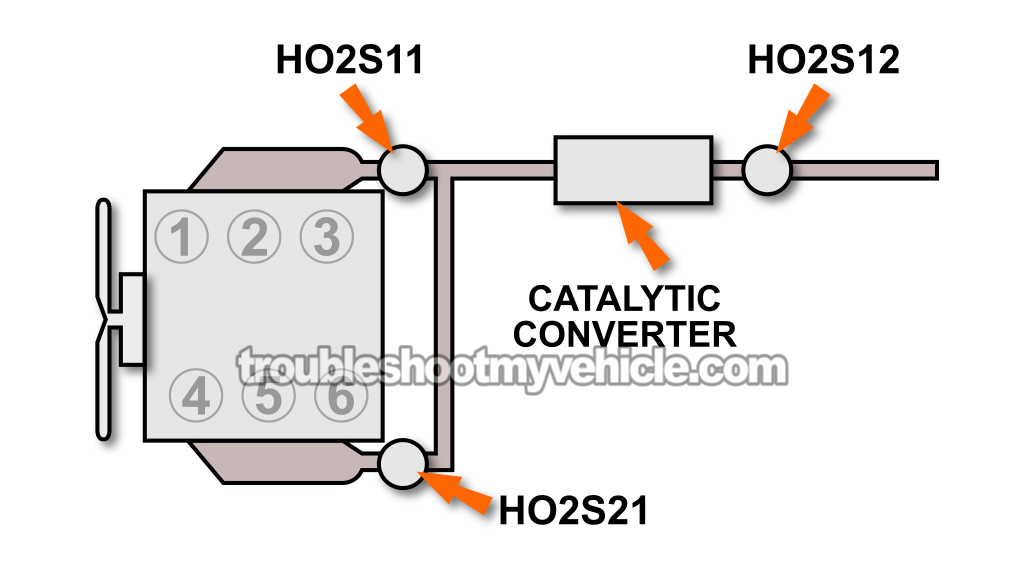
The two upstream oxygen sensors (O2S11 and O2S21), that this article will show you how to test, are located before the catalytic converter.
The key to knowing their location is understanding where Bank 1 and Bank 2 are located.
O2S11 (Oxygen Sensor Bank 1 Sensor 1).
- Bank 1 is the engine bank that houses cylinders 1, 2, and 3.
- O2S11 will be located on the exhaust pipe that connects to the exhaust manifold for this bank.
O2S21 Oxygen Sensor Bank 2 Sensor 1.
- Bank 2 is the one that contains the cylinders 5, 6, and 6.
- O2S21 will be located on the exhaust pipe that connects to the exhaust manifold for this bank.
When the O2 sensors are located after the catalytic converter, they are referred to as sensor 2, as in O2S12 and O2S22.
O2 SENSOR TEST: Inducing A Rich Condition
In a nutshell, what you'll do is to create a rich condition by spraying a little carburetor spray into the engine and observing the oxygen sensors reaction on your scan tool.
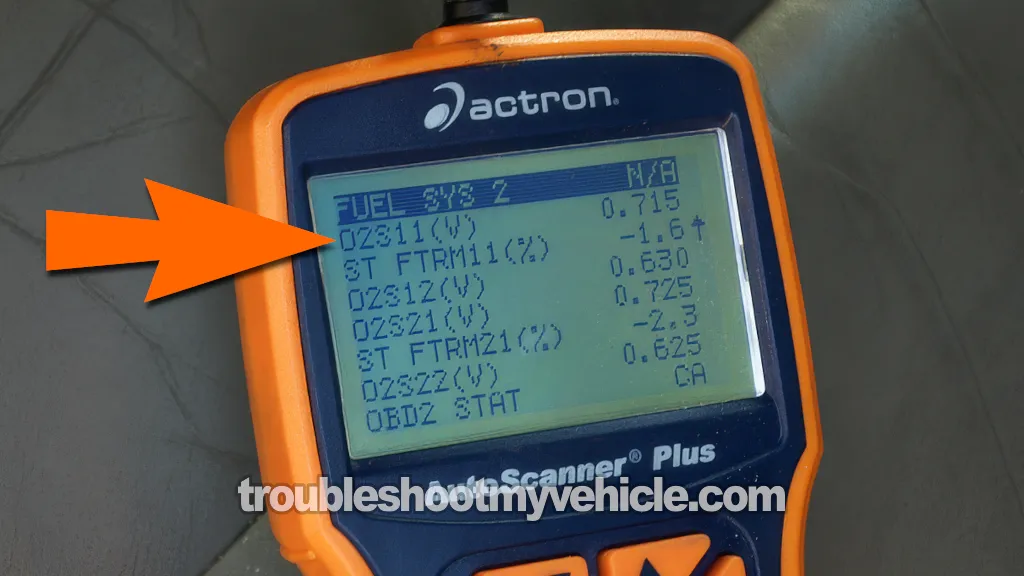
If the oxygen sensors (O2S11 and O2S21) are functioning properly, they should immediately react and report 0.800 to 0.900 Volts on your scan tool display screen (in Live Data mode).
If the oxygen sensors are not working properly, meaning they are bad, then they won't respond to the rich condition that you're inducing with the carburetor spray.
In the test instructions below, I'm going to ask you to spray carb cleaner into the engine. You can do this in one of two ways.
You can disconnect a vacuum hose that has vacuum with the engine running and spray short bursts of carb cleaner into the hose.
Or, before starting the engine, open the air filter box. Once the engine is running, spray short bursts of carb cleaner into the top half of the air filter box (the part that connects to the air duct leading to the throttle body). The carb cleaner will be drawn into the engine through the air duct.
Alright, this is what you'll need to do:
- 1
Connect your scan tool to your vehicle and get to its Live Data mode.
- 2
Start the engine and let it idle for about 15 minutes. This will activate the O2 sensors.
- 3
On your scan tool, scroll down to the PIDs (Parameter Id) labeled O2S11 and O2S21.
These are the PIDs that'll show you what voltage values the upstream O2 sensors are producing and sending the PCM. - 4
Now, take a look at the voltage readings for O2S11 and O2S21.
If the engine has been running for about 15 minutes, and IF the 02 sensors are OK, you should see the voltages moving between 0.200 Volts and 0.900 Volts.
If the voltages are not moving between 0.100 and 0.900 Volts, don't worry about it just yet, continue on to the next step. - 5
With the engine running, spray a little carburetor cleaner into a vacuum hose (that has engine vacuum) while you observe your scan tool's display screen.
You're not going to be able to spray carb cleaner into the throttle as the engine is running, because if you were to do this, the engine will die as soon as you disconnect the air duct from it (to spray into it).
If you spray too much, the engine will stall. If this happens to you, just restart the engine and repeat the step and spray less carb cleaner spray. - 6
As you spray short bursts of carb cleaner into the vacuum hose, you should see the voltage numbers of O2S11 and O2S21 immediately spike to 0.800 to 0.900 Volts.
And as long as you're spraying, these voltage number should stay there. - 7
When you stop spraying, the O2 sensor values should come down and within a few seconds and should start oscillating between 0.100 Volts to 0.900 Volts.
OK, the test is done, let's take a look at what your test results mean:
TEST RESULT 1: O2S11 and O2S21 voltage numbers spiked to 0.900 Volts when you sprayed carb spray into the vacuum hose. This is the normal (and correct) oxygen sensor reaction and tells you that both oxygen sensors are OK at this point in time.
This test result also tells you that the oxygen sensors don't need to be replaced, since what's causing the PCM to think they're fried is something else.
For more info on this, go to the section: Oxygen Sensor Codes Keep Coming Back.
TEST RESULT 2: O2S11 voltage numbers DID NOT spike to 0.900 Volts when you sprayed carb spray into the vacuum hose. This confirms that Bank 1 Oxygen Sensor 1 is no longer working. You can replace the oxygen sensor.
The reason why is that if the sensor were working correctly, then it would've reacted to the induced rich condition you created (by spraying carburetor spray into the vacuum hose). Since it didn't react, in other words its voltage output did not spike up, then you and I can conclude that it's defective and needs to be replaced.
TEST RESULT 3: O2S21 voltage numbers DID NOT spike to 0.900 Volts when you sprayed carb spray into the vacuum hose. This confirms that Bank 2 Oxygen Sensor 1 is no longer working. You can replace the oxygen sensor.
The reason why is that if the sensor were working correctly, then it would've reacted to the induced rich condition you created (by spraying carburetor spray into the vacuum hose). Since it didn't react, in other words its voltage output did not spike up, then you and I can conclude that it's defective and needs to be replaced.
Oxygen Sensor Codes Keep Coming Back
One of the most common problems I get emailed about is that the oxygen sensor code keeps coming back (and lighting up the check engine light) even after replacing the sensor or sensors with new ones.
When this happens, it's usually due to either a rich condition or lean condition that's being caused by some other component on the engine.
In plain English this means that something else on the engine has gone bad and is making the computer over-inject or under-inject fuel. Since the computer is not that smart, it usually just ends up accusing the sensors as bad, instead of the actual condition causing the problem, when all they're doing is just reporting the rich or lean condition.
What sucks about this, is that whatever is causing the rich or lean condition is not present all of the time (specially when you're conducting the tests). This happens quite a bit. The strategy here is to wait a few days for the condition (that's causing the O2 sensor issues) to get worse. When this occurs, you'll be able to test it and solve it.
The other key, to diagnosing this type of problem, is to think what could be causing the extreme rich or extreme lean condition and then test those components.
Things that could cause an extreme rich condition are:
- Bad fuel pressure regulator leaking fuel into its vacuum line.
- A misfire caused by:
- Extremely worn spark plugs.
- One or several spark plug wires that are not transmitting spark anymore to the spark plugs.
- A bad ignition coil (remember the coil on the 4.0L engines feed spark to all 6 cylinders.
- Problems with the fuel injectors like:
- A bad fuel injector stuck open.
- Dirty fuel injectors.
Things that could cause an extreme lean condition are:
- Manifold intake gaskets that are bad and leading vacuum.
- Vacuum hoses that are leaking vacuum.
- Fuel pump that is bad (more specifically a fuel pump that's slowly going bad and not producing enough fuel pressure and volume even though it's able to keep the engine running.
Other things that you need to keep in mind are: the possibility of a short in the wiring between the O2 sensor and the computer or that the computer may be bad (although this is extremely rare).
More 4.0L V6 Ford Explorer And Mercury Mountaineer Diagnostic Tutorials
I've written quite a few 'how to' tutorials that'll help you troubleshoot your Ford Explorer or Mercury Mountaineer. You can find the complete list in this index:
Here's a sample of the Ford 4.0L V6 articles you'll find:
- How To Test The Starter Motor (1991-2010 4.0L V6 Ford Explorer, Aerostar, And Mercury Mountaineer).
- How To Test The Alternator (1991-2000 4.0L V6 Ford Explorer And Aerostar).
- How To Test Engine Compression (1991-2010 4.0L V6 Ford Explorer, Aerostar, And Mercury Mountaineer).
- How To Test The Thermostat (1996-2003 4.0L V6 Ford Explorer And Mercury Mountaineer).

If this info saved the day, buy me a beer!


