
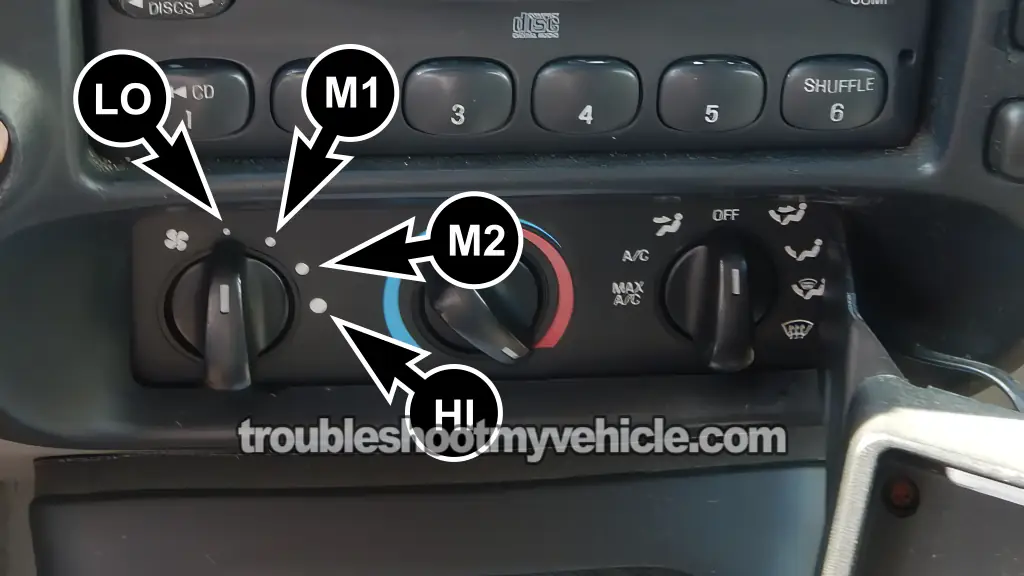
Troubleshooting the blower switch on your Ford Explorer's A/C Heater control panel isn't hard.
All you need is a multimeter and to know what blower switch terminals should have continuity when you turn the knob to the various speeds (on the switch).
I'll show you how in a step-by-step way so that you can find out if it's bad and needs to be replaced or not.
Before you start, take a look at the ‘Applies To:’ box on the right column and check to see if this tutorial applies to your specific Ford Explorer.
To further aid in making sure this blower motor switch tutorial applies to your specific Ford, this tutorial applies to the following blower switches:
- Airtex/Wells 1S3046.
- Duralast SW3316.
- Four Seasons 20046.
- Motorcraft YH1670.
- Standard Motor Products: HS333.
Contents of this tutorial:
ES  You can find this tutorial in Spanish here: Cómo Probar El Interruptor Del Motor Soplador (4.0L Ford) (at: autotecnico-online.com).
The following tutorials tie in to this one and may help in further troubleshooting the A/C-heater blower issue:
- How To Test The Blower Motor Resistor (Ford 4.0L).
- How To Test The A/C Heater Blower Motor (Ford 4.0L).
Basics Of Troubleshooting The Blower Control Switch
The blower motor switch takes the current from terminal number 2 and as you turn the knob from one speed to another, diverts it to another terminal.
To explain this in more appropriate technical terms (but keeping it in plain English), the blower switch ‘opens’ and ‘closes’ internal contacts to channel the current to a different wire (circuit).
So, when two contacts are ‘open’, there's no direct connection between them and current does not flow between them. When two contacts are ‘closed’ they are bridged together and current flows between them.
Here's an example of what happens when you turn the blower fan speed knob from OFF to LO using the wiring diagram in the image above:
- When the blower fan is in the LO position:
- Battery power is available on terminal 2 of the blower switch connector. The BLK/ORG wire is the one that connects to terminal 2 of the blower motor switch.
- Inside the blower motor switch this battery power goes nowhere.
- When you turn the blower fan switch to the M1 position:
- Battery power is available on terminal 2 of the blower switch connector (BLK/ORG wire).
- This battery power is now diverted to terminal 3 of the blower switch harness connector (LT GRN/WHT wire).
- In tech speak: circuit 2 and 3 is now considered ‘closed’.
- The end result is that your Ford's blower motor now runs in M1 speed.
- When you turn the blower fan switch to the M2 position:
- Battery power is available on terminal 2 of the blower switch connector (BLK/ORG wire).
- This battery power is now diverted to terminal 4 (YEL/RED wire) of the blower switch harness connector.
- In tech speak: circuit 2 and 4 is now considered ‘closed’.
- In tech speak: circuit 2 and 3 is now considered ‘open’.
- The end result is that your Ford's blower motor now runs in M2 speed.
- This interruption and diverting of battery power goes on for all of the other blower fan speeds.
Unfortunately, over time the ‘opening’ and ‘closing’ of these contacts creates electrical arching that results in pits and carbon tracks on the contact itself. When the metal of the contact becomes sufficiently covered in carbon, the current stops being transmitted and one or several of the blower fan speeds stop working.
The cool thing is that diagnosing/troubleshooting the blower switch isn't hard. The following circuit descriptions will help:
| Blower Switch Circuit Descriptions | ||
|---|---|---|
| Pin | Wire Color | Description |
| 1 | ORG/BLK | HI Speed Output. |
| 2 | BLK | Power Input From A/C Heater Panel. |
| 3 | LT GRN/WHT | M2 Speed Output. |
| 4 | YEL/RED | M1 Speed Output. |
NOTE: There's a good chance that the color of the wires described above DOES NOT match what's on your particular vehicle. This is no cause for concern since the circuit descriptions are the same for all of the Ford vehicles covered by this repair tutorial.
TEST 1: Checking Continuity Of The Blower Switch Fan Speeds
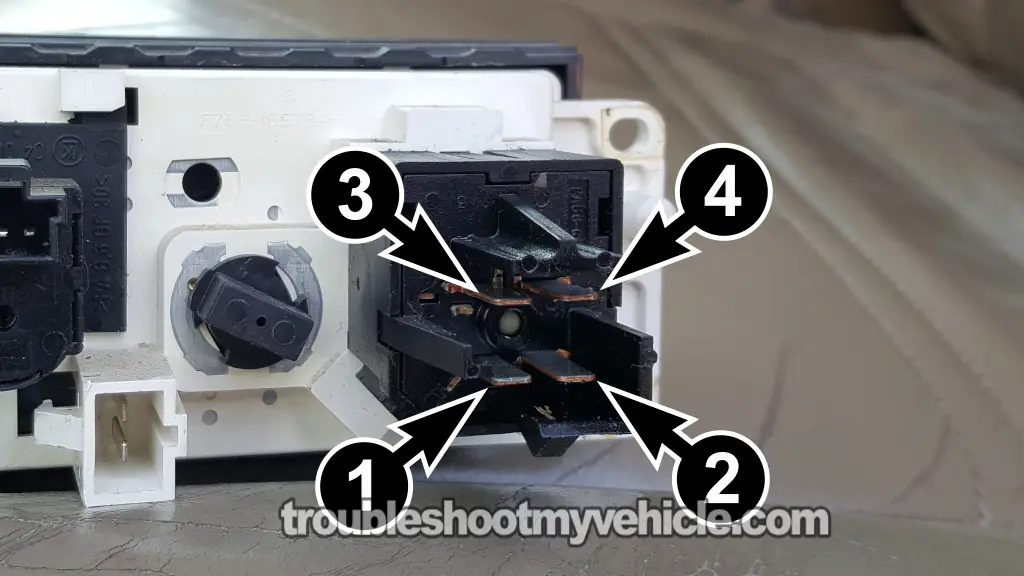
As stated in the previous section, the blower motor switch's job is to ‘bridge’ two separate contacts together.
Keeping this in mind, we're gonna' use a multimeter (in Ohms mode) to check to see if two specific terminals are ‘bridged’ together.
If these two specific contacts are ‘bridged’ (closed) then your multimeter will register continuity. This continuity is usually a resistance value of 1 Ohm (Ω) or less.
If they are not, then your multimeter will register the letters OL (which stand for open loop).
IMPORTANT: All multimeter continuity tests described in this test section are done on the blower switch's male spade metal terminals and not on the switch's connector.
OK, let's get started:
- 1
Remove the A/C-Heater control panel from the dash and unplug the blower motor switch from its harness connector. Set your multimeter to Ohms mode (Ω).
Don't have a multimeter or need to upgrade yours? Check out my recommendation: Buying A Digital Multimeter For Automotive Diagnostic Testing (found at: easyautodiagnostics.com). - 2
With the blower switch knob set to the M1 position.
You should have continuity between 2 and 3 (this should be at or less than 5 Ohms). - 3
With the blower switch knob set to the M2 position.
You should have continuity between 2 and 4 (this should be at or less than 5 Ohms). - 4
With the blower switch knob set to the HI position.
You should have continuity between 2 and 1 (this should be at or less than 5 Ohms).
Let's take a look at what your test results mean:
CASE 1: The blower switch failed one or several of the tests above. Double check that you're testing the correct blower switch terminals and retest.
If continuity is not present where indicated in the test steps above and this lack of continuity coincides with the blower fan speed that's not working on your Ford Explorer then you've found the cause of the problem.
Replace the blower switch in the A/C-Heater control panel with a new one to solve the problem. To comparison shop for the blower control switch, take a look at this section here: Where To Buy The Blower Switch And Save.
CASE 2: All circuits tested had continuity where indicated in the test steps. This is good and is the correct and expected test result that tells you that the blower fan switch (in the A/C-Heater control panel) is NOT defective.
Your next step is to bypass the blower resistor using a simple jumper wire. For this test go to: TEST 2: Using A Jumper Wire To Bypass The Blower Switch.
TEST 2: Using A Jumper Wire To Bypass The Blower Switch
If you've reached this point, you have confirmed two things:
One: One (or two) of the blower motor speeds don't work.
Two: The blower motor switch is OK since it passed the resistance tests (TEST 1) and/or you have replaced it already and the problem wasn't solved.
The next step is to bypass the blower switch using a small jumper wire and indirectly test the wiring and blower resistor between the switch and the blower motor.
IMPORTANT: To avoid damaging the blower switch connector's female metal terminals you should use a small diameter wire as a jumper wire.
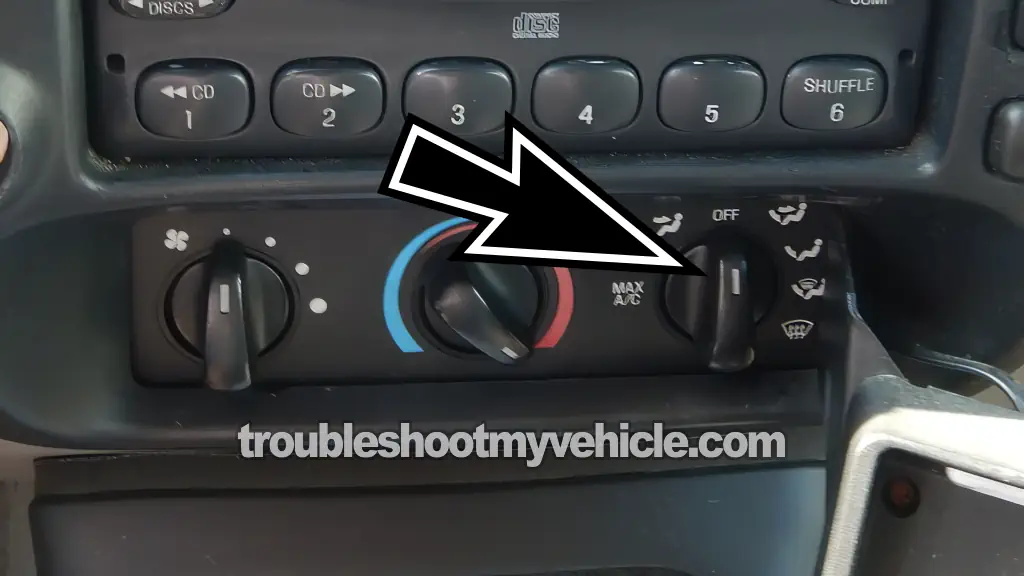
NOTE: All of the tests below require that the A/C Heater control panel vent knob NOT BE in the OFF position. In the OFF position, the ORG/BLK wire of the blower switch will NOT get power and this wire needs power for the tests to work. See the photo below to identify the vent control knob.
Alright, these are the test steps:
- 1
Disconnect the blower switch from its harness connector and turn the key to the on position (but no need to start the engine).
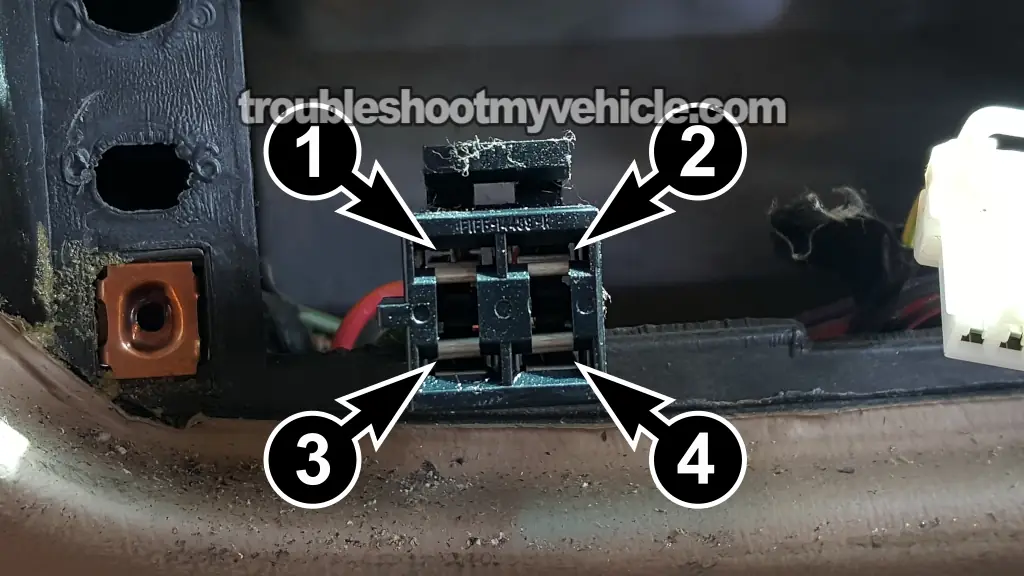
NOTE: All of the tests in this section are done on the blower switch's harness connector and not on the switch itself. The photo above shows the front view of the female metal terminals of the connector. - 2
Jumper terminals 2 and 3 together. This is the circuit that controls blower speed M1.
The correct test result is for the blower motor to run on M1 speed. - 3
Jumper terminals 2 and 4 together. This is the circuit that controls blower speed M2.
The correct test result is for the blower motor to run on M2 speed. - 4
Jumper terminals 2 and 1 together. This is the circuit that controls blower speed HI.
The correct test result is for the blower motor to run on HI speed.
Let's take a look at what your test results mean:
CASE 1: The blower motor failed to run in one of the jumper wire tests above. This tells you that that specific circuit is bad.
Although it's beyond the scope of this tutorial to test these circuits, you have eliminated the blower switch (on the A/C-Heater control panel) as bad. There's a good chance that you've got a bad blower motor resistor.
The blower resistor can be tested and the following diagnostic tutorial may be of help:
CASE 2: The blower motor ran when all of the indicated terminals were jumpered together. This tells you several important things:
- That the circuits between the resistor connector and the blower motor are OK.
- That the blower motor relay is OK.
No further testing is required of the blower resistor, the blower relay or the blower motor.
Where To Buy The Blower Switch And Save
You don't have to buy the whole A/C-Heater Control Panel to replace the blower control switch since the switch is removable. If you're interested in the original Ford Motorcraft blower switch or on an after-market part (and save), the following links will help you comparison shop.
The following links will help you comparison shop for the blower motor control switch and the connector:


Wondering if the above switches fit your particular Ford Explorer (Ranger)? Don't worry, once you get to the site, they'll make sure it fits by asking you the specifics of your vehicle. If they don't fit, they'll find you the right one.
More Ford 4.0L Tutorials
You can find a complete list of 4.0L Ford troubleshooting tutorials here: Ford 4.0L Index Of Articles.
Here's a sample of the tutorials you'll find in the index:
- How To Test The Fuel Pump (1993-2000 4.0L V6 Ford Explorer, Aerostar, And Mercury Mountaineer).
- How To Test Engine Compression (1991-2010 4.0L V6 Ford Explorer, Aerostar, And Mercury Mountaineer).
- How To Troubleshoot A No-Start Problem (1991-2010 4.0L V6 Ford Explorer, Aerostar, And Mercury Mountaineer).
- How To Test The Fuel Injectors (1991-1996 4.0L Ford Explorer And Aerostar).
- How To Test The Ford EGR Valve EGR Vacuum Solenoid, DPFE Sensor (at: easyautodiagnostics.com).
- How To Test The Coil Pack (Ford 3.0L, 3.8L, 4.0L, 4.2L) (at: easyautodiagnostics.com).

If this info saved the day, buy me a beer!


