
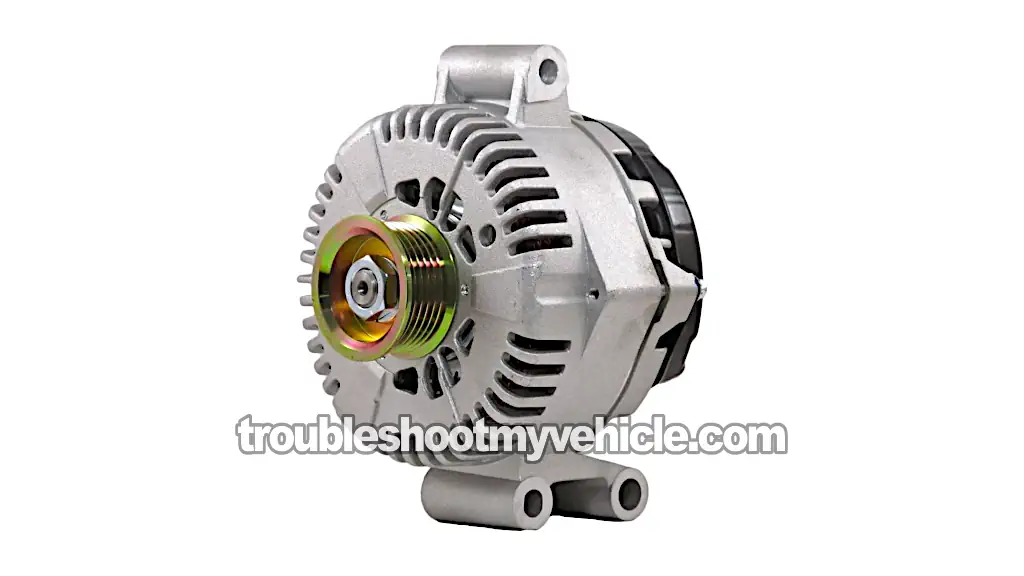
This tutorial will explain how to test the 1998-2001 4.0L Mercury Mountaineer's alternator with a multimeter.
You'll easily and quickly find out if the alternator in your Mercury Mountaineer is good or bad.
NOTE: You can find the 4.0L Ford Aerostar, Explorer, Ranger, and Mazda B4000 alternator test tutorials here:
- How To Test The Alternator (1991-2000 4.0L Ford Explorer And Aerostar).
- How To Test The Alternator (1996-2001 4.0L Ford Ranger And Mazda B4000) (at: easyautodiagnostics.com).
Contents of this tutorial:
APPLIES TO: This tutorial applies to the following vehicles:
- 4.0L V6 Mercury Mountaineer: 1998, 1999, 2000, 2001.
Important Testing Tips
The following tips will help you accomplish the tests in this tutorial:
TIP 1: The battery must be fully charged to get an accurate test result from your alternator test.
TIP 2: You can use a digital multimeter or an analog multimeter.
TIP 3: Take all necessary safety precautions. Be alert and think safety all of the time since you'll be working around a running engine.
Symptoms Of A Bad Alternator
When the alternator fails, it'll stop charging the battery. And when this happens, you'll see the battery malfunction indicator light illuminated on your 4.0L Mercury Mountaineer's instrument panel.
Besides the battery light shining nice and bright on the instrument panel, you'll see one or more of the following symptoms:
- The engine only start with a jump start. After a few minutes of run time, it dies.
- The engine starts fine if you charge the battery. After your initial trip, the battery needs a jump-start to crank and start the engine.
- Dim headlight glow dim.
TEST 1: Checking Alternator Voltage Output With A Multimeter
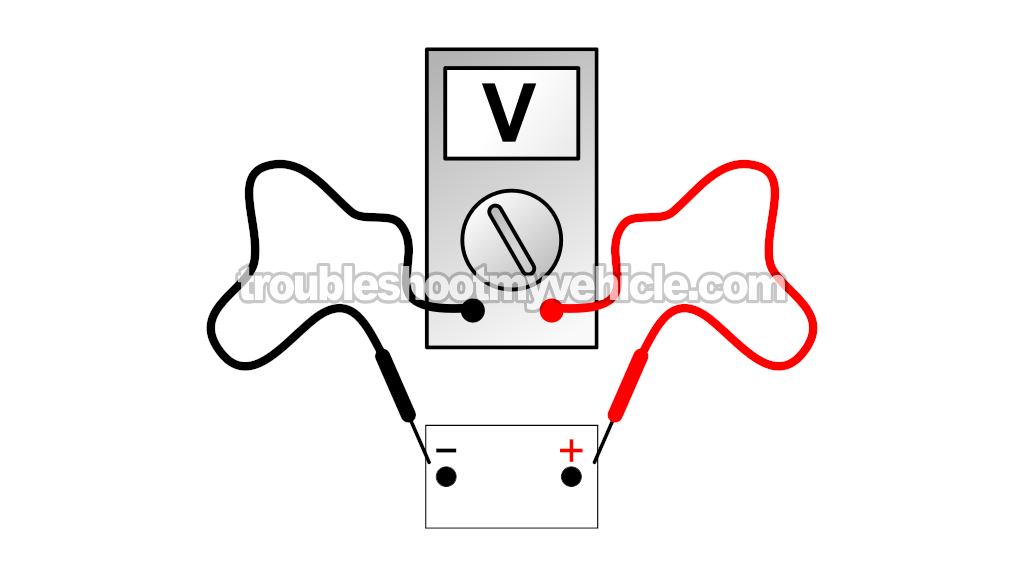
Your first test will check the battery voltage with the engine running.
What you're looking for is for battery voltage to be between 13.5 to 14.5 Volts DC.
If the voltage is within this range, you can conclude that the alternator is functioning correctly and is charging the battery.
If the voltage is at 12.5 Volts DC or less, then you've got an alternator that isn't charging the battery.
NOTE: If you don't have a multimeter or need to upgrade yours, check out my recommendation here: Tekpower TP8268 AC/DC Auto/Manual Range Digital Multimeter (Amazon affiliate link).
IMPORTANT: You must perform this test with a fully charged battery.
Let's get testing:
- 1
Place your multimeter in Volts DC mode.
- 2
Start the engine and let it idle.
- 3
Probe the battery terminals with your multimeter test leads.
The red multimeter test lead to battery positive (+) post. The black multimeter test lead to the battery negative (-) post. - 4
You should see 13.5 to 14.5 Volts on your multimeter. If you don't, don't worry about this just yet, continue to the next step.
- 5
Place a load on the battery. You can do this by turning on the headlights, the A/C or heater on high, the windshield wipers, the radio, the rear window defroster, etc.
- 6
You'll see one of two things:
1.) The voltage will decrease slightly and then stabilize around 13.5 to 14.5 Volts DC when something comes on.
2.) The voltage reading will start to decrease till it reaches 10 Volts DC and your vehicle may stall.
Let's analyze your test results:
CASE 1: The voltage stayed at 13.5 to 14.5 Volts thru' out the whole test. This is the correct and expected test result and it tells you the alternator is charging the battery.
No further testing is required.
CASE 2: The voltage is at 12.5 Volts or less and decreased as you turned on all accessories. This test result confirms the alternator is not charging the battery.
It's starting to look like the alternator is bad. To make sure, go to: TEST 2: Testing The Continuity Of The Alternator's Battery Circuit.
CASE 3: The voltage started at 13.5 Volts to 14.5 Volts, but decreased to 12.5 Volts or less as you turned on all accessories. Generally, this test result indicates the alternator is bad.
It's starting to look like the alternator is bad. To make sure, go to: TEST 2: Testing The Continuity Of The Alternator's Battery Circuit.
TEST 2: Testing The Continuity Of The Alternator's Battery Circuit
In this test section, you'll test the continuity of the alternator's output wire.
This output wire delivers the alternator's voltage and amperage output to the battery.
This wire has a mega fuse or fusible links protecting it between the alternator and the battery.
The alternator's output will not reach the battery if this fuse is blown.
You'll do a simple continuity test with your multimeter to check the condition of the output wire's mega fuse or fusible links.
Let's get testing:
- 1
Disconnect the battery negative (-) terminal from the battery. Do not proceed to the next steps till you do this first.
NOTE: Leave the battery positive (+) cable connected to the battery. - 2
Set your multimeter to Ohms mode.
- 3
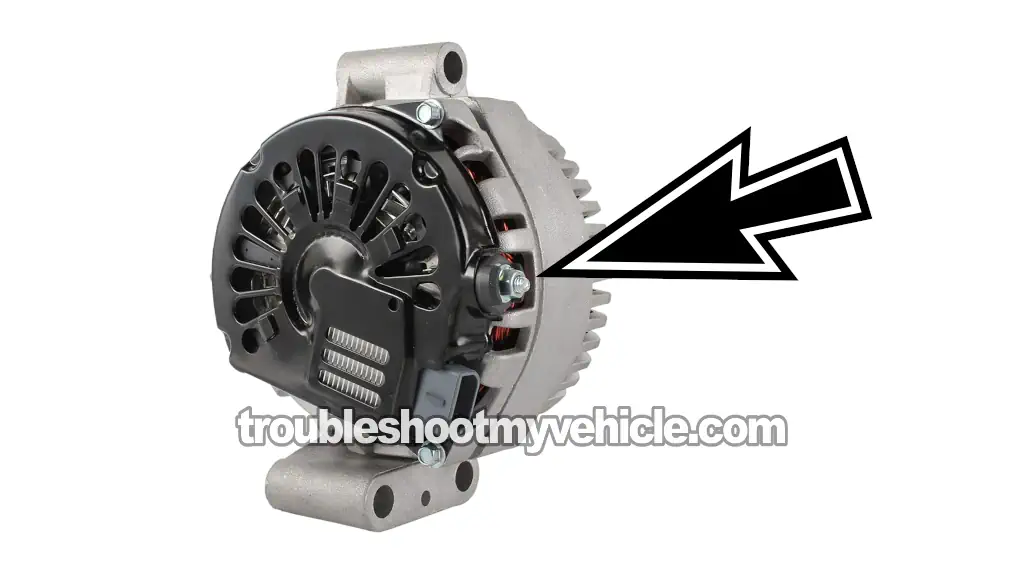
Connect the red multimeter test lead to the stud behind the alternator. This stud is where the big wire that supplies the alternator's output to the battery attaches to with a nut.
The arrow in the photo above points to the stud location. - 4
Connect the black multimeter test lead to the battery positive (+) terminal.
- 5
Your multimeter should register about 0.5 Ohms to 1 Ohms if the inline fusible link or mega fuse is not blown.
If the output wire's inline fusible link or mega fuse is blown, your multimeter will register an infinite Ohms reading (OL).
Alright, let's interpret your test results:
CASE 1: Your multimeter registered continuity (0.5 to 1 Ohms). This is the correct and expected test result.
With this result, you can conclude that the output wire's inline fusible links or mega fuse is OK and not blown.
Your next step is to make sure the alternator's voltage regulator is receiving 12 Volts. For this test, go to: TEST 3: Making Sure The Voltage Regulator Is Receiving 12 Volts.
CASE 2: Your multimeter DID NOT register 0.5 to 1 Ohms, it registered OL. This result tells you that the inline fusible links or mega fuse is blown.
You'll need to replace the inline fusible link or mega fuse and re-test the battery's voltage with the engine running. This should solve your no-charge condition.
TEST 3: Making Sure The Voltage Regulator Is Receiving 12 Volts
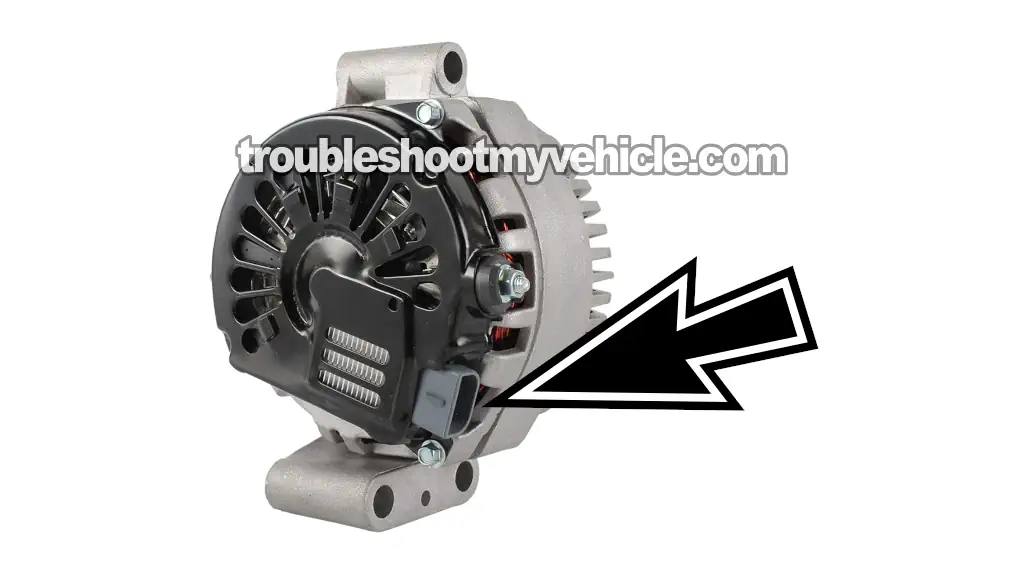
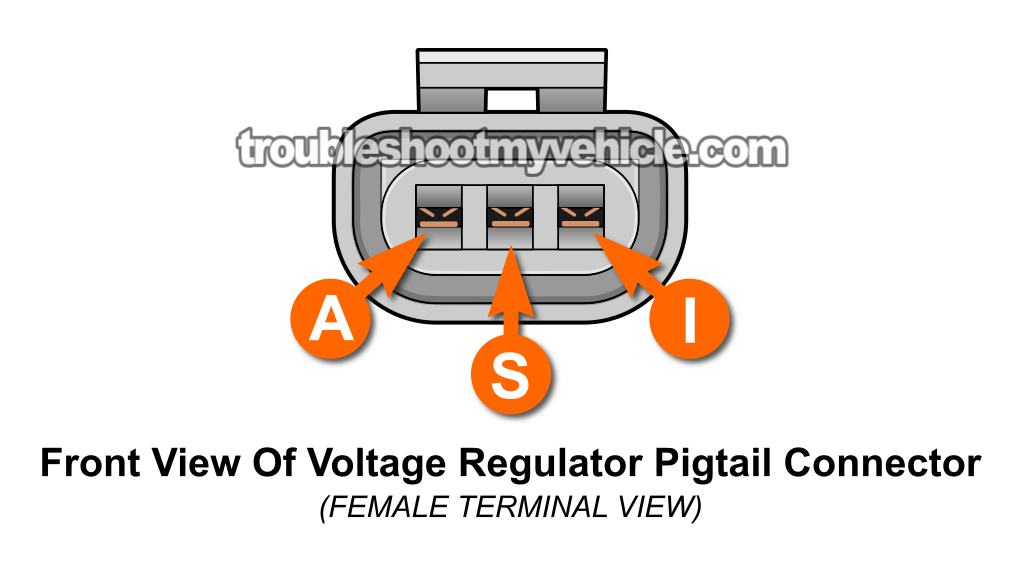
The voltage regulator inside the alternator needs 12 Volts to activate the alternator to charge the battery.
If the voltage regulator doesn't receive these 12 Volts, the alternator will not charge the battery.
So in this test section, you'll check that the yellow with white stripe (YEL/WHT) wire (of the voltage regulator's connector) delivers these 12 Volts.
The YEL/WHT wire connects to the female terminal labeled with the letter A in photo 2 of 2 in the image viewer above.
These are the test steps:
- 1
Reconnect the battery to its battery negative (-) cable.
- 2
Disconnect the voltage regulator from its electrical connector.
- 3
Place your multimeter in Volts DC mode.
- 4
Connect the black multimeter test lead directly to the battery negative (-) terminal.
- 5
Probe the yellow with white stripe (YEL/WHT) wire of the alternator's voltage regulator connector with the red multimeter test lead.
- 6
Your multimeter should register one of two things:
1.) 10 to 12 Volts DC, if the fuse (fusible link) is good.
2.) 0 Volts DC, if the fuse (fusible link) is blown.
Let's take a look at what your specific test results mean:
CASE 1: The multimeter registered 10 to 12 Volts. This is the correct and expected test result and confirms that the voltage regulator is getting power.
You can conclude that the alternator is bad and needs replacement if you have:
- Confirmed that the battery voltage is NOT at 13.5 to 14.5 Volts DC with the engine running and all accessories turned on (TEST 1).
- Confirmed that the alternator's output wire has continuity (TEST 2).
- Confirmed, in this test section, that the YEL/WHT wire has 10 to 12 Volts.
CASE 2: The multimeter DID NOT register 10 to 12 Volts. Please replace the fuse or fusible link with another of the same amperage rating and repeat TEST 1.
More 4.0L Mercury Mountaineer Tutorials
You can find more 4.0L V6 Ford Explorer (Aerostar) diagnostic tutorials here:
Here's a sample of the tutorials you'll find in the index:
- How To Test For A Blown Head Gasket (1991-2010 4.0L V6 Ford Explorer, Aerostar, And Mercury Mountaineer).
- How To Test The Fuel Pump (1993-2000 4.0L V6 Ford Explorer, Aerostar, And Mercury Mountaineer).
- How To Test Engine Compression (1991-2010 4.0L Ford Explorer, Aerostar, And Mercury Mountaineer).

If this info saved the day, buy me a beer!
