

Testing the throttle body temp sensor on the 1989-1991 3.9L V6 Dodge Ram pickup isn't hard. In this 'how to' tutorial, I'm gonna show you exactly how to test it and figure out if it's good or if it's bad.
You just need a multimeter for the two resistance tests we're gonna cover. Once you run these two quick tests, you'll know if the TB temp sensor's doing its job —or if it's cooked.
Contents of this tutorial:
- Symptoms Of A Bad Throttle Body Temperature Sensor.
- What Does the Throttle Body Temperature Sensor Do?
- Important Initial Checks.
- Where To Buy The TB Temp Sensor And Connector.
- TEST 1: Cold Temperature Resistance Check.
- TEST 2: Hot Temperature Resistance Check.
- More 3.9L V6 Dodge Ram Pickup Tutorials.
APPLIES TO: This tutorial applies to the following vehicles:
- Dodge Ram 150 Pickup 3.9L V6: 1989, 1990, 1991.
- Dodge Ram 250 Pickup 3.9L V6: 1989, 1990, 1991.
TBI FUEL INJECTOR TESTS:
Symptoms Of A Bad Throttle Body Temperature Sensor
If the throttle body temp sensor fails, it's gonna trigger the check engine light and store this trouble code:
- Code 23: Throttle Body Temp Sensor Voltage Too Low or Too High.
But that's just the start —it also messes with engine performance, especially when you try restarting the engine after it's already warm.
Here's what you'll usually see when the sensor starts acting up:
- Hard start: Engine struggles to start after a short stop —like filling up at the gas station or making a quick store run.
- Rough idle: Engine shakes or idles unevenly after a warm restart.
- Engine stall: Shuts down right after restarting when when the engine's hot.
- Surging or hesitation: You feel the engine lag when you step on the gas after a warm start.
- Extended engine cranking: You've got to crank the engine longer than usual before it starts when the it's been shut off hot.
You'll probably notice the engine starts up fine first thing in the morning, but acts weird when the engine's hot —or after it's been running for a while. That's a clear sign the sensor's sending the wrong temp signal to the computer.
When the sensor fails, it confuses the fuel injection computer (Single Board Engine Controller —SBEC). It might tell the computer the throttle body's ice cold when it's actually hot —or the other way around. That throws off the air/fuel mixture, especially during warm starts, where fuel vapor builds up and makes getting the engine started a challenge.
What Does the Throttle Body Temperature Sensor Do?
The TB temp sensor bolts directly onto the throttle body. Its main job is to keep track of how hot the throttle body gets once the engine's been running. That info really matters when you shut the engine down and try to restart it shortly after.
Right after shutdown, heat rises and gets soaked up by the throttle body. That extra heat raises the fuel temperature, making it vaporize faster —which can lead to hard starts, a rough idle, or even stalling when you crank and start it back up.
The fuel injection computer relies on this sensor to deliver the right amount of fuel. If the throttle body's hot, the computer commands the fuel injectors to inject more fuel —so the engine restarts without sputtering.
This sensor also plays a backup role. Since the system doesn't have a separate intake air temperature sensor, the computer uses the throttle body temp reading as a stand-in to help it figure out the air temp and keep the air/fuel ratio on point.
Important Initial Checks
Before you remove and resistance test the throttle body temp sensor, take a minute to perform these quick visual checks:
- Look over the sensor's wiring harness for any damage —frayed wires, cracked insulation, or any spots where the insulation's missing.
- Check the connector closely. Is it damaged/broken? Make sure that little U-shaped metal retaining clip (lock clip) is still clipped in tight.
- Give the sensor itself an once-over. The upper part's plastic and can crack or snap off the metal base if it's ever been bumped or installed with the wrong tool.
Missing Metal Locking Clip: On these older V6 Dodge pickups, the TB temp sensor connector uses a metal clip to secure it in place —just like the ones you'll see on the fuel injector connectors from the same era.
If that clip's gone or the connector's broken, it might not stay securely connected and making solid contact with the sensor pins. That's a problem —especially with all the heat and vibration under the hood— and it can cause an intermittent false connection.
If that's the case, don't hesitate to swap it out for a new pigtail connector. They're cheap and easy to replace. A solid choice is the WALKER PRODUCTS 270-1034.
Frayed Wires: Fraying happens when the wire's insulation wears out and the copper strands underneath start showing. Super common on these older pickups with aging wiring harnesses.
Those exposed wires can short out or mess with the signal —and that'll lead to incorrect temp readings and lit up check engine light.
Check out this real-world example to see what it looks like:
- IAT Sensor Wire Insulation Problem And Wires Shorted Together (at: easyautodiagnostics.com).
Here's what to do depending on the damage:
- If the wires are seriously frayed or the damage is right near the plug, it's time to replace the whole connector.
- If it's just a small damaged spot further down the line, wrap it up with electrical tape. It's a quick fix that'll hold for a while.
NOTE: Electrical tape's just a temporary patch. If you want the wiring to hold up long-term, go ahead and replace anything that's damaged —whether it's the connector, the wire, or both.
Where To Buy The TB Temp Sensor And Connector


Disclosure: As an Amazon Associate, I earn from qualifying purchases. If my tutorials help you, using these links is an easy way to support the site at no extra cost to you. Thank you!
TEST 1: Cold Temperature Resistance Check
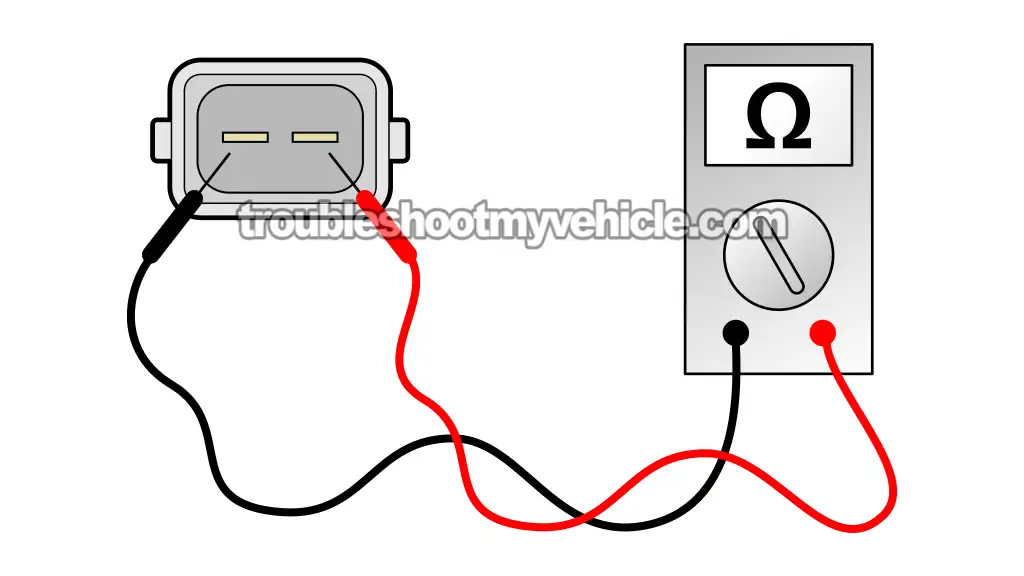
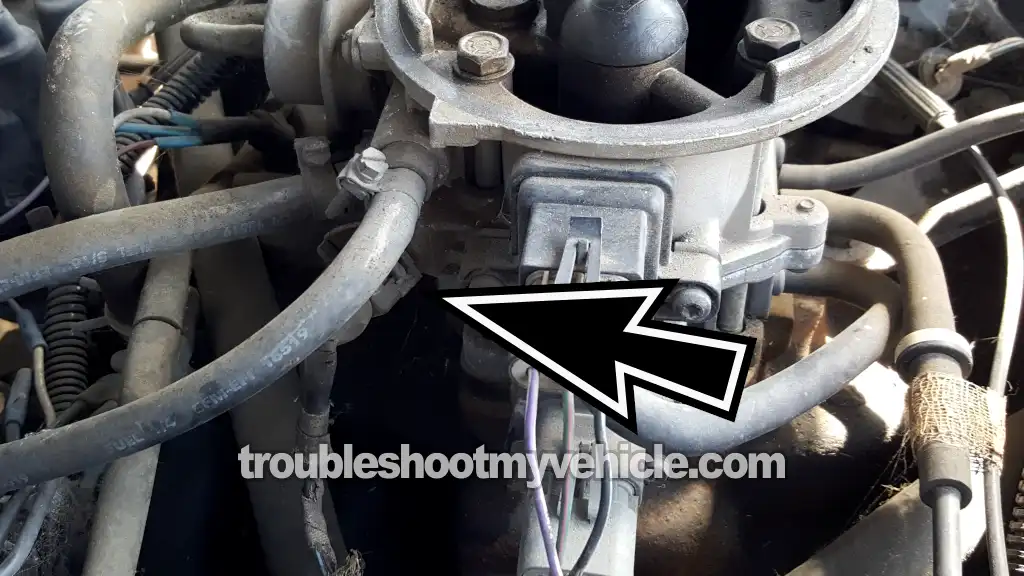
Alright, let's kick things off by pulling the throttle body temp sensor out of the throttle body so we can run a resistance test with a multimeter.
If the sensor's bad, you'll usually get one of these two readings:
- Open circuit: The multimeter will flash "OL" (infinite resistance). That means there's a break inside the sensor —no continuity at all.
- Short circuit: You'll see "0 Ohms" on the screen, which means the sensor's shorted internally from pin to pin.
IMPORTANT: For this test to tell you anything useful, the sensor has to be at room temp. If the engine's been running, give the sensor time to cool all the way down first.
NOTE: Need a multimeter or thinking about upgrading? Here's the one I use and recommend: Tekpower TP8268 AC/DC Auto/Manual Range Digital Multimeter (Amazon affiliate link).
Let's get going:
- 1
Disconnect the TB temp sensor from its 2-wire plug.
NOTE: Take a good look at the connector —check if it's cracked or missing that U-shaped metal clip that keeps it locked in. - 2
Carefully remove the TB temp sensor from the throttle body.
NOTE: Watch out —the plastic top can snap off pretty easily if you're not careful. - 3
Set your multimeter to measure Ohms (Ω).
- 4
Check the sensor's resistance by touching the multimeter leads to both male terminals.
At room temp, you should get a reading somewhere between 5.6 and 14.6 K Ohms.
Alright, now let's break down what those results mean:
CASE 1: Multimeter shows 0 Ohms. That tells you the sensor's shorted inside —time to replace it.
CASE 2: Multimeter flashes OL (infinite resistance). That means there's no connection inside —the sensor's shot and needs to go.
CASE 3: Resistance is outside the normal range. That usually means the sensor's gone bad.
You can run one more test to confirm before replacing it. Go to: TEST 2: Hot Temperature Resistance Check.
CASE 4: Resistance is within spec. If you're seeing a value inside the expected range, your TB temp sensor is doing its job.
You can run one more test to confirm it's good. Go to: TEST 2: Hot Temperature Resistance Check.
TEST 2: Hot Temperature Resistance Check
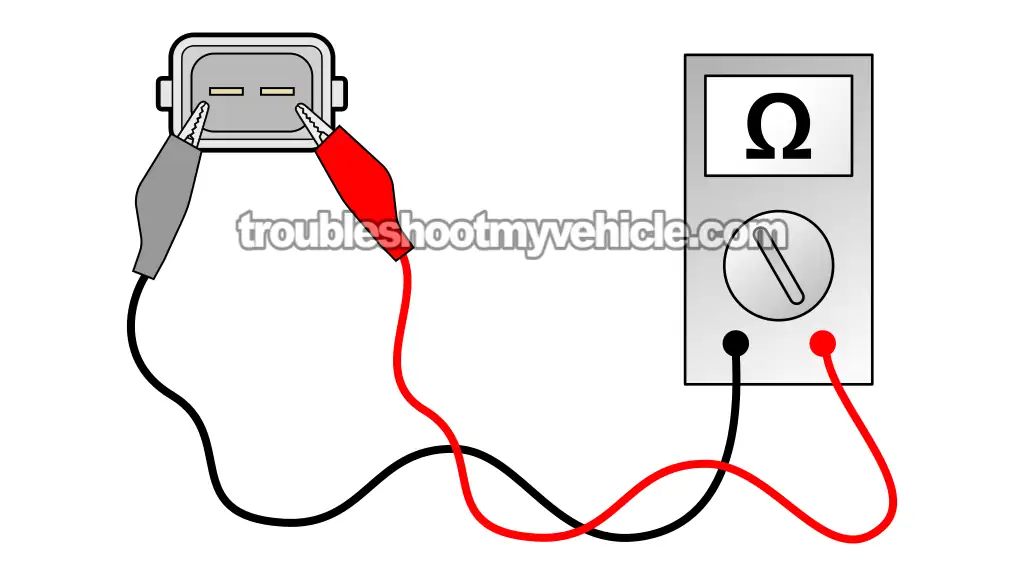
Now that you've knocked out the cold resistance test in TEST 1, it's time to apply some heat to the sensor and check if it's resistance drops like it should.
When it gets up around 200°F, this sensor oughta read somewhere between 400 and 1,500 Ohms. To get it that hot, we're gonna dunk the metal tip in boiling water —water boils at 212°F, so that'll do the trick.
If the resistance doesn't fall into that range while it's sitting in hot water, then yep —the sensor's done for.
CAUTION: Boiling water will burn the heck out of you, so play it safe and follow these tips:
- Don't touch or handle the sensor while its hot.
- Only submerge the sensor's metal part. Keep the plastic plug and terminals completely dry.
- Use long jumper wires with insulated alligator clips so you can stay clear of the heat. Need some? —Jumper Wires With Insulated Alligator Clips (at: amazon.com).
- This is an off-vehicle test —don't try it with the sensor still installed in the throttle body.
- Let the sensor cool off completely before you reinstall it on the throttle body.
Alright, here's how to run this test:
- 1
Clip your multimeter leads to the sensor's two terminals.
IMPORTANT: Use jumper wires with alligator clips so you don't have to get close to the heat. Keep your hands far away from the boiling water during the test. - 2
Set the multimeter to read Ohms (Ω).
- 3
Boil a small pot of water using a stove or hot plate.
If you've got a kitchen thermometer, check that the temp is sitting between 200–212°F (93–100°C). - 4
Dip just the sensor's metal tip into the boiling water.
CAUTION: Don't let the plastic connector or terminals get wet.
IMPORTANT: Use tongs or hang the sensor using a piece of wire —never hold it with your hands. - 5
Watch the multimeter display.
With the sensor heated up, the resistance should drop down into the 400 to 1500 Ohms range. - 6
Take the sensor out and let it cool completely before handling it or reinstalling it.
Now let's break down the results:
CASE 1: You see 0 Ohms. That means the sensor's shorted out. It's toast —replace it.
CASE 2: Display shows OL (infinite resistance). That tells you there's a break inside —the sensor's dead.
CASE 3: Resistance falls outside the proper range. That's a clear sign the sensor's not working right. Time to get a new one.
CASE 4: Resistance is within spec. That's what you wanna see —the sensor passed the test.
If it also passed TEST 1, then the sensor itself is good. If you're still getting that trouble code, the issue is probably somewhere in the wiring between the sensor's 2-wire connector and the fuel injection computer.
More 3.9L V6 Dodge Ram Pickup Tutorials
You can find a complete list of tutorials for the 3.9L V6 Dodge Ram Pickup in this index:
Here's a sample of the tutorials you'll find in the index:
- How To Test The TPS (1989-1990 3.9L V6 Dodge Ram Pickup).
- How To Test The Fuel Pump (1989-1991 3.9L V6 Dodge Ram Pickup).
- How To Test The Engine Compression (1989-2001 3.9L V6 Dodge Ram Pickup).
- How To Test For A Blown Head Gasket (1989-2001 3.9L V6 Dodge Ram Pickup).

If this info saved the day, buy me a beer!
