
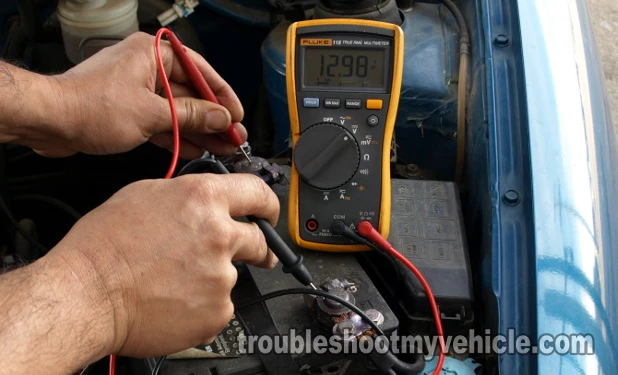
Testing the alternator to see if it's good or bad on your Dodge Neon (or Stratus, Caravan, Chrysler Cirrus, PT Cruiser, Voyager, or any 2.0L or 2.4L equipped Chrysler, Dodge, Plymouth, or Eagle) can be done easily with just a simple multimeter.
The good news is you don't need any expensive or exotic diagnostic equipment. In this tutorial, I'll show you just how easy it is.
Contents of this tutorial:
NOTE: This is an on-car test of the alternator, even though the photos show it off the vehicle. Also, since ALTERNATOR TEST 1 is done with the engine running, stay alert and take all necessary safety precautions.
STARTER MOTOR TESTS: Need to test the starter motor? Check out this step-by-step tutorial:
Symptoms Of A Bad Alternator
The most common symptoms of a bad alternator are:
- The Charge Light (also known as the Battery Light) is ON and letting you know that, yes- there is a problem.
- Driving at night, you notice that the headlights glow very very dim.
- The engine won't crank (turn over) on its own, you have to get someone to jump start your Neon (Stratus, Caravan, Voyager, Breeze, etc.). Once the jump start cables are removed, the car or minivan stays running only for a few minutes and stalls, needing another jump start.
- You have to constantly charge the battery or get jump starts after which the vehicle only runs for a few minutes and stalls.
ALTERNATOR TEST 1: Checking Battery Voltage With Engine Running
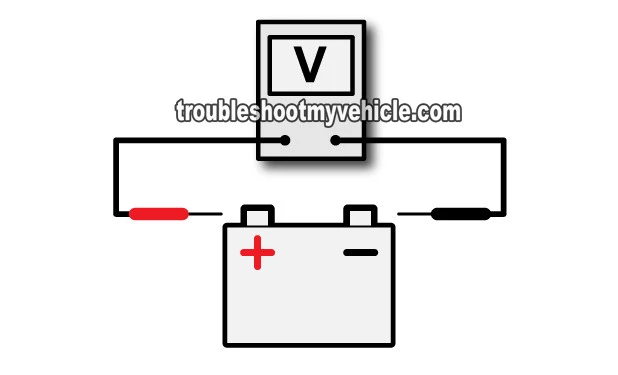
The first order of business is to check the battery's voltage, with a multimeter, while the engine is running. This simple little test will tell you if the alternator is really NOT charging the battery or it is charging the battery.
Now, before you start, the battery in your Dodge Neon (or Stratus or Cirrus or Breeze or PT Cruiser or whatever 2.0L, 2.4L equipped car or minivan) must be fully charged, since the engine must be able to stay running for at least 20 minutes to do this multimeter test.
OK, to get this show on the road, this is what you need to do:
- 1
Set the multimeter in Volts DC mode.
- 2
Start the engine and let it idle.
- 3
Check the battery's voltage with your multimeter.
- 4
Your multimeter will display one of the following two readings:
1.) A steady 13.5 to 14.5 Volts DC.
2.) Or 12.5 Volts that will decrease the longer the engine stays running. - 5
Put an electrical load on the alternator by turning ON every accessory possible inside the vehicle.
Turn on the A/C or heater on high, turn on the windshield wipers, turn on the headlights, turn on everything and anything that uses electricity inside and outside of the vehicle. - 6
As you're turning ON all this stuff, keep your eyes on your multimeter's voltage reading. Here's what is going to happen, you'll get one of following two results:
1.) The multimeter will register a nice and steady 13.5 to 14.5 Volts DC no matter what gets turned ON.
2.) It will register 12.5 V DC and this voltage will decrease more and more as you turn ON stuff inside your vehicle.
Alright, let's find out what it all means:
CASE 1: The battery's voltage, with the engine running and all accessories On, was between 13.5 and 14.5 Volts. This tells you that the alternator on your Neon (Stratus, Cirrus, Breeze, PT Cruiser, etc.) is good and charging the battery.
You don't need to do any other test, since this test result eliminates the alternator.
CASE 2: The battery's voltage, with the engine running and all accessories On, decreased down to 10 Volts DC. This tells you that the alternator is NOT charging the battery.
Now, with this result you could call the alternator fried and replace it. Most of the time (about 90%), this will solve your no charge condition. But unfortunately, one more thing could cause the alternator to not charge. So, what I suggest you do, is to verify one more simple and easy thing on the car. For this second test, go to: ALTERNATOR TEST 2: Testing The Continuity Of The Battery (+) Circuit.
ALTERNATOR TEST 2: Testing The Continuity Of The Battery (+) Circuit

You probably already know, that the one big wire that's attached to the alternator on your Neon (Cirrus, PT Cruiser, Voyage, Caravan, etc) with a nut, is the one that delivers the alternator's charge to the battery and the rest of the vehicle.
This wire (circuit) is protected by an Inline Fusible Link in the older models and a plastic fuse in the newer one. And if this Inline Fusible Link is blown, the alternator's charge will not reach the battery. The Inline Fusible Link (and the fuse) is located in the engine compartment and is usually located on the starter motor solenoid (consult your repair manual to be sure).
This test will help you determine if this Inline Fusible Link is blown or not with a simple Resistance (Ohms) Test. This test is also known as a Continuity Test.
OK, this is what you'll do:
- 1
Disconnect the battery negative (-) cable from the battery. This is critical. Leave the battery positive cable connected.
NOTE: If the battery is located under the passenger-side fender well, remove the access cover to reach it and disconnect the negative (-) cable. Do not proceed until this step is done. - 2
Set your multimeter to Ohms (Ω).
- 3
Probe the alternator output stud (the one with the large wire attached) with the black multimeter lead.
- 4
Probe the center of the battery positive (+) post with the red multimeter lead.
- 5
Your multimeter will show one of two results:
1.) OL (over limit) — the inline fusible link is blown.
2.) 0.5 Ohms or less — the inline fusible link (or fuse) is OK.
OK, now that the testing part is done, let's take a look at what your results mean:
CASE 1: Your multimeter registered continuity (.9 Ohms or less). This is good, since it indicates that the Fuse protecting this circuit is OK and not blown.
Alright, you can now condemn the alternator as bad. Replace the alternator.
CASE 2: Your multimeter DID NOT register continuity (usually indicated as OL on your multimeter's display). This means that the Fusible Link is blown and this is keeping the alternator's charging output from reaching the battery.
Find the Inline Fusible Link, visually verify that it's blown and replace it. When your done, start the car and retest the voltage at the battery once again with your multimeter.
Related Test Articles
I've written several more tutorials that may be of interest to you. These are specific 2.0L (SOHC, DOHC), 2.4L (DOHC) Neon, Stratus, Breeze, Caravan, Voyager, basically all Chrysler vehicles that use these two engines at: Chrysler 2.0L, 2.4L Index Of Articles.
Here's a small sample of the tutorials you'll find in the index:
- How To Test A Bad Starter Motor (Chrysler 2.0L, 2.4L).
- How To Test For A Blown Head Gasket (Chrysler 2.0L, 2.4L).
- How To Test The Crank Sensor (Chrysler 2.0L, 2.4L).
- How To Test The Camshaft Position Sensor (Chrysler 2.0L, 2.4L).
- How To Test The Coil Pack (Chrysler 2.0L, 2.4L) (at: easyautodiagnostics.com).

If this info saved the day, buy me a beer!


