
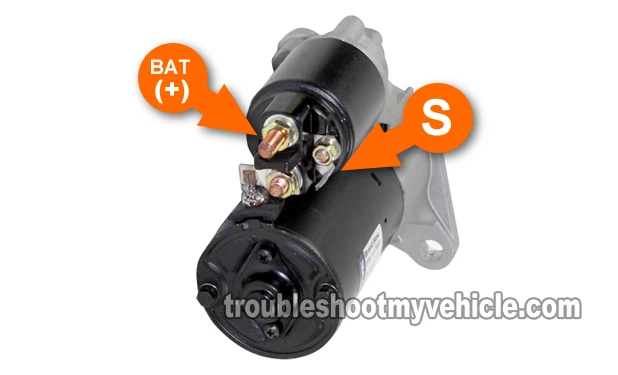
Testing a bad starter motor on your Dodge Neon (or Stratus or Caravan or any 2.0L, 2.4L equipped Chrysler, Dodge, or Plymouth) is an easy test that you can accomplish using just a multimeter and in this article, I'll show you how to do it, step-by-step.
This article will help you to diagnose a no-crank condition on your Chrysler vehicle. To see the list of vehicles that this article applies to, check out the box (on the right column of this Web page) that has the heading ‘Applies To:’ and scroll with the prev and next links to see the entire list.
Contents of this tutorial:
ES  You can find this tutorial in Spanish here: Cómo Probar El Motor De Arranque (Chrysler 2.0L, 2.4L) (at: autotecnico-online.com).
You'll notice that the photos I'm using in this article show the starter motor off from the vehicle and this is just to ease the explanation of the test. When you're doing the tests described in this article, do not remove the starter motor from you car or mini-van. The starter motor Test, in this article, is an On-Car Test of the starter motor.
If you do need to bench-test the starter motor, you can find the tutorial here:
- How To Bench Test A Starter Motor (Step By Step) (at: easyautodiagnostics.com.
Symptoms Of A Bad Starter Motor
The most common symptom of a bad starter are:
- When you turn the ignition switch to Start, the starter motor does nothing on your Dodge Neon (or Stratus or Caravan or Chrysler Cirrus or Voyager, or any other 2.0L or 2.4L equipped Chrysler vehicle).
- A 'jump start' does nothing to help crank the engine and let's you know that the battery is not the problem.
- You've bought a brand new battery (thinking that was the solution to the no-crank condition) and this did nothing to get the car or mini-van to crank and start.
- Turn the key to start your Chrysler (or Dodge or Plymouth) car or mini-van and all you hear is a small knock and nothing else.
Although the above list is a not a very complete list of symptoms, the theme that runs thru' them, and any other related symptom, is that the engine will not turn over when the key is turned to crank the vehicle.
Before we begin, it's important to understand the difference between a no-crank and a no-start condition. Here's the difference:
- When the battery or starter motor prevents the engine from turning over, it's called a no-crank condition.
- When the starter motor does turn the engine over but the engine doesn't start (a no-start condition), it's usually due to a fuel or ignition system issue.
Knowing the difference will help you diagnose the problem faster. This tutorial focuses only on diagnosing a starter motor causing a no-crank condition. If you're dealing with a no-start issue (where the engine does crank), see this tutorial: How To Troubleshoot A No Start (Chrysler 2.0L, 2.4L).
What Tools Do I Need To Test The Starter Motor?
Although it sucks that you're having a ‘does not crank’ issue with your car (mini-van, etc), the cool thing is that you don't need any expensive tools to test the starter motor. You don't even need to use a scan tool.
Tools You'll Need:
- Multimeter.
- You can use a digital multimeter or an analog multimeter although the digital one is the preferred one.
- If you don't have a multimeter or need to upgrade yours, check out my recommendation here: Tekpower TP8268 AC/DC Auto/Manual Range Digital Multimeter (Amazon affiliate link).
- A remote start switch.
- You can see an example of this tool here (you can buy it here too): Innova 3630 Remote Starter Switch (Amazon affiliate link).
- Jack.
- Jack stands.
- Basic hand tools, like ratchet, sockets, etc. To remove and replace the starter motor.
If possible, I recommend having a helper to help you.
STARTER TEST 1: Testing The S Terminal Signal
The first thing we're going to do is make sure the starter motor is receiving a start signal. This is a 12-volt signal that is delivered to the S terminal of the starter motor solenoid. In the image above, I've labeled the S terminal with the letter S.
Now, if you're wondering what the S terminal is or where it's located, the starter solenoid on your 2.0L or 2.4L Chrysler vehicle has two wires connected to it.
One is a large diameter (gauge) wire that comes directly from the battery positive (+) post. The other is a smaller wire, and this is the S terminal wire. This wire carries the Start signal from the ignition switch, through the neutral safety switch.
IMPORTANT: Make sure the battery in your Dodge (or Chrysler or Plymouth or Mitsubishi) is fully charged. If it isn't, charge it before you begin. This is important because a dead (discharged) battery will prevent the engine from cranking and can lead you to think the starter motor is bad when it's not.
OK, enough yakking, here's what you'll need to do:
- 1
Turn on your multimeter and place it in Volts DC mode.
- 2
Ground the black multimeter test lead directly on the battery negative (-) terminal or on a clean and rust-free spot on the engine.
- 3
Probe the S terminal of the starter motor solenoid with the red multimeter test lead.
NOTE: The red test lead needs to be maintained in this position for the duration of the test. - 4
Have your helper turn the key and crank the engine (even tho the engine won't crank).
This will send the Start signal down to the S terminal of the starter motor solenoid (which you're probing with the red multimeter test lead) if the ignition switch and the neutral safety switch are good. - 5
Your multimeter is going to register one of two results:
1.) If the ignition switch and the neutral safety switch are doing their jobs, you'll see 10 to 12 Volts on your multimeter.
2.) If the ignition switch or the neutral safety switch is fried, your multimeter will not register any voltage.
OK, let's make sense of the readings that your multimeter recorded in the test:
CASE 1: Your multimeter registered 10 to 12 Volts. This result tells you that the starter motor is receiving the crank (Start) Signal, which confirms that the ignition switch and the neutral safety switch are OK. You can eliminate these two as the cause of the no-crank condition.
Most folks would stop here and say that the starter motor is bad and replace it. Around 90% of the time, this would be ‘hitting the nail right on the head’ and replacing the starter motor would solve the no-crank condition. But to be absolutely sure, I suggest one more test.
This next test is to apply 12 Volts to the S terminal of the starter motor solenoid. This is an easy and fast test and I'll show you how to do it. Go to: STARTER TEST 2: Applying 12 V To The S Terminal.
CASE 2: If your multimeter DID NOT register 10 to 12 Volts. This multimeter test result lets you know that 1.) that the starter motor is not the cause of the no-crank condition and that 2.) either the ignition switch or the neutral safety switch are the real cause of the no-crank condition on your car or mini-van.
Here's why: Without the Start signal, which is created by the ignition switch and that must pass thru' the neutral safety switch, the starter motor will not activate to crank the engine. Now, it's beyond the scope of this article to test either the ignition switch or the neutral safety switch, but you have at least eliminated the starter motor itself as bad.
STARTER TEST 2: Applying 12 V To The S Terminal
In TEST 1, you confirmed that the starter motor is receiving the activation signal from the ignition switch. This also confirms that the ignition switch (and all of the circuits between it and the starter motor) are OK.
The next step is to apply 12 Volts to the S terminal of the starter motor solenoid using a jumper wire to see if the starter activates.
The best way to do this is with a remote start switch. It's the easiest, most practical, and safest way to apply 12 Volts to the S terminal of the starter motor solenoid. If you don't have one and need to buy one, this is the one I use and recommend: Innova 3630 Remote Starter Switch (Amazon affiliate link).
This is a very simple test, but you do have to take two important precautions:
PRECAUTION 1: The ignition must be in its OFF position, or better yet remove the key from the ignition switch. This will prevent the engine from starting in case the starter motor is OK.
PRECAUTION 2: If your vehicle has a standard transmission, make sure that it's out of gear and in neutral, and the parking brake is activated/on.
PRECAUTION 3: There's a good chance that the starter motor is OK and when you apply these 12 Volts with the jumper wire, the engine may start so be careful, take all necessary safety precautions and think safety as you do this test.
OK, this is what you'll need to do:
- 1
Disconnect the wire connected to the S terminal of the starter motor solenoid.
- 2
Connect one end of your remote start switch to the battery positive (+) post.
- 3
Connect the other end of the remote start switch to the S terminal of the starter motor solenoid.
- 4
Squeeze the remote start switch trigger to apply 12 Volts to the S terminal of the starter motor solenoid.
- 5
You'll see one of two results:
1.) The starter activates and turns the engine over.
2.) The starter motor does nothing.
Let's take a look at what your test results mean:
CASE 1: The starter motor cranked the engine. This means that the starter motor is good and that you have an electrical issue keeping the starter motor from cranking the engine.
CASE 2: The starter motor DID NOT crank the engine. This usually means that your starter motor is bad and needs to be rebuilt or replaced.
I suggest one more test and this is to test the battery cable (that attaches to the starter motor solenoid) for corrosion. This can be accomplished very easily with a voltage drop test. Go to: STARTER TEST 3: Voltage Drop Testing The Battery Circuit.
STARTER TEST 3: Voltage Drop Testing The Battery Circuit
Corrosion on the battery positive cable can keep the starter motor from cranking your 2.0L or 2.4L 4-cylinder Chrysler, even if the cable looks clean or has been cleaned.
Because of this, what I always do is voltage drop test the battery positive cable (the one connected to the starter motor solenoid) to make sure the starter motor is getting all of the battery's available power.
A voltage drop test is quick and easy, and the result is clear: either the starter motor is getting all of the battery's available power, or it isn't.
NOTE: This test is done only when the engine is not cranking (when the starter motor is not turning the engine over). If the starter motor is already turning the engine over, do not perform this voltage drop test on the battery positive cable.
Let's get started:
- 1
Set your multimeter to Volts DC.
- 2
Connect the red multimeter lead to the battery positive (+) post.
It's best to have a helper hold the lead on the center of the battery positive (+) post for the duration of the test. - 3
With the black multimeter lead, probe the large stud on the starter motor solenoid where the battery positive cable is attached.
Keep the multimeter test lead on this stud for the duration of the test. - 4
When ready, have your assistant crank the engine while you watch the multimeter.
The starter isn't crank the engine, but the key must be turned to the Start (crank) position for the test to work. - 5
Your multimeter will show one of two results:
1.) 0 Volts —this indicates no voltage drop.
2.) A voltage reading (usually 5 Volts or more) —this indicates a voltage drop in the circuit, which is not good.
OK, now that the testing part is done, let's take a look at what your results mean:
CASE 1: Your multimeter result confirms NO voltage drop (which is 0.5 Volts or less). This means that the battery positive cable is corrosion-free and that it is transmitting all of the battery's available power to the starter motor. Replace the starter motor.
What if you're reading this article because you have already replaced the starter motor and the engine still doesn't crank? Well, I suggest two more tests:
1.) Confirm that the engine is not locked up due to a thrown rod or a locked up AC compressor. You can easily do this by turning the engine manually (using a 1/2 ratchet and the appropriate socket).
2.) Test the starter motor that you just got from the auto parts store -it could be bad. You can do this by bench testing the starter motor. The step-by-step instructions here: How To Bench Test A Starter Motor (Step By Step) (at: easyautodiagnostics.com).
CASE 2: Your multimeter indicated a voltage drop. This means that your multimeter registered a voltage reading (usually 5 Volts DC or more), and this voltage reading means that the starter motor isn't getting all of the battery's available power. This will keep the starter motor from cranking the engine.
The solution is simple, just thoroughly clean both ends of the battery positive cable and both battery posts. The positive battery cable end that attaches to the starter motor solenoid can be cleaned with a piece of sand paper.
Once you're done and have reconnected both ends of the cable, re-test or simply crank up the car. More than likely it'll now crank and start.
Related Test Articles
You can find several specific Chrysler 2.0L (SOHC and DOHC) and 2.4L (DOHC) ‘how to test’ tutorials here at troubleshootmyvehicle. Com by going here: Chrysler 2.0L, 2.4L Index Of Articles.
Here's a small sample of the tutorials you'll find in the index:
- How To Test The Coil Pack (Chrysler 2.0L, 2.4L) (at: easyautodiagnostics.com).
- How To Test The Crank Sensor (Chrysler 2.0L, 2.4L).
- How To Test The Camshaft Position Sensor (Chrysler 2.0L, 2.4L).
- How To Test The Engine Compression (Chrysler 2.0L, 2.4L).

If this info saved the day, buy me a beer!


