
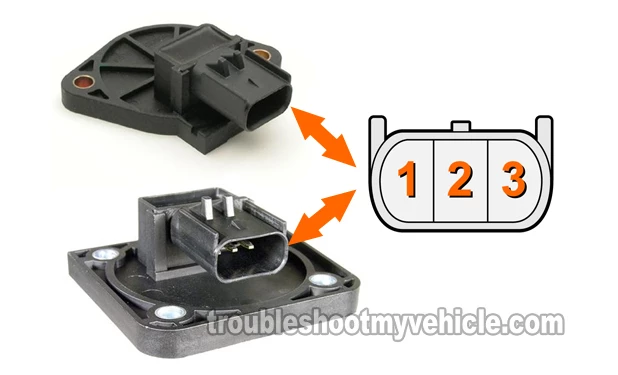
Testing the camshaft position (CMP) sensor (and troubleshooting a Code P0340: No Cam Signal At PCM) on your Chrysler (or Dodge, Plymouth, or Eagle) 2.0L or 2.4L 4-cylinder equipped vehicle is a straightforward test you can do with a multimeter. You don't need a scan tool to follow the test steps in this article.
The test is done on the car and will let you know if the CMP sensor is working or not while it's in action. If you're looking for a simple Ohms (resistance) test of the CMP sensor, this type of test does not exist. Why? Because the CMP sensor is a Hall-Effect type sensor and cannot be resistance tested.
This tutorial jumps right into the test, but I recommend taking a quick look at all of the sections first. Also, this tutorial covers two types of camshaft position sensors: the square one used on 2.0L SOHC engines, and the round one used on 2.0L DOHC and 2.4L DOHC engines.
This tutorial applies to vehicles from Chrysler, Dodge, Eagle, Mitsubishi, and Plymouth. To make sure it applies to your specific vehicle, look for the box titled "Applies To:" (on the right column or, on mobile devices, at the bottom of the page).
Contents of this tutorial:
ES  You can find this tutorial in Spanish here: Cómo Probar El Sensor De La Posición Del Árbol De Levas (Chrysler 2.0L, 2.4L) (at: autotecnico-online.com).
Tools You'll Need:
- Multimeter.
- Jack
- Jack Stands
- 1/2 inch Ratchet Wrench

How Does The CMP Sensor Work?
I'm not going to go into the actual technical theory of the how the CMP sensor works, after all you really don't want to reverse engineer the CMP sensor. What I'll give you is the basics of how it works:
The CMP sensor, on your 2.0L (SOHC and DOHC) is a Hall-Effect type sensor. This means that it needs power, in the form of DC voltage and Ground to produce a CMP signal that the PCM can use.
Once the sensor gets these two signals and the camshaft is rotating, it starts to produce an ON/OFF DC voltage signal. ON is when the sensor outputs 5 Volts, and OFF is when this voltage drops to 0.3 or 0.5 Volts.
Each one of the three wires that connect to it have a specific job to do:
- One delivers power in the form of 8 Volts from the PCM.
- Another delivers Ground. This Ground is provided inside the PCM, too.
- The last remaining, delivers the signal, that the CMP sensor creates, to the PCM.
Where To Buy The CMP Sensor And Save
There's a good chance that you can buy the CMP sensor online for a whole lot cheaper than somewhere local.
The following links will help you comparison shop for the camshaft position sensor:


Disclosure: As an Amazon Associate, I earn from qualifying purchases. If my tutorials help you, using these links is an easy way to support the site at no extra cost to you. Thank you!
Not sure if the above CMP sensor fits your particular Dodge (Chrysler/Plymouth)? Don't worry, once you get to the site, they'll make sure it fits by asking you the specifics of your vehicle. If the above don't fit, they'll find the right one for you.
TEST 1: Testing The CMP Signal
If your specific Chrysler (or Dodge or Eagle or Plymouth or Mitsubishi) uses the square or the round camshaft position (CMP) sensor, they are both bolted to the rear of the Cylinder Head (this is the side that faces the transaxle). The square type is secured to the head by 4 small bolts and the round one is bolted to the head with two small bolts.
You'll need to hand-turn the engine, using a 1/2 ratchet and the appropriate size socket, to turn the crankshaft pulley. You may have to jack up the vehicle to gain access to the crankshaft pulley. Remember to take all necessary safety precautions (like using jack stands, wearing eye-protection, etc.).
OK, here's the test:
- 1
Disable the ignition system. You can accomplish this by disconnecting the ignition coil pack from its electrical connector.
This is important! Do not proceed with the test without first unplugging the ignition coil pack. - 2
Locate the CMP sensor. Now since you need to test the signals (inside the wires) of the CMP sensor, you may have to remove some of the black electrical tape insulation that covers the three wires. Remove enough of it to have comfortable access to the wires.
- 3
Reconnect the CMP sensor if you disconnected the camshaft position (CMP) sensor's connector to remove some of the black electrical tape insulating the wires.
IMPORTANT: To perform this test, the camshaft position (CMP) sensor has to be connected to its connector. - 4
Place your multimeter in Volts DC mode.
- 5
Probe the wire that connects to the male spade terminal identified with the number 3 (in the photo above).
I recommend that you use a wire-piercing probe or an appropriate tool to pierce the wire and then connect the red multimeter test lead to this tool. To see what a what wire piercing probe tool looks like, click here: Goupchn 4mm Banana to Banana Plug Test Leads Kit (Amazon affiliate link). - 6
Connect the black multimeter test lead to the battery negative (-) terminal.
- 7
Turn the crankshaft pulley by hand in a clock-wise direction, using a 1/2 inch ratchet, an extension, and the appropriate socket while you keep your eyes on the multimeter.
IMPORTANT: Do not use the starter motor to crank the engine. - 8
If the camshaft position (CMP) sensor is working correctly, the multimeter will register an ON/OFF voltage of 5 Volts DC.
ON is when the multimeter displays 5 Volts DC and off is 0.3 to 0.5 Volts DC (this is technically considered 0 Volts). The key to seeing this voltage change is to turn the crankshaft pulley slowly and steadily.
OK, let's interpret the multimeter test results:
CASE 1: The multimeter registered the ON/OFF 5 Volts DC as you turned the crankshaft pulley. This test result indicates that the camshaft position sensor is working fine. You have now eliminated the camshaft position (CMP) sensor as bad.
This result also confirms that the camshaft position sensor is getting power and Ground (since without any of these two, you wouldn't see a signal).
CASE 2: The multimeter DID NOT register the ON/OFF 5 Volts DC as you turned the crankshaft pulley. Recheck all of your multimeter connections.
If your multimeter still does not register the indicated ON/OFF voltage, then the next step is to verify that the camshaft position sensor is getting fed power and Ground. Go to: TEST 2: Making Sure The CMP Sensor Is Getting Power.
It's important to verify that the cam (CMP) sensor is receiving power and Ground before condemning it as bad.
TEST 2: Making Sure The CMP Sensor Is Getting Power
The camshaft position (CMP) sensor needs power to work. Without power, the CMP sensor will not produce a cam signal.
This power is in the form of 8 Volts, which the PCM (Powertrain Control Module=Fuel Injection Computer) supplies.
IMPORTANT: Be very careful not to short this wire to Ground or you could damage the PCM. Also, do not use a test light to verify this voltage. Use a multimeter.
These are the test steps:
- 1
Place your multimeter in Volts DC mode.
- 2
Probe the wire that connects to the terminal identified by the number 1 (see photo above) with red multimeter test lead.
As in the CMP TEST 1, pierce the wire with an appropriate tool. Avoid probing the front of the connector. - 3
Connect the black multimeter test lead to the battery negative (-) terminal.
- 4
Have your helper turn the key to the On position but don't crank or start then engine.
- 5
Your multimeter should register 8 Volts.
OK, let's interpret the multimeter test results you just obtained:
CASE 1: Your multimeter registered 8 Volts DC when the key was turned On. This indicates that the camshaft position sensor on your Chrysler (or Dodge or Plymouth) is getting a good supply of juice. The next test is to test the sensor Ground circuit. Go to: TEST 3: Making Sure The CMP Sensor Is Getting Ground.
CASE 2: Your multimeter DID NOT register 8 Volts DC when the key was turned On. Recheck your connections and try the test again.
If still no 8 Volts, then this test result eliminates the CMP sensor as bad, since without this voltage, the CMP sensor will not produce a cam signal.
TEST 3: Making Sure The CMP Sensor Is Getting Ground
This is the last test to perform to be able to decisively say that the camshaft position sensor is bad.
So far, you have verified two very important things:
One: That the camshaft position sensor is not producing a cam signal (TEST 1).
Two: That the camshaft position sensor is getting power (TEST 2).
In this test step, you're gonna' check its Ground circuit.
IMPORTANT: You got to be very careful not to short this wire to power (battery voltage) or you run the risk of damaging the PCM. Also, do not use a test light to verify this voltage -use a multimeter.
These are the test steps:
- 1
Place your multimeter in Volts DC mode.
- 2
Probe the wire that connects to the terminal identified by the number 2 (see photo above) with the black multimeter test lead.
Avoid probing the front of the CMP sensor connector to check this Ground. Pierce the wire with an appropriate tool. - 3
Connect the red multimeter test lead to the battery positive (+) terminal.
- 4
Have your helper turn the key to the On position.
- 5
Your multimeter should register battery voltage (10 to 12 Volts DC).
Let's examine your test result:
CASE 1: The multimeter registered 12 Volts DC when the key was turned On. This indicates that the PCM is providing a Ground path for the CMP sensor.
You can conclude that the CMP sensor is bad if you have:
- Confirmed that the camshaft position sensor is not producing an ON/OFF voltage signal (TEST 1).
- Confirmed it's getting Ground (TEST 2).
- Confirmed it's getting power (this test section).
CASE 2: The multimeter DID NOT register 12 Volts DC when the key was turned On. Recheck your connections and try the test again.
If your multimeter still does not register the 12 Volts, then you have just eliminated the CMP sensor as bad. Without this Ground path the CMP sensor will not work.
Related Test Articles
I have written quite a bit about the 2.0L and 2.4L (SOHC and DOHC) ignition systems. You can find all of them here: Chrysler 2.0L, 2.4L Index Of Articles.
Here's a sample of the articles you'll find there:
- How To Test The Crank Sensor (Chrysler 2.0L, 2.4L).
- How To Test The Engine Compression (Chrysler 2.0L, 2.4L).
- How To Test The Oxygen Sensors (Chrysler 2.0L, 2.4L).
- How To Test The Coil Pack (Chrysler 2.0L, 2.4L) (at: easyautodiagnostics.com).
- How To Bench Test The Starter Motor (at: easyautodiagnostics.com).

If this info saved the day, buy me a beer!


