
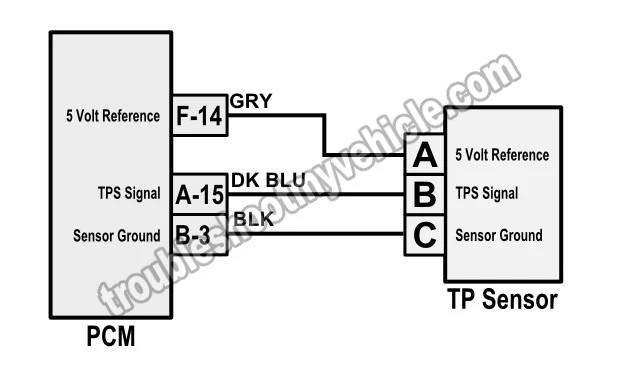
This tutorial will help to test the throttle position sensor (TPS) circuits between the PCM and TPS connector to see if they are shorted together or 'open' (or not).
More importantly, this tutorial will help you to come to an informed decision as to whether the PCM has fried and is causing the TPS trouble code or not.
IMPORTANT: Although the basic testing method described in this tutorial could be used with any vehicle, the illustrations, PCM pin identification, and throttle position sensor (TPS) pin identification APPLY ONLY to 1993 and 1994 4.3L, 5.0L, and 5.7L GM equipped pickups equipped with throttle body fuel injection (TBI) and the 4L60-E automatic transmission.
Contents of this tutorial:
Can A Bad PCM Cause A False TPS Code?
It doesn't happen very often that a PCM goes bad and causes a false throttle position sensor (TPS) code, but it does happen. When it happens, the most effective way to diagnose/troubleshoot this hypothesis is to make sure that the TPS is good and that there ISN'T a problem in the wiring between the PCM and the throttle position sensor (TPS).
So, in a nutshell, testing for a bad PCM involves a process of elimination that involves checking these specific things:
- Making sure that the old (or new sensor you just bought and installed) is working correctly and producing a variable throttle angle voltage signal when the throttle plate opens and closes.
- Making sure there is continuity in the wiring between the PCM and the throttle position sensor (TPS).
- Making sure that the throttle position sensor (TPS) wires are not shorted to each other.
- Making sure that the throttle position sensor (TPS) wires are not shorted to Ground.
- That the PCM is getting power and Ground.
All of the above circuit tests aren't hard and I'll show you how in this tutorial. Remember, you have to first start by verifying the sensor is OK. The following tutorial will help to test it:
- How To Test The Throttle Position Sensor (GM 4.3L, 5.0L, 5.7L) (at: easyautodiagnostics.com).
OK, before we get started, it's important that you know that the PCM covered by this tutorial has two connectors. One PCM connector is red and the other is blue in color.
Each PCM connector has 32 slots and are identified by a number preceded by a letter prefix (e.g. B-4, B-13, E-14). The test steps, in this tutorial, will point out what specific PCM circuits you have to test in a detailed step-by-step way and with an illustration to boot.
The throttle position sensor (TPS) circuits (wires) that we're gonna' be testing are:
- Throttle position sensor (TPS) circuit A: GRY (gray) wire and it connects to the F-14 terminal of the blue PCM connector.
- Throttle position sensor (TPS) circuit B: DK BLU (dark blue) wire and it connects to the A-15 terminal of the red PCM connector.
- Throttle position sensor (TPS) circuit C: BLK (black) wire and it connects to the B-3 terminal of the red PCM connector.
The PCM circuits we're gonna' be testing are:
- F-14 terminal of the red PCM connector: GRY (gray) wire and it connects to the throttle position sensor (TPS) circuit A.
- A-15 terminal of the red PCM connector: DK BLU (dark blue) wire and it connects to the throttle position sensor (TPS) circuit B.
- B-3 terminal of the blue PCM connector: BLK (black) wire and it connects to the throttle position sensor (TPS) circuit C.
There a few other PCM circuits (for power and Ground) that we'll testing that I did not include in the list above, but you'll see them in TEST 4. To correctly identify the PCM terminals, the following 1993 PCM pin out chart will come in handy:
TEST 1: TPS Circuit Continuity Tests
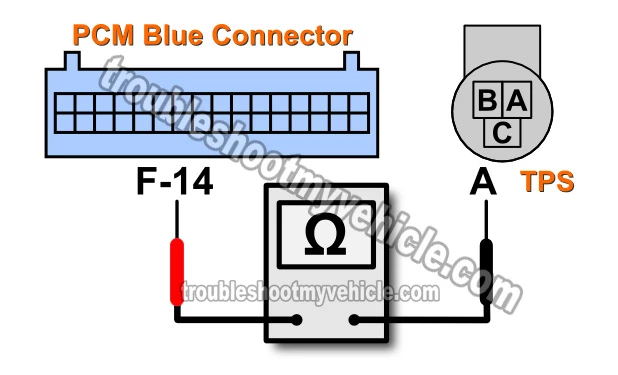
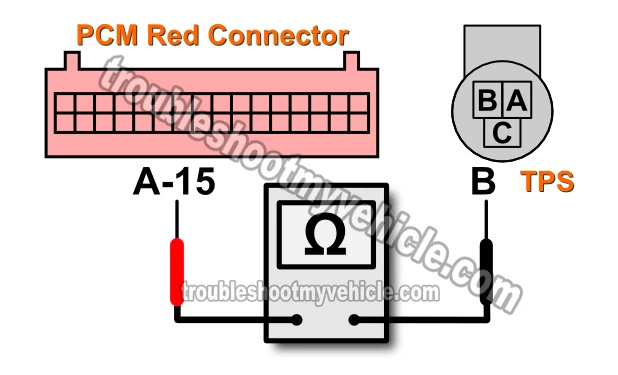
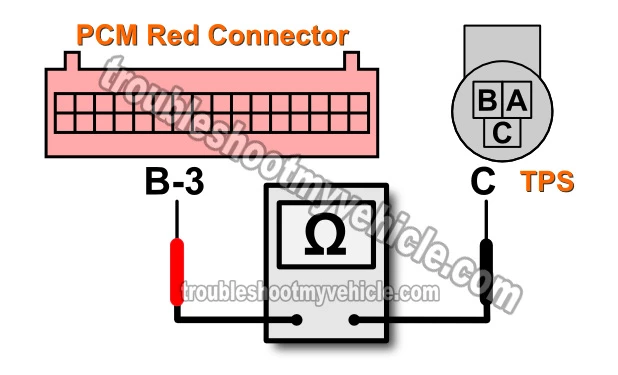
To get this show on the road, the first set of tests will be to check that continuity does exist between the PCM and TPS connectors.
These continuity tests are simple resistance tests done with a multimeter in Ohms (Ω) mode.
In the test steps below, I'll show you which PCM and TPS circuits you'll need to test.
IMPORTANT: Do not probe the front of the PCM connector to test for continuity between it and the throttle position sensor or you'll cause permanent damage to the metal terminal (inside the connector).
These are the test steps:
- 1
Disconnect the battery negative (-) terminal. All tests in this section must be done with the battery disconnected from the battery negative cable.
- 2
Disconnect the engine coolant temperature (EC) sensor from its connector. Don't skip this step because the throttle position sensor (TPS) PPL wire also connects to the automatic transmission and this circuit needs to be completely isolated.
- 3
Disconnect the PCM and throttle position sensor (TPS) from their connectors. Check the connectors for any obvious problems (like damage) and repair if necessary.
IMPORTANT: Before disconnecting the PCM, touch any unpainted/clean metal surface on your vehicle to discharge any static electricity you may have stored on you. Static electricity can fry the PCM. - 4
Check continuity between throttle position sensor (TPS) terminal A (GRY wire) and terminal F-14 of the blue PCM connector using the appropriate tools (see image 1 of 3).
Continuity should be present (.5 Ohms or less). - 5
Check continuity between throttle position sensor (TPS) terminal B (DK BLU wire) and terminal A-15 of the red PCM connector using the appropriate tools (see image 2 of 3).
Continuity should be present (.5 Ohms or less). - 6
Check continuity between throttle position sensor (TPS) terminal C (BLK wire) and terminal B-3 of the blue PCM connector using the appropriate tools (see image 3 of 3).
Continuity should be present (.5 Ohms or less).
Let's take a look at what your test results mean:
CASE 1: Continuity was present in all throttle position sensor (TPS) circuits. This tells you that the wires (that connect the PCM to the TPS) are OK and are not 'open'.
The next step is to make sure that they are not shorted to Ground or each other. For this test, go to: TEST 2: Circuits Shorted To Each Other.
CASE 2: Continuity was not present in one or more circuits tested. Double check that you're testing the correct circuit(s) and repeat the tests.
If your multimeter still does not register continuity in the indicated circuit, then that throttle position sensor (TPS) wire has a problem that needs to be solved and tells you that the problem IS NOT due to a bad PCM.
Repairing the 'open' in the wire that did not show continuity should solve the throttle position sensor (TPS) problem and trouble code.
TEST 2: Circuits Shorted To Each Other
So far you have checked and confirmed that all 3 of the throttle position sensor (TPS) wires have continuity between them and the PCM (TEST 1).
The next troubleshooting step is to make sure that the TPS wires are not shorted to each other somewhere in the engine's wiring harness.
The cool thing is that we don't have to tear apart the wiring harness to physically check to see if the wires are shorted together or not.
How can we check to see if the wires are shorted to each other? By doing several continuity test between the wires (since there should not be any continuity between them) with your multimeter in Ohms mode.
These are the test steps:
- 1
Disconnect the battery from its negative cable. This will ensure that no circuit is 'live' with power before proceeding to the next step.
- 2
Make sure the PCM is disconnected from its 2 connectors before proceeding to step 3.
- 3
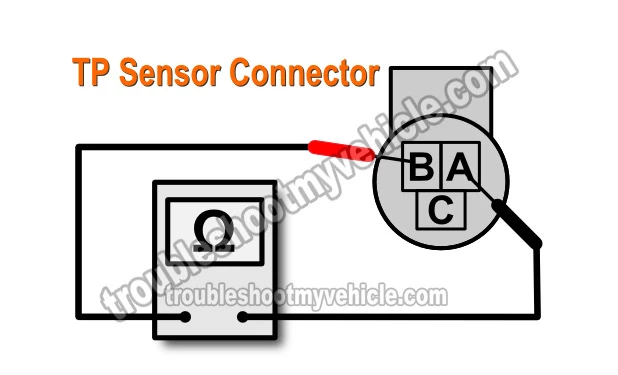
Check the continuity of throttle position sensor (TPS) connector terminals B and A with your multimeter in Ohms (Ω). See image 1 of 3.
Your multimeter should register OL (open Loop), in other words: it should NOT register continuity. - 4
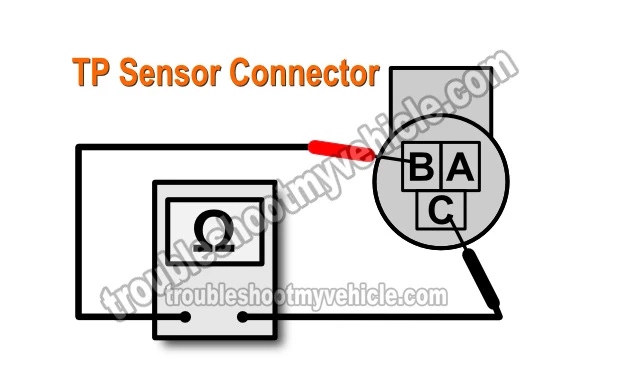
Check the continuity of throttle position sensor (TPS) connector terminals B and C with your multimeter in Ohms (Ω). See image 2 of 3.
Your multimeter should register OL (no continuity). - 5
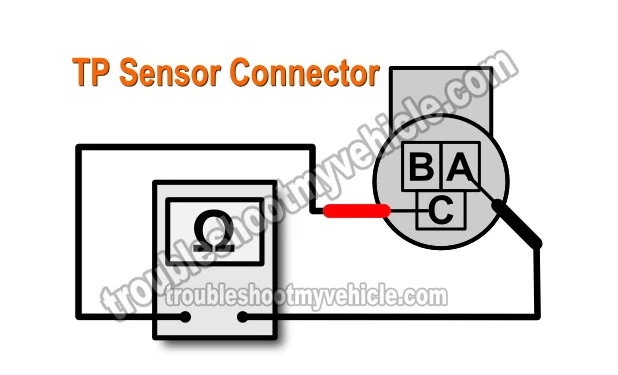
Check the continuity of throttle position sensor (TPS) connector terminals C and A with your multimeter in Ohms (Ω). See image 3 of 3.
Your multimeter should register OL (no continuity).
Let's take a look at what your test results mean:
CASE 1: None of the throttle position sensor (TPS) wires were shorted together. This is the correct and expected test result. Your next step is to make sure none of the throttle position sensor (TPS) wires are shorted to Ground. For this test, go to: TEST 3: Checking For Shorts To Ground.
CASE 2: One or more of the throttle position sensor (TPS) wires were shorted together. Make sure that the PCM is disconnected from its two connectors.
If the PCM is unplugged from its two connectors, then this test result tells you that you have a problem in the wiring since the multimeter should have NOT registered continuity.
Repairing the shorted throttle position sensor (TPS) wires will solve the throttle position sensor (TPS) problem and trouble codes.
TEST 3: Checking For Shorts To Ground
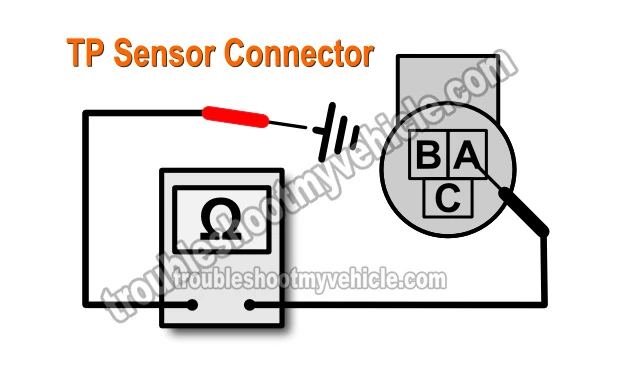
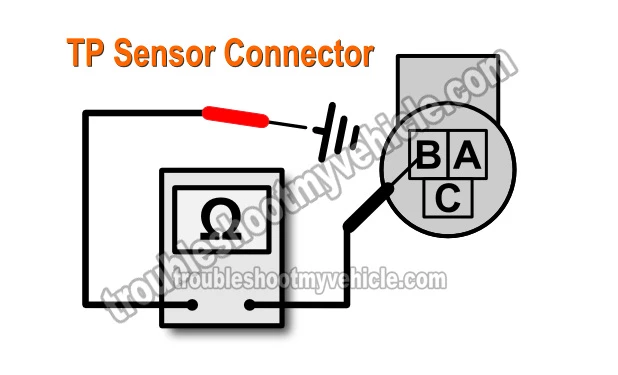
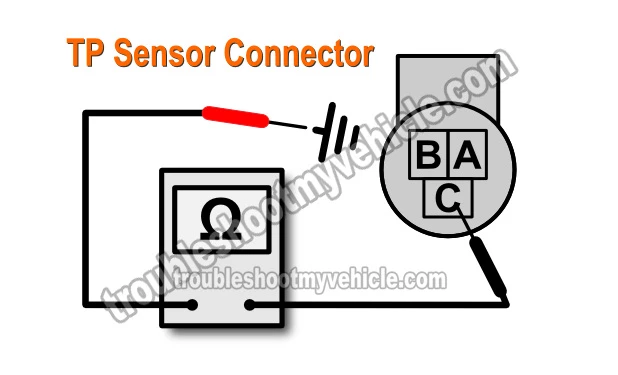
In this test step, we're gonna' make sure that none of the 3 throttle position sensor (TPS) wires are shorted to Ground.
This test can also be accomplished with a few simple multimeter continuity tests between the specific TPS wire, you're testing, and chassis Ground.
NOTE: The chassis Ground point you choose needs to be a clean rust and paint free spot on the engine or intake manifold.
These are the test steps:
- 1
The PCM, the battery negative (-) terminal, and the automatic transmission must remain disconnected to accomplish the next test steps.
- 3
Check the continuity of throttle position sensor (TPS) connector terminals A and Ground with your multimeter in Ohms (Ω) mode. See image 1 of 3.
Your multimeter should register OL (open Loop), in other words: it should NOT register continuity. - 4
Check the continuity of throttle position sensor (TPS) connector terminals B and Ground with your multimeter in Ohms (Ω). See image 1 of 3.
Your multimeter should register OL (no continuity). - 5
Check the continuity of throttle position sensor (TPS) connector terminals C and Ground with your multimeter in Ohms (Ω). See image 3 of 3.
Your multimeter should register OL (no continuity).
Let's take a look at what your test results mean:
CASE 1: None of the throttle position sensor (TPS) wires are shorted to Ground. This is the correct and expected test result and it's looking like you just might have a bad PCM on your hands.
There's still one more set of tests you should do and it's to make sure that the PCM has power and Ground. For these tests, go to: TEST 4: PCM Power And Ground Tests.
CASE 2: One or more of the throttle position sensor (TPS) wires were shorted to Ground. Make sure that the PCM and the automatic transmission are disconnected from their connectors.
If the PCM and automatic transmission (4L60-E) are unplugged from their connectors, then this test result tells you that you have a problem in the wiring since the multimeter should have NOT registered continuity.
Repairing the shorted throttle position sensor (TPS) wires will solve the throttle position sensor (TPS) problem and trouble codes.
TEST 4: PCM Power And Ground Tests
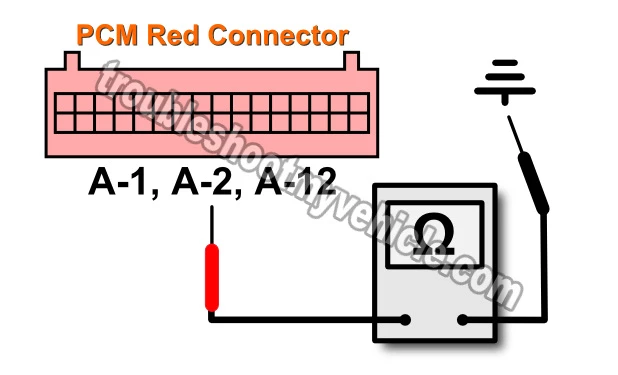
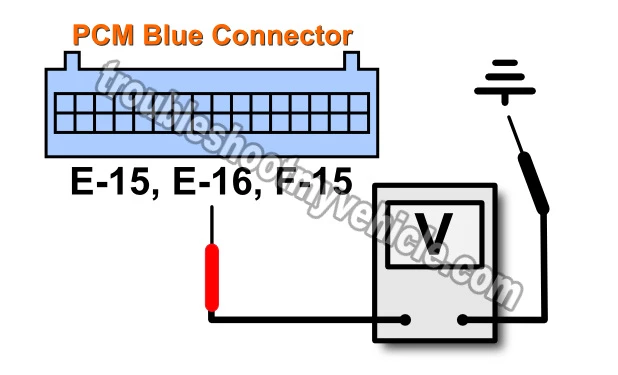
So far, you have checked and eliminated quite a few things:
One: 'Opens' in the wires between the PCM connector and TPS connector (TEST 1: TPS Circuit Continuity Tests).
Two: Shorts between the wires of the TPS connector (TEST 2: Circuits Shorted To Each Other).
Three: Shorts to Ground in the TPS connector wires (TEST 3: Checking For Shorts To Ground).
The last thing we'll do is to make sure that the PCM has good Ground and is getting power.
These are the test steps:
- 1
Disconnect the battery negative cable and unplug the PCM from its two connectors. The PCM will remain disconnected from its two connectors for the remainder of the tests.
- 2
Test continuity between terminals A-1, A-2, and A-12 (of the red connector) and Ground with your multimeter in Ohms (Ω) mode. See image 1 of 2 in the image viewer.
Your multimeter should register continuity (.5 Ohms or less) if these circuits are feed the PCM a good Ground.
IMPORTANT: Don't probe the front of the PCM connector. You need to back-probe the connector or use a wire-piercing probe on the wire that connects to the terminal to be tested. - 3
Re-connect the battery negative cable BUT leave the PCM unplugged from its two connectors. This is so that we can have power available for the next round of tests.
- 4
Test terminals E-15, E-16, and F-15 (of the blue connector) for voltage (10 to 12 Volts) with your multimeter in Volts DC mode. See image 2 of 2 in the image viewer.
Terminals E-15 and F-15 will have power only with the key in the On position. Terminal E-16 is hot all of the time.
IMPORTANT: Don't probe the front of the PCM connector. You need to back-probe the connector or use a wire-piercing probe on the wire that connects to the terminal to be tested.
Let's take a look at what your test results mean:
CASE 1: The PCM is being fed power and Ground where indicated in the test steps above. This is the correct and expected test result.
These test results tell you, with about 95% accuracy, that the PCM is probably bad and causing a fake TPS code only if you have:
- Eliminated the throttle position sensor (TPS) as bad (defective).
- Confirmed all 3 throttle position sensor (TPS) wires have continuity between the PCM and throttle position sensor (TPS) (TEST 1).
- Confirmed that the throttle position sensor (TPS) wires are not shorted together (TEST 2).
- Confirmed that the throttle position sensor (TPS) wires are not shorted to Ground (TEST 3).
CASE 2: The PCM is missing power or Ground. You'll need to solve the missing power or Ground issue and retest.
After restoring the missing power or Ground, you'll need to road-test the vehicle and see if it solved the throttle position sensor (TPS) trouble code issue.
More GM 4.3L, 5.0L, 5.7L Tutorials
You can find a complete list of tutorial in this index: GM 4.3L, 5.0L, 5.7L Index Of Articles.
Here's a sample of the tutorials you'll find in the index:
- How To Test The Blower Resistor (1988-1993 Pickups).
- How To Test The Blower Motor (GM 4.3L, 5.0L, 5.7L).
- How Can I Tell If My 4L60-E Transmission Is Bad?
- Shift Solenoid A And B Tests (GM 4.3L, 5.0L, 5.7L).
- How To Test The Engine Compression (GM 4.3L, 5.0L, 5.7L).
- How To Test The GM Distributor Mounted Ignition Module (at: easyautodiagnostics.com).

If this info saved the day, buy me a beer!
