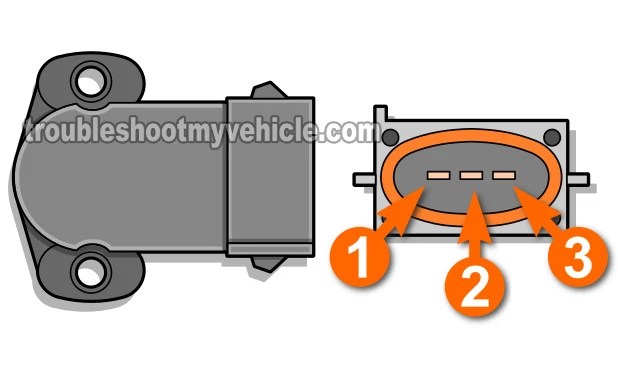
In this tutorial, I'll show you how to test the throttle position sensor (TPS) on your 4.9L L6 equipped Ford with a simple multimeter.
You'll be surprised just how easy it is to find out if the throttle position sensor (TPS) is bad or not.
And the best part is that you don't have to remove it to test it since the test I'm gonna' show you is done with the throttle position sensor (TPS) in place on the throttle body.
Contents of this tutorial:
- Symptoms Of A Bad Throttle Position Sensor (TPS).
- Basics Of The Throttle Position Sensor (TPS).
- TEST 1: Checking The Throttle Position Sensor (TPS) Signal.
- TEST 2: Making Sure The TPS Is Getting 5 Volts.
- TEST 3: Making Sure The TPS Is Getting Ground.
- Throttle Position Sensor (TPS) Is Good But Code Won't Go Away.
- More ‘How To Test’ Tutorials.
ES  You can find this tutorial in Spanish here: Cómo Probar El Sensor TPS (1988-1995 Ford 4.9L) (at: autotecnico-online.com).
Symptoms Of A Bad Throttle Position Sensor (TPS)
The throttle position sensor (TPS) is one of those sensors that the fuel injection injection can't live without. When this TP sensor fails, the fuel injection computer won't be able to effectively control the amount of fuel injection or timing advance and you're gonna' feel it as you drive your vehicle down the road.
Here an other symptoms of a bad throttle position sensor your Ford vehicle may experience:
- Trouble codes lighting up the check engine light (CEL):
- Code 23: Throttle Position (TP) Circuit Performance Problem.
- Code 53: Throttle Position (TP) Circuit High Input.
- Code 63: Throttle Position (TP) Circuit Low Input.
- Hesitation when accelerating the pick-up (van or SUV).
- Intermittent lack of power when accelerating.
- Bad gas mileage.
- Extended cranking time.
- Idle lopes (idle RPMs go up and down).
Basics Of The Throttle Position Sensor (TPS)
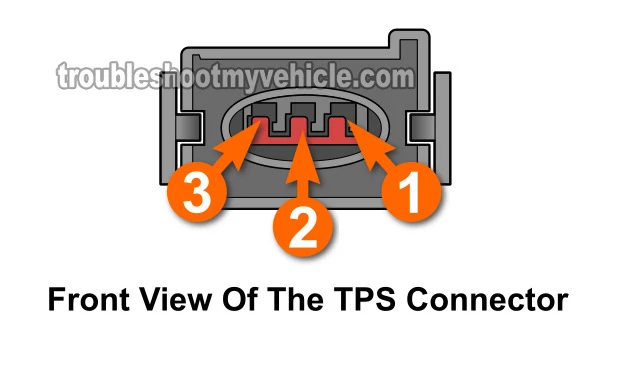
As you're already aware, the throttle position sensor (TPS) on your 4.9L equipped Ford has 3 wires coming out of its connector.
Each wire starts and ends at the fuel injection computer (known in today's tech lingo as the Powertrain Control Module = PCM).
Each one carries a specific type of signal and in this section, I'll briefly go over each one.
NOTE: I didn't include the color of the wires because they'll be different for each Ford covered by this tutorial. But don't worry, the circuits are the same regardless of the color of the wires or your specific model (as long as they're covered by this tutorial -see the ‘Applies To:’ box on the right).
TPS circuit descriptions:
- Circuit labeled 1:
- Ground (provided by the PCM).
- Circuit labeled 2:
- Throttle Position (TP) Signal Circuit.
- The TP signal's voltage increases as the throttle angle increases.
- The TP signal's voltage decreases as the throttle angle decreases.
- Circuit labeled 3:
- Power in the for of 5 Volts DC (provided by the PCM).
TEST 1: Checking The Throttle Position Sensor (TPS) Signal
When the TP sensor is working correctly, the voltage it produces (and sends the PCM on circuit #2) increases and decreases depending on the amount the throttle plate opens.
So, the first thing we'll do is connect a multimeter to circuit #2 and manually open and close the throttle and see if the TP sensor voltage signal increases and decreases.
If the signal doesn't move (increase or decrease) or the voltage signal shows gaps, then the TP sensor is bad and needs to be replaced.
If you don't have a multimeter or need to upgrade yours? Check out my recommendation: Tekpower TP8268 AC/DC Auto/Manual Range Digital Multimeter (Amazon affiliate link)
Here are the test steps:
- 1
Place your multimeter in Volts DC mode.
- 2
Turn the key to the ON position but don't crank or start the engine.
- 3
Connect the red multimeter test lead to the wire that connects to female terminal 2. This should be the middle wire of the connector.
NOTE: The 3-wire connector needs to remain connected to the TPS, so you'll need to either back-probe the connector or use a wire piercing probe to get to the signal inside the wire (to see what a wire piercing probe looks like: Goupchn 4mm Banana to Banana Plug Test Leads Kit (Amazon affiliate link).). - 4
Ground the black multimeter test lead directly on the battery negative (-) post.
- 5
Manually rotate the throttle.
You'll get the best results by opening and closing the throttle directly on the throttle body instead of stepping on the accelerator pedal. - 6
The multimeter should show an increasing voltage as you (or your helper) open up the throttle.
You'll get the best results by opening and closing the throttle directly on the throttle body instead of stepping on the accelerator pedal. - 7
The multimeter should show a decreasing voltage as you begin to close the throttle.
- 8
Using a screwdriver's handle, gently tap the TP sensor as you open and close the throttle and observer the multimeter.
The purpose (of tapping the TP sensor with the screwdriver's handle) is to see if the TP sensor shows gap's in the voltage signal. Why? Because a good TP sensor will show a continuous increasing or decreasing voltage signal even while getting tapped by the screw-driver's handle.
Let's take a look at what your test results mean:
CASE 1: The TP sensor signal's voltage increased or decreased smoothly and without gaps. This test result tells you that the TPS is OK.
This test result also tells you that:
- Circuit #1 is providing Ground.
- Circuit #3 is providing power (5 Volts).
CASE 2: The TP sensor signal's voltage DID NOT increase or decrease smoothly and/or showed gaps. This test result usually tells you that the throttle position sensor (TPS) is fried and needs to be replaced but not always.
We need to do one more test to make sure and that's to verify that the TP sensor is getting both power and Ground. For this test, go to: TEST 2: Making Sure The TPS Is Getting 5 Volts.
TEST 2: Making Sure The TPS Is Getting 5 Volts
If the TP sensor doesn't get power, Ground, or both, it's not going to produce a TP sensor voltage signal.
So, if in TEST 1 the TP sensor did not produce a decreasing or increasing voltage signal, the next step is to make sure the sensor is being fed power.
This power comes in the form of 5 Volts, which are provided by your Ford vehicle's fuel injection computer. These 5 Volts are delivered through the terminal labeled with the number 1 in the illustration above.
We're going to do a simple multimeter voltage test to check for the presence of these 5 Volts in female terminal 1.
This is what you need to do:
- 1
Disconnect the TP sensor from its 3-wire connector.
- 2
Connect the black multimeter test lead to the battery negative (-) terminal.
- 3
Put your multimeter in Volts DC mode.
- 4
Turn the key to its ON position but do not start the engine.
- 5
Gently probe the female terminal labeled with the number 1 with the red multimeter test lead (see illustration above).
- 6
Your multimeter should read 4.5 to 5 Volts.
Let's analyze your TPS test result:
CASE 1: 5 Volts are present. This is the correct and expected test result.
Now that we've confirmed that the TP sensor is getting power from the fuel injection computer, our next step is to make sure that the computer is also providing a solid Ground. For this test, go to: TEST 3: Making Sure The TPS Is Getting Ground.
CASE 2: 5 Volts ARE NOT present. Double-check that you're testing the correct female terminal of the connector and repeat the test.
If you still don't see 4.5 to 5 Volts DC on your multimeter, then we can conclude that the TP sensor itself is not behind the issue, since without power, the sensor cannot function.
Although this is beyond the scope of this tutorial, your next step is to find out why these 5 Volts are missing from the circuit and restore them. The most likely cause of this issue is an open-circuit problem in the wire between the TP sensor connector and the fuel injection computer.
TEST 3: Making Sure The TPS Is Getting Ground
If you've reached this point, you've checked that:
- The TP sensor is not creating a variable voltage signal as you open or close the throttle plate (TEST 1).
- You've confirmed that it's getting power from the fuel injection computer (TEST 2).
For our final test, we're going to make sure that the TP sensor is getting Ground, which also comes from the fuel injection computer. The female terminal that delivers this Ground to the sensor is the one labeled with the number 3 in the illustration above.
We'll do a simple multimeter voltage test to check for the presence of this Ground (this PCM-supplied ground) at female terminal number 3.
NOTE: Since this is a PCM-supplied Ground, be careful and do not connect this circuit to battery power, or you'll damage the PCM. The voltage test outlined below is a safe way to check for the presence of this PCM-supplied Ground at terminal 3.
OK, let's get to it:
- 1
Disconnect the TP sensor from its 3-wire connector.
- 2
Connect the red multimeter test lead to the battery positive (+) terminal.
- 3
Put your multimeter in Volts DC mode.
- 4
Turn the key to its ON position but do not start the engine.
- 5
Gently probe the female terminal labeled with the number 3 with the black multimeter test lead (see illustration above).
- 6
Your multimeter should read 10 to 12 Volts.
Let's analyze your TPS test result:
CASE 1: Ground is present. This is the correct and expected test result.
You can conclude that the TP sensor is defective and needs to be replaced if you have confirmed the following:
- No TP signal —The signal is either missing or stuck at one value regardless of throttle plate movement (TEST 1).
- Power present —The sensor is getting 5 Volts from the PCM (TEST 2).
- Ground present —As confirmed in this last test section, the PCM is supplying ground to the sensor.
CASE 2: Ground IS NOT present. Double-check that you're testing the correct female terminal of the connector and repeat the test.
If you still don't see 10 to 12 Volts DC on your multimeter, then we can conclude that the TP sensor itself is not behind the issue, since without this PCM supplied Ground, the sensor cannot function.
Although this is beyond the scope of this tutorial, your next step is to find out why this Ground is missing from the circuit and restore it. The most likely cause of this issue is an open-circuit problem in the wire between the TP sensor connector and the fuel injection computer.
Throttle Position Sensor (TPS) Is Good But Code Won't Go Away
If you've tested the TP sensor or you've replaced it with a new one and yet the TP sensor code doesn't go away, then this section may be of help.
The most important thing you've done has been eliminating the TP sensor as the source of the problem (trouble code) itself. Your next steps should be:
- Checking the adjustment of the throttle plate stop set screw.
- This screw's adjustment usually has been altered to idle up the engine and mask a rough idle condition. The PCM doesn't like it when this is done and sets a TP sensor code.
- Check the continuity of the TP sensor's wires (between the PCM and the TP sensor connector).
- If there's a break in any of the 3 wires, the PCM will set a TP sensor code.
- Check for a bad fuel injection computer (PCM).
- Is there a way to test for a bad PCM? Yes and no. The only way to test for a bad PCM is to test it indirectly. This is what I do to test for a bad PCM (with about a 98% success rate):
- Eliminate the TP sensor itself as bad.
- Check the continuity of the 3 TP sensor wires (between the PCM and the sensor). The idea here is to make that none of the TP sensor wires are cut (‘open’).
- Check all of the PCM Ground wires by doing a voltage drop test on them. This simply involves checking the Ground wire for voltage (not Ohms) with the Key On Engine Off. There should be no voltage on the wire. If there's voltage (2 Volts or more) that specific Ground wire is not providing a good path to Ground and it means you need to clean the Ground terminals and/or check their condition.
- Check that the PCM is getting power on the all of it's power circuits.
- After eliminating the TP sensor, a problem in the 3 TP sensor wires (between the PCM and sensor), eliminating the PCM's Ground wires, and verifying the PCM is getting power on all its power circuits, then, and only then I can say with confidence that the PCM is bad.
- Is there a way to test for a bad PCM? Yes and no. The only way to test for a bad PCM is to test it indirectly. This is what I do to test for a bad PCM (with about a 98% success rate):
The key to testing all of the above (and either exonerating or blaming the PCM as bad) requires that you have the specific wiring diagram for your particular Ford vehicle.
More ‘How To Test’ Tutorials
You can find a pretty big list of Ford tutorials in this index: Ford 4.9L, 5.0L, 5.8L Index Of Articles.
Here's a small sample of the tutorials you'll find in the index:
- Manifold Absolute Pressure MAP Sensor Test (Ford 4.9L, 5.0L, 5.8L).
- Ignition Coil Test -No Spark No Start Tests (Ford 4.9L, 5.0L, 5.8L).
- How To Troubleshoot A No Start (Ford 4.9L, 5.0L, 5.8L).
- Testing A Blown Head Gasket (Ford 4.9L, 5.0L, 5.8L).
- How To Test Engine Compression (4.9L, 5.0L, 5.8L).
- How To Test The Ford Mass Air Flow (MAF) Sensor (at: easyautodiagnostics.com).

If this info saved the day, buy me a beer!