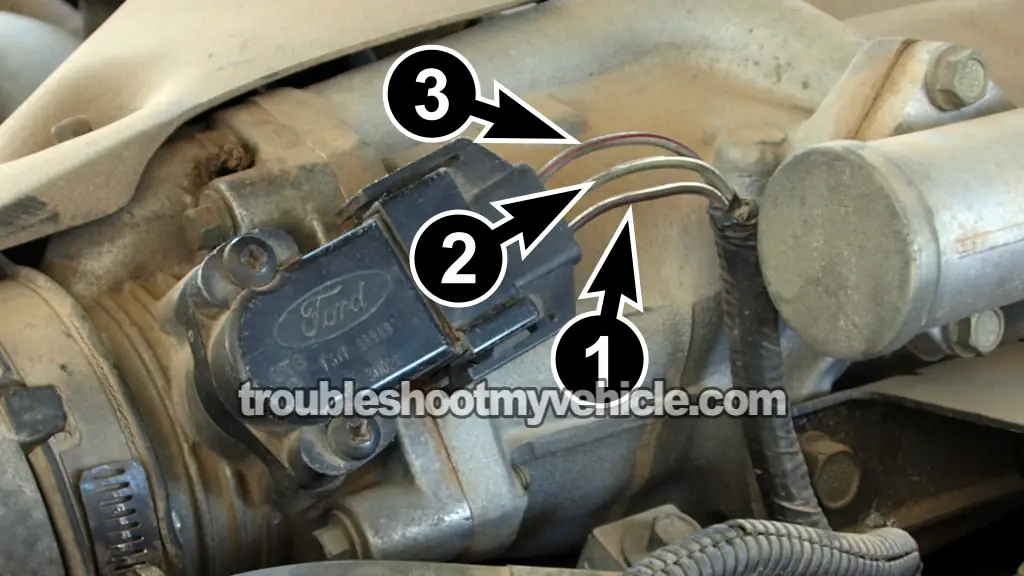
You can easily and quickly test the throttle position sensor on your 1991-1995 4.0L Ford Explorer or Aerostar.
All you need is a multimeter. No scan tool is required. In this tutorial, I'll show you how to test it in a step-by-step manner.
With your test results, you'll be able to say that the TPS is good or bad.
You can find the 1991-1995 4.0L Ford Ranger (Mazda B4000) TPS test here:
- How To Test The TPS (1991-1995 Ford Ranger And Mazda B4000) (at: easyautodiagnostics.com).
Contents of this tutorial:
ES  You can find this tutorial in Spanish here: Cómo Probar El Sensor TPS (1991-95 Ford 4.0L Explorer, Ranger, Aerostar) (at: autotecnico-online.com).
APPLIES TO: This tutorial applies to the following vehicles:
- 4.0L V6 Ford Aerostar: 1991, 1992, 1993, 1994, 1995.
- 4.0L V6 Ford Explorer: 1991, 1992, 1993, 1994, 1995.
OTHER TPS DIAGNOSTIC TUTORIALS:
- How To Test The TPS (1995-2000 4.0L V6 Ford Explorer, Aerostar, And Mercury Mountaineer).
- How To Test The TPS (1997-2001 4.0L V6 SOHC Ford Explorer And Mercury Moutaineer).
Symptoms Of A Bad Throttle Position Sensor
As you're probably aware, the accelerator pedal connects to the throttle plate via a cable.
As you step on the accelerator pedal, the throttle plate opens. With the engine running, this results in more air entering the engine.
As you step off the accelerator pedal, the throttle plate closes, and less air enters the engine.
The fuel injection computer on your 4.0L Ford needs to know how much the throttle plate opens (as you step on or off the accelerator pedal) to calculate a host of things to keep the engine running smoothly and optimally.
Since the TP sensor is a critical sensor for the engine management system, engine performance suffers when it fails.
These are some of the symptoms that you're going to see when the TP sensor fails:
- One of the following trouble codes lighting up the check engine light (CEL):
- 23: Throttle Position Sensor Out of Self-Test Range.
- 43: Throttle Position Sensor Below Idle Spec.
- 53: Throttle Position Sensor Above Maximum Voltage.
- 63: Throttle Position Sensor Below Minimum Voltage.
- 121: Closed Throttle Position Sensor Voltage Higher or Lower Than Expected.
- 122: Throttle Position Sensor Below Minimum Voltage.
- 123: Throttle Position Sensor Above Maximum Voltage.
- 124: Closed Throttle Position Sensor Voltage Higher Than Expected.
- 125: Closed Throttle Position Sensor Voltage Lower Than Expected.
- Hesitation when accelerating the engine.
- Lack of power.
- Bad gas mileage.
Where To Buy The TPS And Save
The following links will help you to comparison shop for the 1990-1994 4.0L Ford TPS. I think they'll save you a few bucks:


Disclosure: As an Amazon Associate, I earn from qualifying purchases. If my tutorials help you, using these links is an easy way to support the site at no extra cost to you. Thank you!
Not sure if the above TPS fits your particular 4.0L Ford Explorer (Aerostar)? Don't worry, once you get to the site they'll make sure it fits by asking you the specifics of your particular Ford vehicle. If it doesn't fit, they'll find you the right one.
TEST 1: Testing The TPS Voltage Signal
As I mentioned earlier, the TPS produces a voltage signal that corresponds to the position of the throttle plate.
To give you more details, the TPS produces a small voltage signal when the throttle plate is closed.
As the throttle plate opens, the TPS produces a higher voltage signal. When the throttle plate reaches its maximum wide open position, the TPS produces a voltage of about 4.5 Volts DC.
Generally, when the TPS fails, its voltage signal will not increase/decrease as you open/close the throttle plate.
In this test section, you'll confirm the performance of the TPS voltage signal.
NOTE: You'll need a multimeter to be able to test the throttle position sensor. If you don't have one, check out my recommendations here: Tekpower TP8268 AC/DC Auto/Manual Range Digital Multimeter (Amazon affiliate link).
NOTE: The TP sensor must remain connected to its electrical connector. You'll need to use a back probe or a wiring piercing probe to tap into the signal of the middle wire. To see what a wire piercing probe looks like and where to buy one, go here: Goupchn 4mm Banana to Banana Plug Test Leads Kit (Amazon affiliate link).
OK, let's start:
- 1
Place your multimeter in Volts DC mode.
- 2
Ground the black multimeter test lead on the battery negative (-) terminal.
- 3
Connect the red multimeter test lead to the GRY/WHT wire. I've labeled it with the #2 in the photo above.
NOTE: The TPS must remain connected to its 3-wire connector to read the TP voltage signal, so you'll need to back-probe the connector or use a wire-piercing probe on the GRY/WHT wire. - 4
Turn the key to the ON position but don't start the engine.
- 5
Your multimeter should report a voltage between 0.2 to 0.9 Volts DC with the throttle plate closed.
If your multimeter doesn't, don't worry about it just yet, continue with the other steps. - 6
Slowly open the throttle (by hand and from the engine compartment).
Voltage should increase: The voltage numbers should increase as the throttle plate opens.
This increase in voltage should be smooth and without any gaps or skips. Once the throttle is wide open, your multimeter should read somewhere between 3.5 to 4.5 Volts DC. - 7
Slowly close the throttle plate.
Voltage should decrease: As the throttle is closing, you should see the voltage decrease smoothly and without any gaps or skips, to the exact same voltage you noticed in step 3. - 8
Lightly tap on the throttle position sensor with the handle of a screw-driver (or something similar, and I want to emphasize the words ‘lightly tap’) as you slowly open and close the throttle and observe the multimeter.
If the TPS is bad, the tapping will cause the voltage numbers to skip or go blank. If the TPS is OK, the tapping will have no effect on the voltage numbers. - 9
Repeat step 8 several times to make sure of your multimeter test results.
Let's take a look at your test results:
CASE 1: The TPS signal voltage increased/decreased as you opened/closed the throttle plate. This is the correct test result. It tells you that the throttle position sensor IS NOT defective.
This test result also confirms that the TPS is getting both power and Ground from the fuel injection computer.
CASE 2: The TPS signal voltage DID NOT increase/decrease as you opened/closed the throttle plate. This test result usually tells you that the TPS is bad.
So that you can make sure the TPS is bad, you need to make sure it's getting power and Ground. Go to: TEST 2: Making Sure The TPS Is Receiving 5 Volts.
CASE 3: The multimeter DID NOT register any voltage. This test result doesn't condemn the TP sensor as bad just yet.
Why? Because the TP sensor may be missing either power or Ground. So your next step is to check that the TP sensor is getting power and Ground. Go to: TEST 2: Making Sure The TPS Is Receiving 5 Volts.
TEST 2: Making Sure The TPS Is Receiving 5 Volts
There's a good possibility that the TPS is not getting power if, in TEST 1, its voltage signal did not increase/decrease.
In this test section, you'll ensure that the brown with white stripe (BRN/WHT) wire of the TP sensor connector delivers 4.5 to 5 Volts DC.
In the photo above, I've labeled the BRN/WHT wire with the number 1.
You'll perform a simple multimeter voltage test to confirm the presence of 5 Volts in the BRN/WHT wire.
These are the test steps:
- 1
Disconnect the TP sensor from its connector.
- 2
Turn the key to the ON position but don't start the engine.
- 3
Select Volts DC mode on your multimeter.
- 4
Connect the black multimeter test lead to the negative (-) battery terminal.
- 5
With the red multimeter test lead, probe the female terminal that connects to the BRN/WHT wire.
The BRN/WHT wire is labeled with the number 1 in the photo above.
NOTE: Be careful not to damage the female terminal. - 6
The multimeter should display 4.5 to 5 Volts DC.
Let's interpret your test results:
CASE 1: Your multimeter registered 4.5 to 5 Volts. This is the correct and expected test result and it lets you know the TPS is getting power.
Your next and last step is to make sure the TPS is getting Ground. Go to: TEST 3: Making Sure The TPS Is Receiving Ground.
CASE 2: Your multimeter DID NOT register 4.5 to 5 Volts. Double check your connections and make sure that you're testing the correct wire.
If your multimeter still does not register 4.5 to 5 Volts, you can conclude the TPS is not receiving the power it needs to function.
These missing 5 Volts is usually due to an open-circuit problem in the wiring between the TP sensor harness connector and the PCM's harness connector. In the extreme of cases, the PCM has an internal problem (although this is very rare).
Although testing these two conditions is beyond the scope of this tutorial, you have now eliminated the throttle position sensor (TPS) as being the cause of the problem and/or the TP sensor diagnostic trouble code (DTC) lighting up the check engine light (CEL).
TEST 3: Making Sure The TPS Is Receiving Ground
If you've reached this point, you have:
- Confirmed that the TP sensor does not produce a voltage signal that increases/decreases when you open/close the throttle plate (TEST 1).
- Confirmed that the TP sensor receives 4.5 to 5 Volts (TEST 2).
Your next and last test is to make sure that the gray with red stripe (GRY/RED) wire delivers Ground to the TPS.
In the photo above, I've labeled the GRY/RED wire with the number 3.
You'll confirm or disprove the presence of Ground in the wire with a multimeter voltage test.
These are the test steps:
- 1
Disconnect the TP sensor from its connector.
- 2
Turn the key to the ON position but don't start the engine.
- 3
Select Volts DC mode on your multimeter.
- 4
Connect the red multimeter test lead to the positive (+) battery terminal.
- 5
With the black multimeter test lead, probe the female terminal that connects to the GRY/RED wire.
The GRY/RED wire is labeled with the number 3 in the photo above.
NOTE: Be careful not to damage the female terminal. - 6
The multimeter should display 10 to 12 Volts DC.
Let's interpret your test results:
CASE 1: Your multimeter registered 10 to 12 Volts. This is the correct and expected test result and it lets you know the TPS is getting Ground.
You can conclude that the TPS is bad and needs replacement if you have:
- Confirmed that the TP sensor is not producing a voltage signal that increases/decreases when you open/close the throttle plate (TEST 1).
- Confirmed that the TP sensor is receiving 4.5 to 5 Volts (TEST 2).
- Confirmed that the TP sensor is receiving Ground (this test section).
CASE 2: Your multimeter DID NOT register 10 to 12 Volts. Double check your connections and make sure that you're testing the correct wire.
If your multimeter still does not register 10 to 12 Volts, you can conclude the TPS is not receiving the Ground it needs to function.
This missing Ground is usually due to an open-circuit problem in the wiring between the TP sensor harness connector and the PCM's harness connector. In the extreme of cases, the PCM has an internal problem (although this is very rare).
Although testing these two conditions is beyond the scope of this article, you have now eliminated the throttle position sensor (TPS) as being the cause of the problem and/or the TP sensor diagnostic trouble code (DTC) lighting up the check engine light (CEL).
More 4.0L Ford Explorer And Aerostar Tutorials
You can find a complete list of 4.0L Ford Explorer and Aerostar tutorials in this index:
Here's a small sample of the tutorials you'll find in the index:
- How To Test The Fuel Pump (1993-2000 4.0L V6 Ford Explorer, Aerostar, And Mercury Mountaineer).
- How To Test Engine Compression (1991-2010 4.0L V6 Ford Explorer, Aerostar, And Mercury Mountaineer).
- How To Troubleshoot A No-Start Problem (1991-2010 4.0L V6 Ford Explorer, Aerostar, And Mercury Mountaineer).
- How To Test For A Blown Head Gasket (1991-2010 4.0L V6 Ford Explorer, Aerostar, And Mercury Mountaineer).

If this info saved the day, buy me a beer!