

OBD II trouble code P0117 ECT Sensor Circuit Low Voltage is telling you that your 4.0L equipped Ford vehicle's fuel injection computer is seeing a continuous engine coolant temperature of 250°F (121°C) or higher.
The two most common causes of a P0117 trouble code is either a bad ECT sensor or a short in the sensor's wires. In this tutorial, I'm gonna' help you troubleshoot this diagnostic trouble code (DTC) in a step-by-step way.
If a trouble code P0118 is stored in your Ford's PCM's memory, the following tutorial will help:
Contents of this tutorial:
- Symptoms Of A P0117 Diagnostic Trouble Code.
- P0117 -What Does This Code Really Mean?
- How The ECT Sensor Works.
- Common Causes Of A P0117 Trouble Code.
- START HERE: Troubleshooting DTC P0117.
- TEST 1: Checking The Engine Coolant Temperature Value.
- TEST 2: Checking The Condition Of The ECT Sensor's 2 Wires.
- TEST 3: Disconnecting The ECT Sensor From Its Connector.
- TEST 4: Checking The Temperature With The Key On Engine Running.
- More Test Tutorials.
ES  You can find this tutorial in Spanish here: Cómo Probar El Sensor ECT -Código P0117 (4.0L Ford) (at: autotecnico-online.com).
APPLIES TO: This tutorial applies to the following vehicles:
- 4.0L V6 Ford Aerostar: 1996, 1997.
- 4.0L V6 Ford Explorer: 1996, 1997, 1998, 1999, 2000, 2001, 2002, 2003.
- 4.0L V6 Mercury Mountaineer: 1998, 1999, 2000, 2001, 2002, 2003.
Symptoms Of A P0117 Diagnostic Trouble Code
Since the fuel injection computer needs to know the engine's temperature, via the engine coolant temp (ECT) sensor, when it sees the wrong temperature, your Ford is gonna' have a hard time playing ball.
You may see one or more of the following symptoms when the engine coolant temperature (ECT) sensor fails:
- Check engine light (CEL) is on.
- DTC P0117 is present.
- Won't pass the state mandated emissions test.
- Gas mileage will suffer.
- Hard start and/or extended cranking time (after shut off).
- Black smoke coming out of the tailpipe.
Let's find out what are the common causes of a P0117 DTC, in the next subheading.
P0117 -What Does This Code Really Mean?
In a nutshell, when a code P0117 ECT Sensor Circuit Low Voltage lights up the check engine light (CEL), the PCM is letting you know that it sees a continuous engine coolant temperature of 250°F (121°C) or hotter.
To give you more specifics, the PCM sees this extremely hot temperature as soon as you start your Ford (whose engine is cold) and thru' out the entire time you're driving. The PCM sees this hot temp not because the engine is really overheating, but due to a problem with the sensor or its circuits.
Why is the engine coolant temperature so important for the fuel injection computer? This is due the fact that the colder the engine is, the more fuel the fuel injection computer (known as the PCM = Powertrain Control Module) needs to inject. The warmer the engine is, the less fuel the PCM is needs to inject.
So when the PCM gets the wrong engine coolant temperature, it can no longer control fuel injection to maximize performance and decrease emissions.
How The ECT Sensor Works
Knowing the basics of the engine coolant temperature (ECT) sensor will help diagnose the P0117 ECT Sensor Circuit Low Voltage trouble code lighting up the check engine light.
Briefly, this is how the engine coolant temperature (ECT) sensor works:
- The engine coolant temperature (ECT) sensor is a 2-wire sensor.
- One wire (circuit) supplies power.
- Power is in the form of 5 Volts DC and is provided only with Key On Engine Off (KOEO) or Key On Engine Running (KOER).
- Power is provided by the PCM.
- The other wire (circuit) supplies Ground.
- This Ground is fed to the ECT sensor by the PCM (internally).
- One wire (circuit) supplies power.
- The ECT sensor is a resistor (thermistor). Its resistance changes in response to changes in the engine coolant's temperature.
- The cooler the engine coolant, the higher the resistance of the ECT sensor.
- The warmer the engine coolant, the lower the resistance of the ECT sensor.
- When the 5 Volts pass through the engine coolant temperature (ECT) sensor, the resistance of the sensor produces a voltage drop. This in plain English means that only a certain amount of the 5 Volts are let through to the Ground wire.
- The cooler the engine coolant is, the less voltage is let thru' onto the Ground wire (due to the ECT sensor's higher resistance).
- The amount of voltage that doesn't make it thru is the voltage drop.
- The PCM translates this higher voltage drop into a colder temperature value.
- The warmer the engine coolant, the more voltage is let thru' onto the Ground wire (due to the ECT sensor's lower resistance).
- The PCM translates this lower voltage drop into a warmer/hotter temperature value.
- The cooler the engine coolant is, the less voltage is let thru' onto the Ground wire (due to the ECT sensor's higher resistance).
- The following chart shows the temperature-resistance relationship:
| Temperature | Resistance (K Ω) |
Voltage Drop |
|---|---|---|
| 50° F (10° C) | 58.75 Ω | 3.51 Volts DC |
| 68° F (20° C) | 37.30 Ω | 3.07 Volts DC |
| 86° F (30° C) | 24.27 Ω | 2.60 Volts DC |
| 104° F (40° C) | 16.15 Ω | 2.13 Volts DC |
| 122° F (50° C) | 10.97 Ω | 1.7 Volts DC |
| 140° F (60° C) | 7.70 Ω | 1.33 Volts DC |
| 158° F (70° C) | 5.37 Ω | 1.02 Volts DC |
| 176° F (80° C) | 3.84 Ω | 0.78 Volts DC |
| 194° F (90° C) | 2.80 Ω | 0.60 Volts DC |
| 212° F (100° C) | 2.07 Ω | 0.46 Volts DC |
Common Causes Of A P0117 Trouble Code
The 2 most common cause of trouble code P0117 are:
- A bad engine coolant temperature (ECT) sensor.
- A problem in the sensor's 2 wires. Usually a short-circuit.
Although extremely rare for this to happen, a bad PCM can also cause a false P0117 trouble code.
In this tutorial, I'll help you troubleshoot all three of the above. With this basic info under our belts, let's turn the page and get testing!
START HERE: Troubleshooting DTC P0117
The key to diagnosing and repairing trouble the P0117 ECT Sensor Circuit Low Voltage trouble code is remembering that your Ford's PCM thinks that the engine coolant temperature is at 250°F (121°C) or higher all of the time (even at start up when the engine is completely cold).
Fortunately, you and I can test the engine coolant temperature (ECT) sensor with a scan tool that's Live Data equipped.
Now, if you don't have a scan tool with Live Data capability and need to buy one, check out my recommendation here: Actron CP9580 Scan Tool Review.
Here's a brief description of the tests you'll be doing with the help of this tutorial:
- Confirm the ECT sensor's temperature value.
- Using the scan tool, we'll see if the ECT sensor is reporting a temp that's 250°F (121°C) or higher.
- TEST 1: Checking The Engine Coolant Temperature Value.
- Check that the ECT sensor connector's wiring is not shorted together.
- This involves removing the hard plastic protector that's over the wires and inspecting the condition of the two ECT sensor wires.
- We'll also do a wiggle test of the ECT sensor's 2 wires.
- TEST 2: Checking The Condition Of The ECT Sensor's 2 Wires.
- Unplugging the ECT sensor and verifying the PCM sees an extreme cold temperature.
- In this test step, we'll unplug the ECT sensor from its connector and then, via the scan tool's Live Data mode, see if the PCM now reads -4 °F (-20 °C).
- This test will help you to eliminate a bad PCM and/or a hidden electrical short somewhere in the wiring between the PCM and ECT sensor.
- TEST 3: Disconnecting The ECT Sensor From Its Connector.
- Testing the ECT sensor with the engine running.
- In this test step, we'll see if the ECT sensor can report a rising coolant temperature as the engine idles and warms up.
- TEST 4: Checking The Temperature With The Key On Engine Running.
TEST 1: Checking The Engine Coolant Temperature Value

Since the PCM sees the ECT sensor reporting an engine coolant temperature of 250°F (121°C) or higher as the reason for setting trouble code P0117 ECT Sensor Circuit Low Voltage, the first thing we'll do is use our scan tool to visually confirm this high temperature.
On our scan tool, the PID (Parameter Identification) that will let us see what temperature the PCM is seeing, is labeled as: COOLANT (see the photo in the image above).
If you don't have a scan tool and you need to buy one, check out my Actron CP9580 Scan Tool Review.
IMPORTANT: Start this test with a completely cold engine. Starting out with a cold engine will ensure the accuracy of your test results.
OK, this is what you need to do:
- 1
Connect your scan tool to your Ford and turn the key to the on position.
NOTE: This test is done with the Key On Engine OFF (KOEO). - 2
Go to its Live Data mode once the scan tool has powered up.
Scroll down to the PID labeled COOLANT (°F). - 3
The COOLANT PID should register a temperature that's ±10 °F of ambient temperature (if all is normal)
So let's say that it's 50 °F outside, then the ECT sensor PID should register something between 40 to 60 °F. - 4
You'll see one of three possible temperature results:
- -4°F (-20°C).
- OR
- 250 to 300°F (-121 to -150°C).
- OR
- The current outside coolant temperature.
Let's interpret your test results:
CASE 1: Your scan tool shows a 250-300°F reading. This high temperature (when the engine is completely cold) confirms that there's a problem with the ECT sensor or its circuits.
Also, this test result tell us that the P0117 ECT Sensor Circuit Low Voltage Input code stored in the PCM's memory is reporting a real problem.
The most likely cause will be that the ECT sensor circuits (wires) are shorted together or the sensor has failed (internally).
The next step is to physically check the condition of the wires and do a simple wiggle test. Go to: TEST 2: Checking The Condition Of The ECT Sensor's 2 Wires.
CASE 2: Your scan tool shows a -4 °F (-20°C) reading. This confirms that you do have a problem with the engine coolant temperature (ECT) sensor or its circuits.
Seeing an extreme cold temperature of -4 °F (-20°C) indicates one of two things, either that the ECT sensor is bad or the ECT sensor connector's wires have an open-circuit problem (think unplugged sensor). You'll also see a diagnostic trouble code P0113 (ECT Sensor Circuit High Voltage) stored in the PCM's memory.
CASE 3: Your scan tool shows a temperature reading that's ±10 °F of ambient temperature. This tells you that at the moment the ECT sensor and its circuits are OK and more importantly, that the problem is intermittent.
But, since your scan tool retrieved a DTC P0117 the problem may just be hiding at the moment, I recommend doing the next three tests in this tutorial. Go to: TEST 2: Checking The Condition Of The ECT Sensor's 2 Wires.
If the ECT sensor passes TEST 2, continue on to TEST 3 and TEST 4 (or until one test is failed).
TEST 2: Checking The Condition Of The ECT Sensor's 2 Wires
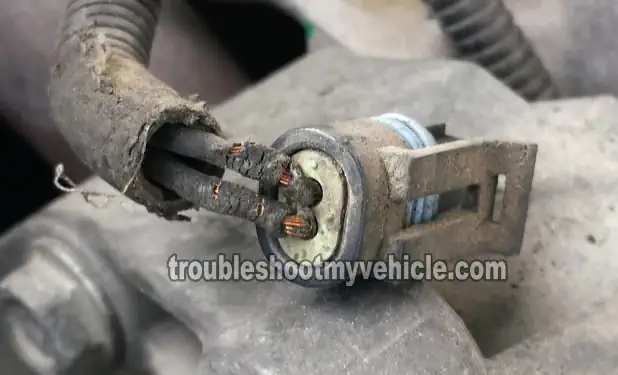
In about half the cases, in which the PCM registered a P0117 ECT Sensor Circuit Low Voltage Input, the 2 ECT sensor's wires were shorted together.
What I saw was the insulation of the wires had fallen off, exposing the copper. Eventually these 2 wires touched and shorted together.
The example of the connector, in the photo above, highlights this type of problem (although it's not the ECT sensor's connector).
You don't have to check the entire length of the wiring between the PCM and ECT sensor connector, just the length nearest to the ECT sensor's connector (about 6 inches away from ECT sensor's connector).
OK, this is what you need to do:
- 1
Remove the hard plastic protector that's over the wires.
You need to expose the ECT sensor's wires starting from the connector to about 6 inches away (from the connector). - 2
Check for dry-rot and/or insulation peeling off the 2 ECT sensor wires.
The most likely place you'll find this condition (dry-rot and/or insulation peeling off) is right near the ECT sensor's connector. - 3
Reconnect the sensor and have a helper wiggle the 2 ECT sensor wires while you observe the ECT sensor's PID labeled COOLANT (on your scan tool).
What you're looking for is to see if wiggling the wires has any effect on the temperature reported on your scan tool.
Let's interpret your test results:
CASE 1: The wires have dry-rot and/or insulation peeling off. This is probably the reason behind the P0117 lighting up the check engine light (CEL) on your Ford.
Your next step is to replace the engine coolant sensor's connector or repair/replace the affected wires.
After the repair, road test your Ford to make sure the P0117 DTC doesn't come back.
CASE 2: Wiggling the 2 ECT sensor wires caused a change in the temperature reading. This test result tells you that the wires do have a problem.
You need to carefully inspect the connector and the 2 wires and replace and/or repair what is damaged or shorted.
To give you some more specifics: Gently wiggling the ECT sensor connector's 2 wires should have no effect on the ECT sensor reading displayed on the scan tool, unless the connector is bad or one of the wires has an ‘open’. Since wiggling the connector did have an effect, you now know that replacing the ECT sensor connector or repairing the problem in the wires will solve the ECT sensor and P0117 Code problem.
CASE 3: The wires DO NOT HAVE dry-rot and ARE NOT shorted together and wiggling the ECT sensor connector's wires DID NOT cause the temperature to change. This tells you that the ECT sensor connector and its wires are OK.
This test result also tells you that the ECT sensor is the one that's malfunctioned and needs to be replaced. Before you do, I suggest one more test.
And this is to test to make sure that the PCM is not fried. This is a very simple test and it requires that you disconnect the ECT sensor from its connector and then checking, with your scan tool in Live Data mode, that the engine coolant temperature (ECT) sensor's PID is now reading -4 °F (-20°C).
For this test, go to: TEST 3: Disconnecting The ECT Sensor From Its Connector.
TEST 3: Disconnecting The ECT Sensor From Its Connector
In this test, I'm gonna' ask you to disconnect the ECT sensor (from its connector) and then see if the PCM registers an ECT temperature of -4 to -46°F (-20 to -43°C) on your scan tool.
The purpose of this test is to see make sure the PCM isn't fried and falsely accusing the ECT sensor as having failed.
It's rare for the PCM to go bad and falsely accuse the ECT temp sensor but, it does happen and we need to eliminate this possibility.
Also, the ECT sensor's wiring may have an electrical short, between the PCM and ECT sensor, that could fool the PCM into thinking the ECT sensor is bad. We can test these two possibilities with a very simple test.
OK, here's what you'll need to do:
- 1
Check the current COOLANT value on your scan tool's display.
- 2
Have a helper disconnect the ECT sensor from its connector (while you observe the ECT sensor's PID on your scan tool).
- 3
PID COOLANT should now read somewhere between -4 to -46°F (-20 to -43°C) for the engine coolant temperature (ECT) sensor reading.
- You'll also see DTC P0118.
CASE 1: The PID labeled COOLANT registered -4 to -46°F (-20 to -43°C) and TEST 1 showed you an ECT sensor temp of 250-300°F reading. This test result tells you that the wiring between the PCM and ECT sensor connector is OK and that the PCM is not fried.
You have now confirmed 3 very important things:
- That the PCM is seeing an extreme cold temperature around 250 to 300°F (TEST 1).
- That there are no shorts in the sensor's wiring or in its connector (TEST 2).
- That the PCM is OK (TEST 3).
Therefore, you can confidently conclude that the ECT sensor is bad and needs to be replaced.
CASE 2: The PID labeled COOLANT registered -4 to -46°F (-20 to -43°C) and in TEST 1 the ECT sensor temp reading was normal. This test result tells you that the wiring between the PCM and ECT sensor connector is OK and that the PCM is not fried.
Now, since in TEST 1 your scan tool showed that the ECT sensor is behaving normally, your next test is TEST 4. Go to: TEST 4: Checking The Temperature With The Key On Engine Running.
CASE 3: The PID labeled COOLANT DID NOT register -4 to -46°F (-20 to -43°C). Make sure that you're testing the correct wires, that your connections are OK, and repeat the test.
Then this tells you that you have a problem in the wiring between the ECT sensor and the PCM or that the PCM is fried (although a bad PCM is rare).
Although testing the wiring between the PCM and the ECT sensor is beyond the scope of this tutorial, you now have eliminated the ECT sensor as the source of the P0117.
TEST 4: Checking The Temperature With The Key On Engine Running
You're here because TEST 1, TEST 2 and TEST 3 show the ECT sensor behaving normally and without problems in the sensor's circuits.
There's a good chance, that once the engine warms up, the sensor could start malfunctioning, so in this test you'll start the engine and let it warm up and make sure that the coolant temperature your scan tool is reporting actually rises.
This is what you need to do:
- 1
Check and take note of the coolant temperature your scan tool is displaying.
The coolant temperature that your scan tool is showing, should be at or around ambient temperature.
Now, touch the upper radiator hose with your hand. The hose will be cool to cold (ambient temperature). - 2
Start the engine and let it warm up.
As the engine runs, keep your eyes on the engine coolant's temperature (on your scan tool). The temperature displayed should rise.
Every now and then, recheck the temperature of the upper radiator hose. It should still be cool to the touch. - 3
Once the coolant temperature has reached 190° F, check the temperature of the upper radiator hose by lightly touching it with your hand.
The hose should now be hot to the touch since at 190° F the thermostat opens and lets hot coolant start to flow to the radiator. OK, let's interpret your test results below:
CASE 1: The coolant temperature displayed by your scan tool rose. This tells you that the engine coolant temperature (ECT) sensor is working correctly and that the ECT sensor problem, causing the ECT sensor code, is intermittent.
Here's why: In this test step, we've used the opening of the thermostat, which occurs at 190 to 195° F as a cross reference source for the temp sensor's accuracy.
Although this test is not 100% accurate, it is a good indicator of the ECT sensor's performance.
CASE 2: The coolant temperature displayed by your scan tool jumped between one negative number to a positive number (for example -30° F to 240° F). This confirms a malfunction with the engine coolant temperature (ECT) sensor. Replace the ECT sensor.
More Test Tutorials
If this tutorial was helpful/informative, you can find a complete list of tutorials for your 4.0L Ford Explorer, Aerostar and Mercury Mountaineer in this index:
Here's a sample of the tutorials you'll find there:
- How To Test For A Blown Head Gasket (1991-2010 4.0L V6 Ford Explorer, Aerostar, And Mercury Mountaineer).
- How To Test The Fuel Pump (1993-2000 4.0L V6 Ford Explorer, Aerostar, And Mercury Mountaineer).
- How To Test Engine Compression (1991-2010 4.0L V6 Ford Explorer, Aerostar, And Mercury Mountaineer).
- How To Bench Test A Starter Motor (Step By Step) (at: easyautodiagnostics.com).

If this info saved the day, buy me a beer!


