
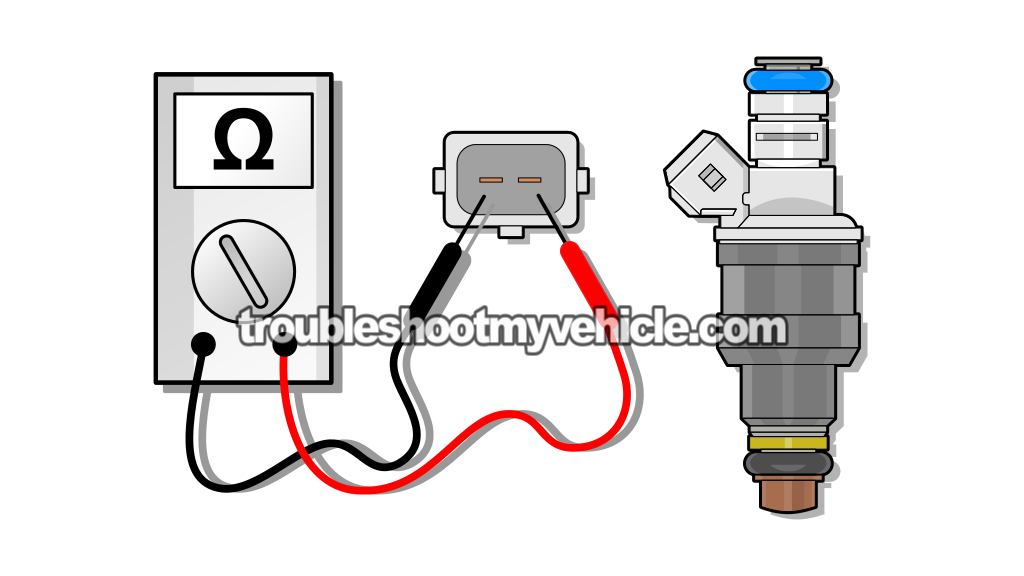
The fuel injectors on your 1996-1999 3.0L V6 (OHV) Ford Taurus or Mercury Sable are hard-working electromechanical valves that are going to wear out sooner or later.
For the most part, when a fuel injector fails, it's going to stop injecting fuel. You and I can easily check its internal resistance to see if an electrical problem has caused the injector to stop injecting fuel.
In this tutorial, I'm going to show you how to check the internal resistance of all six fuel injectors without having to remove the upper intake manifold plenum to test the injectors for cylinders 1, 2, and 3.
With your test results, you'll quickly and easily find out if you have a fuel injector with either an internal short-circuit or an open-circuit problem that's keeping it from spraying fuel. I'm also going to explain a fuel injector diagnostic strategy you can use to figure out if you've got a clogged fuel injector on your hands.
Contents of this tutorial:
- Symptoms Of A Defective Fuel Injector.
- Where To Buy The Fuel Injector.
- Testing The Fuel Injector Resistance.
- Checking The Injector's Resistance Directly At Its Terminals.
- The Intake Manifold Plenum Has To Be Removed.
- How To Find The Bad Or Clogged Fuel Injector.
- More 3.0L V6 Ford Taurus Diagnostic Tutorials.
ES  You can find this tutorial in Spanish here: Cómo Probar Los Inyectores De Combustible (1996-1999 3.0L V6 Ford Taurus, Mercury Sable) (at: autotecnico-online.com).
APPLIES TO: This tutorial applies to the following vehicles:
- 3.0L V6 (OHV) Ford Taurus: 1996, 1997, 1998, 1999.
- 3.0L V6 (OHV) Mercury Sable: 1996, 1997, 1998, 1999.
FUEL INJECTOR CIRCUIT DIAGRAMS:
- Fuel Injector Circuit Wiring Diagram (1996-1997 3.0L V6 Ford Taurus, Mercury Sable).
- Fuel Injector Circuit Wiring Diagram (1998-1999 3.0L V6 Ford Taurus, Mercury Sable).
FUEL INJECTOR SPRAY TEST:
Symptoms Of A Defective Fuel Injector
As you're probably already aware, each cylinder in your Ford Taurus or Mercury Sable's 3.0L V6 engine needs three things to run: fuel, air, and spark. If any one of these is missing, that cylinder's going to misfire.
So when one or more fuel injectors fail, you're going to see one or more of the following engine performance issues:
- Rough idle.
- Lack of power when you accelerate your Ford on the road.
- If your Ford Taurus comes equipped with OBD2, you'll see one of the following trouble codes.
- P0300: Random Cylinder Misfire.
- P0301: Cylinder #1 Misfire.
- P0302: Cylinder #2 Misfire.
- P0303: Cylinder #3 Misfire.
- P0304: Cylinder #4 Misfire.
- P0305: Cylinder #5 Misfire.
- P0306: Cylinder #6 Misfire.
When fuel injectors fail, they usually fail for one of the following reasons:
- The internal coil winding (of the fuel injector) suffers a short-circuit or an open-circuit. When this happens, the fuel injector will stop injecting fuel completely.
- The fuel injector becomes clogged and does not atomize the fuel correctly or doesn't inject enough fuel.
- The fuel injector does not activate because it's not getting either power or activation signal from the fuel injection computer.
- The fuel injector comes on and stays on due to a short in the wiring for a defective fuel injection computer.
In this tutorial, we're going to focus on testing the internal coil winding of the fuel injectors to see if they are in a short-circuit or open-circuit state. Testing for a clogged fuel injector isn't hard and I'll offer you some suggestions.
Where To Buy The Fuel Injector
When you're ready to replace the fuel injector on your Ford Taurus or Mercury Sable, I want to recommend the following automotive brands. These are brands I've used my entire automotive repair career, and I don't hesitate to recommend them:

Disclosure: As an Amazon Associate, I earn from qualifying purchases. If my tutorials help you, using these links is an easy way to support the site at no extra cost to you. Thank you!
NOTE: Not sure if the fuel injectors fit your particular Ford Taurus or Mercury Sable? Don't worry. Once you get to the site, they'll ask you for the specifics of your vehicle and check to see if the part fits. If it doesn't, they'll find the right one for you.
Testing The Fuel Injector Resistance
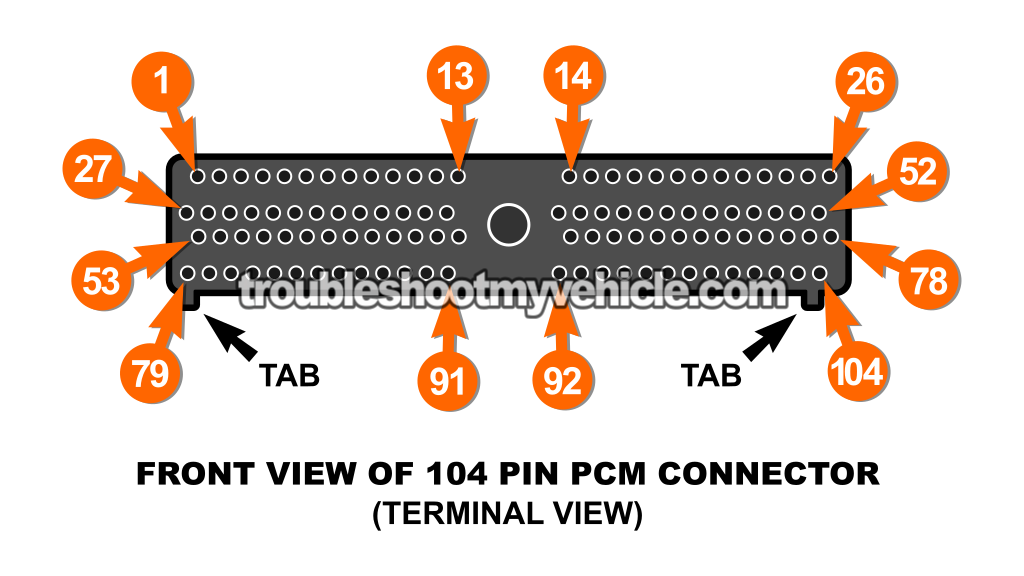
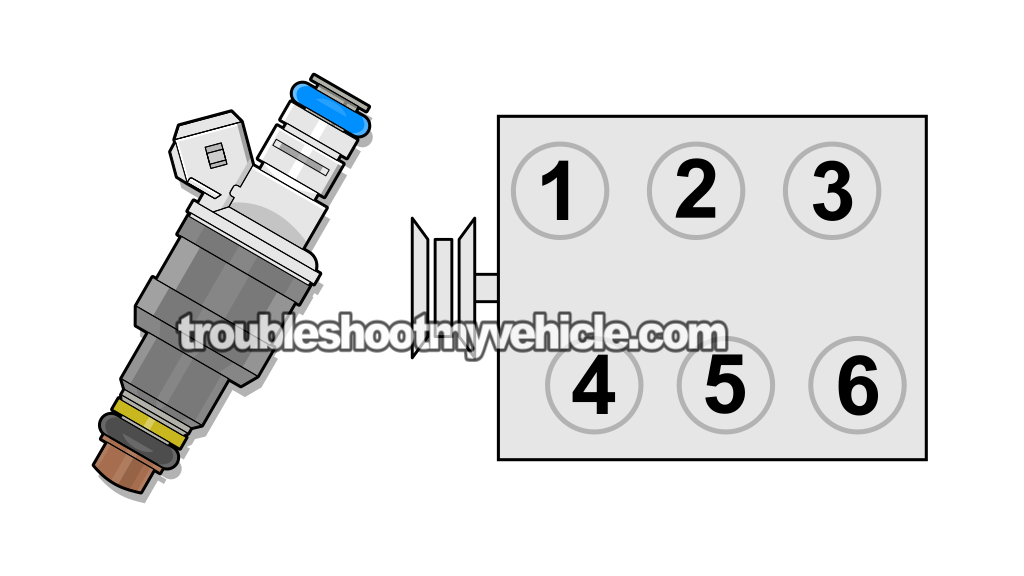
To check the internal resistance of all six fuel injectors —including the ones under the intake manifold plenum— we're going to do the test right from the PCM's 104-pin connector. This lets us check all six without removing the plenum.
To be a bit more specific, we're gonna disconnect the PCM from its 104-pin connector and check the resistance of the entire fuel injector circuit from there.
This is a super easy test to do, but you do need to take a few precautions —mainly using specialized multimeter test probes to probe the PCM connector's female terminals safely. Standard multimeter leads are usually too thick and could damage them (the female terminals of the PCM connector). You can find out more about this in the guide I've written: How To Safely Probe The PCM Connector -Without Damaging It (1991-2007 3.0L V6 Ford Taurus, Mercury Sable).
We're looking for two specific issues:
- Good fuel injector: The injector's resistance —and its circuit— will be between 11 and 18 Ohms.
- Bad fuel injector: The multimeter will either report an open-circuit or short-circuit problem, or a resistance value that's not within the specification.
NOTE: If you don't have a multimeter or you need to upgrade the one you've got, this is the one I use and recommend: Tekpower TP8268 AC/DC Auto/Manual Range Digital Multimeter (Amazon affiliate link).
OK, let's get going:
- 1
Disconnect the battery's negative cable and leave it disconnected for the entire test.
NOTE: This step is important. Don't move on to the next step without first disconnecting the negative battery cable from the battery. - 2
Disconnect the PCM from its 104-pin connector.
- 3
Set your multimeter to Ohms mode.
- 4
With your multimeter test leads —and the appropriate tool— probe between the following female terminals of the 104-pin PCM connector:
- Injector 1: Pins 75 and 71.
- Injector 3: Pins 74 and 71.
- Injector 5: Pins 73 and 71.
- Injector 2: Pins 101 and 71.
- Injector 4: Pins 100 and 71.
- Injector 6: Pins 99 and 71.
NOTE: Use the connector pinout above to locate VPWR (pin 71) and the injector pins.
- 5
Write the resistance value down on a piece of paper, and make sure you note which injector that value belongs to.
- 6
Your multimeter should report a resistance between 11 and 18 Ohms for each injector circuit.
If the meter shows an open-circuit, a short-circuit, or a resistance outside the 11–18 Ohm range, that injector circuit is bad.
Let's analyze your multimeter test results:
CASE 1: The fuel injector circuit resistances are within the indicated specification. This is the correct and expected test result, and it lets you know that both the fuel injector and the wiring between the injector and the PCM are in good shape.
Now, if you're dealing with a cylinder misfire issue and you still suspect you've got a clogged fuel injector —after all, this resistance test doesn't check for a clogged injector— head over to: How To Find The Bad Or Clogged Fuel Injector.
CASE 2: One or more fuel injector circuits did not register the indicated resistance specification. This test result tells you that you have an issue either with the fuel injector itself or the wiring between the fuel injector and the PCM. Now, don't worry. The most likely cause of this failed test result is usually a bad fuel injector.
Your next step is to check the resistance directly at the fuel injector's two male spade terminals. Depending on the injector's location, you may or may not have to remove the intake manifold plenum. For more information on your next step, head over to: Checking The Injector's Resistance Directly At Its Terminals.
Checking The Injector's Resistance Directly At Its Terminals
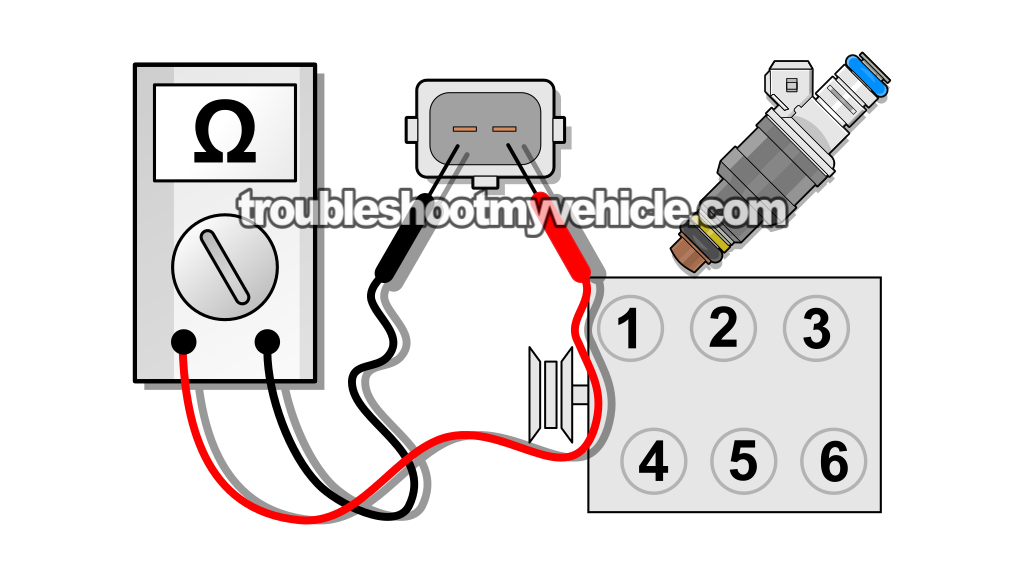
If in your initial resistance test (at the PCM connector) you got one or more fuel injector circuits that didn't pass it, more than likely your multimeter reported one of the following readings:
- The resistance is infinite Ohms, which tells us there's an open-circuit problem.
- The resistance is 0 Ohms, which tells us there's a short-circuit problem.
- The resistance isn't within specification, but it's not a straight open or short-circuit issue. It's just out of range.
These issues could be caused by the injector itself or an electrical issue with the wires between the fuel injector and the PCM connector. So, our next step now is to:
- Inspect the condition of fuel injector's connector and the 2 wires coming out of it.
- A common failure point is right at the fuel injector connector. Usually, the insulation of the wires peels off where the wires exit the connector. When that happens, the copper strands get exposed and they'll short together.
- Check the resistance directly at the injector's two terminals.
- The fuel injector itself may have suffered an internal electrical issue —honestly, it's usually the most likely cause of the failed test result you got at the PCM connector.
Now, here's what complicates things. Three of the fuel injectors are located underneath the intake manifold plenum. These are the injectors for Bank 1 (cylinders 1, 2, and 3), and they're on the side of the engine that faces the firewall. Since they're under the plenum, you've got to remove the plenum to check the resistance directly at their terminals (and the wires coming out of their connectors).
Now, if you do have a fuel injector circuit that didn't pass the resistance test (at the PCM connector) and it's for cylinders 1, 2, or 3, then take a look at the following section: The Intake Manifold Plenum Has To Be Removed.
The Intake Manifold Plenum Has To Be Removed
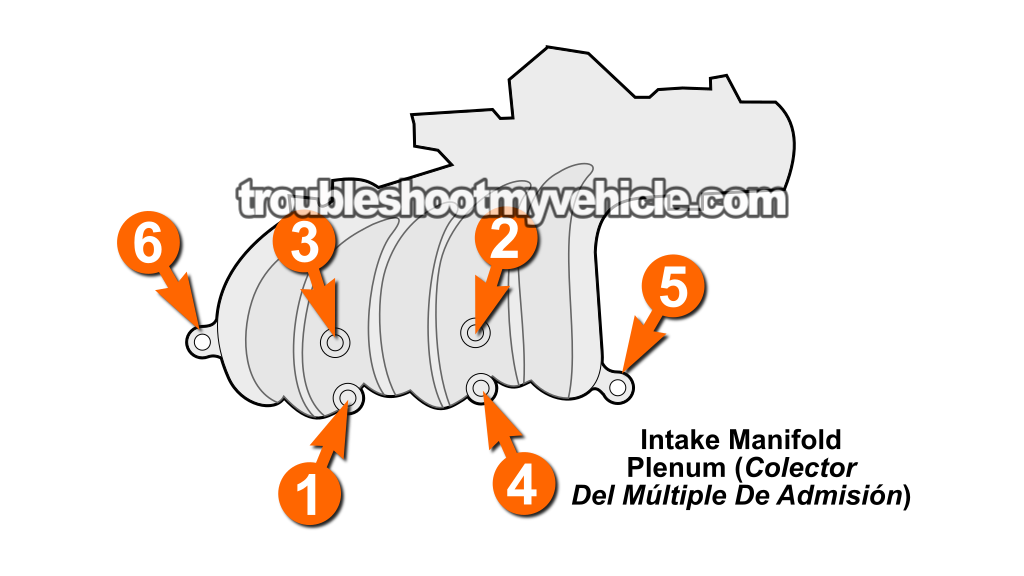
If you do get to the point in your diagnostic process where you need to check the resistance directly at the fuel injector terminals for cylinders 1, 2, and 3, which are located underneath the intake manifold plenum, I want to point out a few important precautions to take so that you can avoid any complications or headaches:
- Once you've removed intake manifold plenum, place clean shop towels over the exposed lower intake manifold ports. You want to make sure that nothing (like a bolt or a washer or any other metal component) falls into them as you're performing the fuel injector resistance tests.
- As you're removing bolts (or nuts), place them in a container that's located away from the engine compartment.
- Use new gaskets and install them dry. In other words, don't use any type of sealant on the gaskets when reinstalling the intake manifold plenum.
If anything falls into any one of the 6 ports of the lower intake manifold, and you start the engine -you're gonna' be in a world of hurt. The only way to remove whatever fell into the engine is to remove the cylinder head (or heads). Also, the engine can suffer piston or cylinder head valve damage as the metal object bounces around the cylinder.
How To Find The Bad Or Clogged Fuel Injector
At first glance, it seems like diagnosing a bad or clogged fuel injector is an impossible task, especially since 3 of the 6 injectors are under the intake manifold plenum.
Not only that, but so many different issues can cause the 3.0L V6 engine in your Ford Taurus or Mercury Sable to suffer a cylinder misfire.
But let me tell you, pinpointing a bad or clogged fuel injector that's causing a cylinder misfire isn't that difficult —especially if you have a diagnostic strategy.
In this section, I'm going to share with you the diagnostic strategy that I've used my entire automotive repair career. It's going to help you quickly and easily figure out if you do have a bad or clogged fuel injector —or if something else is causing the cylinder misfire issue you're troubleshooting.
OK, this is the step-by-step of what I do.
- Identify the dead cylinder:
- Since the 1996-1999 Ford Taurus or Mercury Sable is equipped with OBD2 diagnostics, you can just connect a code reader or scan tool to see if you have a specific cylinder misfire trouble code.
- You can also perform a manual cylinder balance test to figure out which cylinder is the dead one.
- Make sure that the dead cylinder is getting spark:
- This involves making sure that the spark plug wire that delivers spark to the dead cylinder is sparking with a spark tester. This tutorial will help with those checks: How To Test The Ignition Coil Pack (1996-2000 3.0L V6 Ford Taurus, Mercury Sable).
- Closely inspect the spark plug wire for its entire length and its boot; you need to make sure it's not damaged in any shape, form, or way.
- Remove the spark plug and inspect it closely to make sure it's not damaged in any way, shape, or form.
- Check that the spark plug boot and the spark plug's porcelain insulator aren't covered in carbon tracks. You can find out more about carbon tracks in this real-life case study: Carbon Tracks Are A Common Cause Of Ignition Misfires (at: easyautodiagnostics.com).
- Check that the dead cylinder has good compression:
- Low or zero compression in the dead cylinder will cause a cylinder misfire.
- The compression test is probably one of the most overlooked diagnostic tests when diagnosing a cylinder misfire, but it's super important not to skip it.
- You can learn how to do and interpret the compression test in this step-by-step how-to tutorial: How To Do And Interpret An Engine Compression Test (1990-2007 3.0L V6 Ford Taurus, Mercury Sable).
- Check the internal resistance of the dead cylinder's fuel injector:
- Once I've eliminated all of the other usual suspects —which are lack of spark and lack of compression— then I check the fuel injector's internal resistance.
- If the resistance isn't within specification, then I've found the source of the cylinder misfire issue I'm troubleshooting.
- Check the fuel injector's spray pattern:
- If the injector's resistance is within specification and it has good compression and it's getting spark, then my next step is to remove the fuel injector and check its spray pattern with a DIY fuel injector tool.
- This DIY fuel injector cleaner kit lets me connect the fuel injector, after removing it, thru a hand-held adapter to a can of brake cleaner spray and physically see if it sprays or not.
- If the fuel injector does spray, I make sure that it's spraying in a conical pattern and not just squirting fuel out.
- You can check this tool out here: Universal Fuel Injector Tester and Cleaner Tool Kit (Amazon affiliate link).
- This tutorial will walk you thru how to check the fuel injector spray pattern: Fuel Injector Spray Test (1990-2007 3.0L V6 Ford Taurus, Mercury Sable).
The key thing to remember here is that this diagnostic strategy is simply a process of elimination that begins with identifying the dead cylinder.
Once you know which cylinder of all six is dead, the next step is to make sure it's getting spark, fuel, and that it has good compression. Whatever component is causing any one of these three things to be missing is the component that's bad and needs to be replaced.
The beauty of this diagnostic process is that it eliminates a lot of guesswork and helps you zero in on the exact cause of the cylinder misfire. That way, you're not going to be spending money on parts that won't solve the issue.
More 3.0L V6 Ford Taurus Diagnostic Tutorials
You can find a complete list of 3.0L V6 Ford Taurus and Mercury Sable tutorials in this index:
Here's a sample of the tutorials you'll find in the index:
- How To Test The CKP Sensor (1996-1999 3.0L V6 Ford Taurus, Mercury Sable).
- How To Test The MAF Sensor (1996-1999 3.0L V6 Ford Taurus, Mercury Sable).
- How To Test For A Blown Head Gasket (1990-2007 3.0L V6 Ford Taurus, Mercury Sable).
- How To Test The Fuel Pump (1990-2000 3.0L V6 Ford Taurus, Mercury Sable).

If this info saved the day, buy me a beer!
