
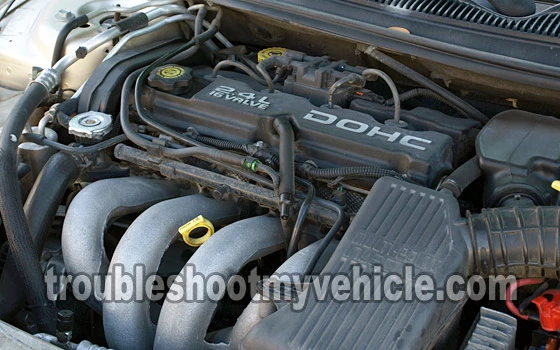
Troubleshooting a cranks but does not start condition can be quite a challenge since so many different things can cause your car or minivan not to start.
In this article, we'll explore the basics of a no-start condition and how to troubleshoot it.
Contents of this tutorial:
ES  You can find this tutorial in Spanish here: Cómo Probar Un Arranca Pero No Prende (Chrysler 2.0L, 2.4L) (at: autotecnico-online.com).
Difference Between A No-Crank And A No-Start Condition
I'm sure you've heard the terms: ‘my car doesn't crank’ and ‘my car doesn't start’. Is there a difference between the two? Yes there is! Here's a brief description of both conditions:
No-Start Condition: The engine cranks (turns over) like it wants to start but it never does. The usual culprits are:
- Failed crank position sensor.
- Failed fuel pump.
No-Crank Condition: The engine does not turn over when you turn the key to start your Chrysler/Dodge/Plymouth vehicle. This is usually due to:
- Failed starter motor.
- Failed neutral safety switch.
- Failed ignition switch.
- Locked up engine.
This tutorial is geared toward a cranks but does not start condition. If you do need to test the starter motor, this tutorial will help you:
No Start Condition Basics
In a nutshell, your 2.0L, 2.4L equipped Chrysler car or minivan needs 3 things to start:
- Air.
- Fuel.
- Spark.
When either one of the above three things is missing (when you crank the engine), your car or minivan is not gonna' start.
This basic piece of information will make you aware that you need to see if the problem is being caused by a problem in the fuel system, or in the ignition system, or in the engine mechanical system.
Here are some more specifics:
1.) Ignition System
- The ignition system is the one responsible for creating and delivering spark. Without spark, the engine will crank but not start.
- The ignition system of the Chrysler 2.0L, 2.4L equipped vehicles covered by this article use a distributor-less ignition system. More specifically, it uses a coil pack type ignition system.
- In my experience, the most common component failures, of the ignition system that cause a no-start no-spark condition are:
- No power to the ignition coil pack.
- Bad ignition coil pack.
- Bad crankshaft position sensor.
- The Ignition System components can be tested in a methodical way to find out exactly what has failed (if indeed something has).
2.) Fuel System
- The fuel system is the one responsible with supplying the engine with fuel.
- The fuel system component that causes the majority of no-start no-fuel problems:
- Fuel pump relay (if equipped).
- Bad ASD (Auto Shutdown) relay (this is the relay that provides power to the PCM and the fuel pump or fuel pump relay).
- Fuel pump.
- The fuel pump can be tested to make sure it has really fried.
3.) Engine Mechanical System
- The engine pistons and cylinder head valves (and all the other related components like: timing chains, etc.) are the ones responsible for the induction of the fresh air the engine needs for the combustion process.
- Although rare, internal engine mechanical problems can and do cause no-start conditions.
- Possible internal engine problems are:
- Blown head gasket.
- Blown engine.
- Broken timing belt.
OK, the list of possible things that can go wrong looks pretty long but it is rare to see (or have) two different components go bad from two separate systems at the same time.
The cool thing is, is that there is a diagnostic strategy that you can use to figure out exactly what's wrong with your particular no-start problem. Let's find out more about it in the next subheading.
NO START 1: Checking For Spark
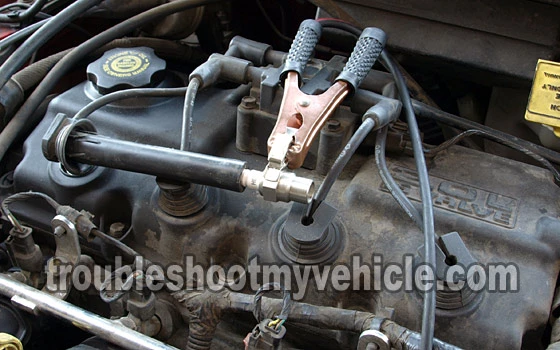
To find out if the ignition system is the cause of the cranks but does not start condition of your car or minivan, you'll need to make sure each cylinder is being fed spark.
So, my recommendation to you is to check for spark at all of the spark plug wires with a spark tester. Now, when I test for spark, I also test for fuel pressure with a fuel pressure gauge. It's not that I'm trying to see if I'm missing both fuel and spark (as mentioned before, usually one of them will be missing from the mix), it's just my way of speeding up the troubleshooting process.
Testing the ignition system on your Chrysler 2.0L, 2.4L equipped vehicle isn't hard or difficult. I've written a tutorial that'll show you in a step-by-step manner and you can find it here: How To Test The Coil Pack (Chrysler 2.0L, 2.4L) (at: easyautodiagnostics.com).
Remember, the idea behind checking for spark is to see if all of the 4 engine cylinders are getting spark. Here are the most common causes of a no spark result:
CASE 1: Spark was present in all of the cylinders. This result tells you three very important things:
- The crankshaft position (CKP) sensor is good.
- The ignition coil pack is getting power.
- The ignition coil coil packs are good (the ignition coil pack is made up of 2 individual ignition coils).
You don't have to spend any time testing them or any money replacing them. Your next step is to check the fuel pump pressure. Go to: NO START 2: Checking For Fuel.
CASE 2: Spark was NOT present in all of the cylinders. This usually tells you that the ignition coil pack is bad (or missing power) or the crank sensor is bad. It's usually one or the other, I have never seen both go out at the same time.
Now, with no spark in any of the engine cylinders, this what I would suggest:
- Test the crankshaft position sensor using the following tutorial I've written:
- Test the ignition control module using the following tutorial I've written:
- How To Test The Coil Pack (Chrysler 2.0L, 2.4L) (at: easyautodiagnostics.com).
NO START 2: Checking For Fuel
Fuel pumps fail all of the time and if it has failed in your 2.0L/2.4L equipped Chrysler car or minivan, you'll have a bonafide cranks but does not start condition on your hands.
The absolute best way to test the fuel pump is with a fuel pressure gauge, since your 2.0L/2.4L Chrysler car or minivan comes equipped with a Schrader Valve to make it convenient to attach a fuel pressure test gauge to it. If you don't have a fuel pressure test gauge, you can buy one online or rent one at your local auto parts store (like AutoZone or O'Reilly Auto Parts).
If you need to test the fuel pump, to see if it's the cause of the no-start condition on your specific vehicle, you can check out the following tutorial: How To Test The Fuel Pump (Chrysler 2.0L, 2.4L).
When testing the fuel pump (with a fuel pressure gauge), you'll usually see one of two results:
CASE 1: Fuel pressure is at specification. Not only does this result tell you that the fuel pump is OK but that the following components, that supply the fuel pump with power, are OK too:
- Fuel pump fuse.
- Fuel pump relay.
And so, there's no need to spend time testing them or money replacing them.
CASE 2: Fuel pressure is not present. This usually means that the fuel pump has failed, but not always. I would recommend testing/checking the following before condemning the fuel pump:
- After verifying that no fuel pressure exists, check that the fuel pump is getting power by tapping into the power circuit that feeds the pump with 12 Volts with a multimeter.
- Once you're tapped in, have a helper crank the engine while you observe your multimeter in Volts DC mode. If voltage is present (12 Volts), then you have confirmed that the fuel pump fuse and fuel pump relay are working perfectly.
- Confirming power to the fuel pump (with a multimeter) also verifies that the fuel pump has failed and needs to be replaced.
- If no voltage is present, as your helper cranks the engine, then the cause of no-fuel condition is due to either a bad fuse, fuel pump relay.
NO START 3: Checking Engine Mechanical Condition
If you've reached this point, you've confirmed that all four spark plug wires are sparking and that fuel pressure is within specification.
The next step is to check the engine's mechanical condition to see if it's causing the no-start. This involves three tests:
- Checking for a broken timing belt.
- Checking for a blown head gasket.
- Checking engine compression.
The following tutorials will help you test each one:
- How To Test For A Broken Timing Belt (1995-2005 2.0L SOHC Dodge/Plymouth Neon).
- How To Test For A Blown Head Gasket (Chrysler 2.0L, 2.4L).
- How To Test The Engine Compression (Chrysler 2.0L, 2.4L).
The idea is simple: test one component at a time. If a test passes, you can eliminate that as the cause and move on to the next one. This is a process of elimination —keep going until you find the cause of the engine no-start problem.
No Start Summary
Checking the basics (spark, fuel, and air) is not that hard. Not to mention that it's the key to saving yourself time, money and a lot of frustration, when troubleshooting a cranks but does not start condition.
To check the basics, you need tools. There's just no way around it. One of the analogies that I've always enjoyed repeating, about doing a job without the right tools is like trying to eat a bowl of soup with a fork.
So besides knowing what to test, you need tools to do those tests. You don't have to spend an arm and a leg, since you can buy a lot of diagnostics tools that are tailored for the pocket-books of the serious do-it-yourself-er. Here are some of the basic tools you'll need:
- Fuel pressure gauge.
- Spark tester.
- Compression gauge.
- Multimeter.
Related Test Articles
You can find a complete list of tutorials here: Chrysler 2.0L, 2.4L Index Of Articles. Below, is a sample of articles you'll find in this index of articles:
- How To Test A Fuel Injector (Chrysler 2.0L, 2.4L).
- How To Test A Bad Starter Motor (Chrysler 2.0L, 2.4L).
- How To Test The Crankshaft Position (CKP) Sensor (Chrysler 2.0L, 2.4L).
- How To Test The Coil Pack (Chrysler 2.0L, 2.4L) (at: easyautodiagnostics.com).

If this info saved the day, buy me a beer!


