
Although quite a few things can cause a cylinder misfire code (P0300, P0301, P0302, P0303, P0304) to turn on the check engine light, troubleshooting it isn't that difficult.
In this tutorial, I'll walk you through the testing tips and techniques I use to get to the root of the cylinder misfire problem on 2.2L GM equipped vehicles (2.2L Chevrolet Cavalier, or Pontiac Sunfire, or Chevrolet Sonoma, or GMC Sonoma).
I'll also point you to the in-depth tutorials you need to test the system that's actually causing the misfire.
Contents of this tutorial:
What Is A Misfire Condition?
A misfire condition, in plain English, describes an engine that is not operating on all cylinders. Now, in the case of the GM 2.2L 4 cylinder engine, if one cylinder cuts out, the engine will only output 75% of it's power and this will cause some issues. If two or more engine cylinders are misfiring, your vehicle will not start. Here are some of the most common symptoms of a misfire condition on your GM 2.2L:
- The check engine light (CEL) will be on.
- One or more misfire codes (P0300, P0301, P0302, P0303, P0304) will be stored in the car or pickup's computer's memory.
- Misfire is present, but no misfire codes are registered in the computer's memory.
- Lack of power upon acceleration.
- Smell of unburned gasoline exiting the tail pipe.
- Rough idle and may stall.
- Cranks but does not start.
- Will not pass the emissions tests.
- Bad gas mileage.
What Causes A Misfire Condition?
As you may already know, each cylinder needs air, fuel, and spark to produce power. If any one of these components are missing, that engine cylinder will misfire. Therefore, the fault could lie in the ignition system (which is responsible for creating spark), or in the fuel system. Now, in most cases it's usually a lack of spark that's to blame for the misfire, but not always. Let's take a brief look at the different things that can cause your 2.2L to misfire.
Ignition System: As you're already aware, the ignition system on the GM 2.2L is composed of an ignition module, two ignition coils (that feed two cylinders with spark simultaneously), 4 spark plug wires, and 4 spark plugs. If any one of these goes bad (and they do), then you'll end up with a misfire condition. Now, all of these can be tested to see if they are the culprits behind the misfire.
Here are the most common ignition system problems causing a misfire:
- Bad spark plugs.
- Spark plugs that are carbon fouled due to the engine burning oil.
- Broken spark plugs usually happens when they are installed or when the engine is washed.
- Bad spark plug wires.
- Bad ignition coil pack.
- Each ignition coil pack fires spark to 2 cylinders simultaneously (Waste Spark) and what usually happens is that one ignition coil pack will stop firing spark from one tower or both.
- Bad ignition control module
- The ignition control module (ICM) sits under the 2 ignition coil packs.
- The ignition control module can fail and stop activating one of the 2 ignition coil packs sitting atop it, causing 2 cylinders to go ‘dead’ for lack of spark.
Fuel System: Here are the most common fuel system component failures:
- Bad fuel injectors.
- This is the most common type of fuel system failure that will cause the engine to misfire since these guys don't last forever.
- When a fuel injector 'fries' it usually doesn't leave you a bad fuel injector diagnostic trouble code but you'll definitely see a misfire code (P0300, P0301, P0302, P0303, or a P0304).
- Fuel injectors not being fed with power or the activation signal.
- The activation signal comes from the PCM (Powertrain Control Module = Fuel Injection Computer).
- A lack of the power or activation signal usually points to either an open-circuit problem in the wiring or a bad computer.
- Bad fuel pump.
- When fuel pumps die, your vehicle will crank but not start, but sometimes it takes a long time for the fuel pump to die. In the meantime, it sends less than the ideal fuel pressure/volume to the fuel injectors. This results in a rough idle condition that can make you think it's an ignition system misfire.
Engine Mechanical Condition: An engine cylinder that is not producing enough compression, even if it has spark and fuel, will cause a misfire condition that will set a misfire code. Another thing that will cause a misfire (normally at idle) is vacuum leaks coming from a large vacuum hose or the intake manifold gasket.
What Tests Can I Perform To Find The Cause Of The Misfire Condition?
The very first thing you'll need to do is identify the ‘dead’ cylinder and this is easily done by scanning for misfire codes (with a scan tool).
The most common misconception is that a scan tool will tell you exactly what to replace to solve a misfire code or codes. Reading the diagnostic trouble codes is only the beginning of your troubleshooting.
Once you have identified the cylinder that is misfiring (missing or dead), now you need to do some very specific tests to see what is causing the issue. Here's a break down of the tests that you'll need to perform on your 2.2L Cavalier (or Sunfire, Sonoma, S10 Pick Up):
Ignition System:
- Remember, identify the ‘dead’ cylinder first:
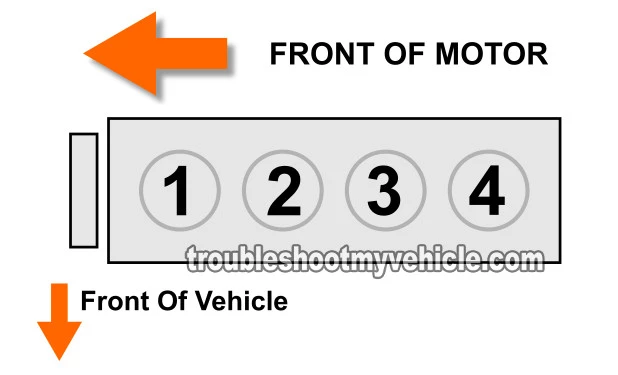
- P0301: Cylinder #1 Misfire. Cylinder #1 is the one closest to the drive belt (see photo).
- P0302: Cylinder #2 Misfire.
- P0303: Cylinder #3 Misfire.
- P0304: Cylinder #4 Misfire.
- Check for spark using a spark tester. What you want to do is confirm that:
- All spark plug wires are sparking.
- Remove and physically check that none of the spark plugs are broken or are cracked.
If one spark plug wire or two are not sparking, then the next step is to see if that spark plug wire is bad or if the cause is due to a bad ignition coil pack or a bad ignition control module.
This is not as hard as it sounds. The following tutorial will show you how to do it in a step-by-step way:
- How To Test The GM 2.2L Ignition Coil Pack (at: easyautodiagnostics.com).
Fuel System:
Once you've checked and have confirmed that all four spark plug wires are good and sparking and that the spark plugs are OK, then next step is checking the fuel injectors and fuel pressure.
You should:
- Test all four fuel injector signals with a Noid light.
- Check the internal resistance of the fuel injectors.
- Check fuel pressure with a fuel pressure gauge.
You can find the fuel injector test tutorial here:
- How To Test The Fuel Injectors With A Multimeter (GM 2.2L).
- How To Test The Fuel Injectors (2002-2005 GM 2.2L Ecotec).
Engine Mechanical Condition:
By testing ‘engine mechanical condition’ I specifically mean checking that engine compression doesn't vary more than 15%.
- Test the engine compression of all engine cylinders.
- Check for vacuum leaks.
- This usually involves visually checking that the vacuum hoses are not broken, burned, or with dry-rot.
- You should also check for vacuum leaks by spraying carburetor spray around the intake manifold gasket area while the engine is running.
- IMPORTANT: When using carb. Spray to check for vacuum leaks, the engine must NOT be hot or you run the risk of fire.
- Check that you don't have a blown head gasket.
You can find an engine compression test tutorial that explains how to do and interpret the compression test:
The following tutorial will help you test for a blown head gasket:
It seems like a long and complicated list doesn't it? What's gonna' make the whole process fast and easy is remembering that only one of three things is gonna' be missing (spark, fuel or air and by ‘air’ I mean engine compression).
If you're getting the impression that you CAN find out the exact cause of your misfire condition on your GM 2.2L car or pickup (Chevrolet: Cavalier, S10 Pick Up, Pontiac Sunfire, GMC Sonoma), you're right! Let's turn the page and find out more.
What Tools Do I Need To Test The Misfire Code(s)?
Finding the exact cause of the misfire codes or misfire condition is possible with the proper tools. Without them, you won't be able to diagnose/troubleshoot those issues on your GM 2.2L car or pickup (Chevy: Cavalier, S10 Pick Up, Pontiac Sunfire, GMC Sonoma).
Depending on what the root cause of the misfire is, you'll need several tools. Most of these you can buy online, none of these will break the bank and I'll make some recommendations on them. Here's a guide to some of the basic tools that can be and are used:
- Ignition System Tests:
- Spark tester.
- Multimeter.
- Test light.
- Fuel System Tests:
- Noid light.
- Fuel fuel gauge.
- Multimeter.
- Engine Mechanical Tests:
- Compression tester.
Now of course, you'll also need basic hand tools like: screw-drivers, ratchet wrenches, sockets, etc. You'll also need a generic scan tool to retrieve the diagnostic trouble codes (DTCs) from the computer's memory (Don't have a scan tool? Need a scan tool? Check out my recommendation: ANCEL AD530 OBD2 Scanner w/ Live Data (Amazon affiliate link).
Keep in mind that using the right tool for the job will save you time, frustration, and /or keep you from damaging the component that you're testing.
Is This Something I Can Do? Or Do I Need To Take It To A Repair Shop?
Most of the tests that you'll need to perform on your GM 2.2L 4 cylinder equipped car or pickup are simple and easy. Even someone with little practical ‘wrenching’ experience can easily accomplish them.
The deciding factor, to either troubleshoot the car or pickup yourself or take it to an auto repair shop, is if you have or don't have the necessary tools and the time required to perform the tests. Here are a couple of questions to consider:
- Do I have all of the required info (such as repair manual, online testing info, etc.) to diagnose/troubleshoot the vehicle myself?
- Do I have the patience to work on my own car?
Where Do I Find The Test Articles?
Finding the right information to troubleshoot the misfire condition on your GM 2.2L car or pickup can be quite a challenge. So many variables, questions, scenarios come into play, when your start testing your vehicle, that it's not possible to find all of the info you may need in one place.
This site will try to make your life as easy as possible by providing a lot of reliable and proven testing information, although you'll still need a repair manual and other online sources of info. Alright, let's get testing! The links below will take you to specific tests to find out what causing your misfire condition:
- GM 2.2L Fuel Injector Noid Light Test.
- How To Do An Engine Compression Test (GM 2.0L, 2.2L, 2.5L).
- How To Test The Fuel Injectors With A Multimeter (GM 2.2L).
- How To Test The GM 2.2L Ignition Coil Pack (at: easyautodiagnostics.com).
You can find a complete list of GM 2.2L diagnostic tutorials here: GM 2.2L Index Of Articles.

If this info saved the day, buy me a beer!


