
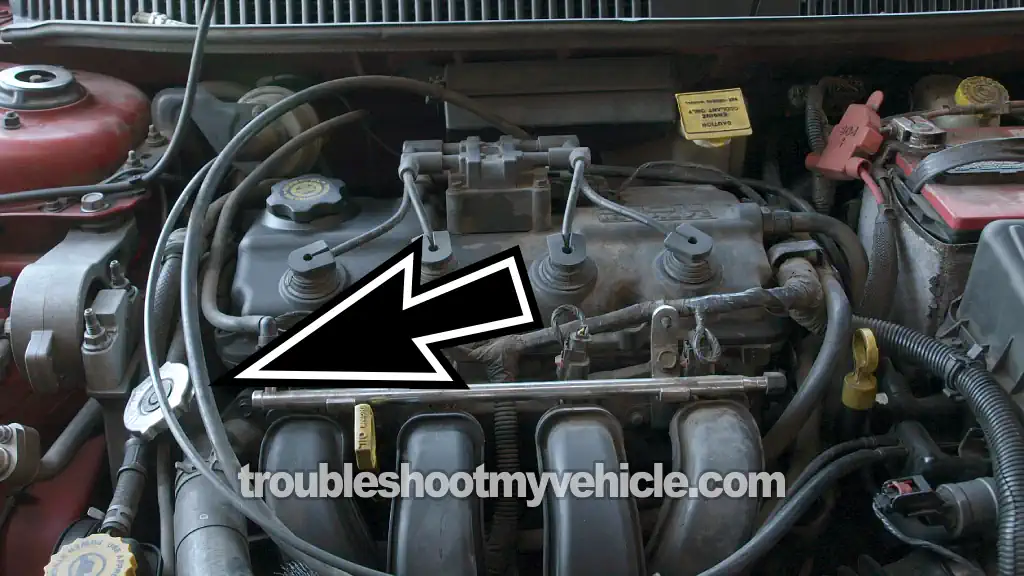
It's possible to test the thermostat in your 2.0L, 2.4L Chrysler vehicle to see if it's stuck open or stuck closed without having to take it out from the engine and I'll show you how to do it.
As you're probably already aware, when the thermostat stays stuck closed, your vehicle will overheat. When it stays stuck open, the engine will never warm up and your heater will not work. Well, whether the thermostat is stuck closed or open, I'll take you through the whole process in a step by step fashion.
In this article, I'll also show you how to check that the electric fan (or fans) are coming on at the appropriate coolant temperature.
Contents of this tutorial:
Important Suggestions And Tips
TIP 1: To take advantage of the test info in this article, you'll need a scan tool that has Live Data capability since you'll need to check the coolant temperature with it. A simple code reader can't do this.
You don't need the factory scan tool or an expensive professional technician level scan tool. A generic scan tool will do great and I've written this article with this tool in mind: ANCEL AD530 OBD2 Scanner w/ Live Data (Amazon affiliate link).
TIP 2: To test the thermostat, the engine has to be started and it has to warm up as close as possible to its normal operating temperature. This means the coolant will get very hot (but not overheat) and so you should not open the radiator cap under any circumstances or you run the risk of getting burned by the hot coolant.
Opening and/or removing the radiator cap with a warmed up or hot engine can cause you severe burns. Be careful, use common sense and think safety all of the time.
TIP 3: It is super important that you start out with a cold engine to successfully test the thermostat.
If you have been running the engine for an extended amount of time, let it cool down completely. This is important for safety reasons and for the accuracy of the thermostat test.
Symptoms Of A Bad Thermostat
The thermostat in your 2.0L or 2.4L equipped Chrysler car or minivan will fail in one of two ways: It will either stay stuck at its open position and let coolant circulate all of the time or it will stay stuck closed. When it stays stuck closed, your car or mini-van will overheat.
Here are some more specifics:
CASE 1: If the thermostat is stuck open, you'll see the following symptoms:
- Bad gas mileage.
- If it's winter time, the heater will not work.
- If your vehicle is equipped with a temperature gauge (and not just a temperature light), it will always show you a low reading or none at all.
- Won't pass the state emission's test.
Most folks are usually surprised to find out that a stuck open or missing thermostat wreaks such havoc with gas mileage but it's true.
CASE 2: If the thermostat is stuck closed, you'll see the following symptoms:
- The engine will overheat.
- Cooling fans come on, but the engine does not cool down.
- If your vehicle is equipped with a temperature gauge, it will max out.
- If your vehicle is equipped with a temperature light, it will shine nice and bright to let you know that an engine meltdown is occurring.
To understand how the thermostat functions to regulate the engine's temperature, head over to the section Engine Thermostat Basics (at the bottom of this tutorial).
TEST 1: Thermostat Operation

Before you jump into the test, on your car or mini-van, please remember that:
- It's critical, for the accuracy of the test (and your safety), that you start out with a cold engine.
- As the engine warms up, do not open the radiator cap for any reason.
NOTE: The instructions below assume that you have a scan tool with "live data" capability. If you don't have one, this is the one that I recommend. It's a sturdy little unit that has live data capability and doesn't cost an arm and a leg: ANCEL AD530 OBD2 Scanner w/ Live Data (Amazon affiliate link)
IMPORTANT: To get the most accurate result from your thermostat test, the engine must be completely cold before you start. If the engine has been running for any length of time, let it cool down fully. If needed, you can place a fan on top of the engine to help bring it down to ambient temperature faster.
OK, this is what you need to do to get this show on the road:
- 1
The first step is to check that the cooling system is completely topped off with coolant.
So, if you have already verified that the engine is completely cold (and by cold, I mean that it's at ambient temperature), remove the radiator cap and check the level of the coolant. Add coolant if necessary and re-install the radiator cap. - 2
Next, check the temperature of the upper radiator hose with you hand. The hose should be cold (at ambient temperature)
Don't skip this step since you need to make sure that the upper radiator hose is cold (at ambient temperature) before cranking and starting the engine.
If the hose is warm or hot, let the engine cool down some more and start then. - 3
Connect your scan tool to the vehicle and get to its Live Data mode.
Scroll down to the PID for the Coolant Temp Sensor.
This PID will be labeled: Coolant °F or Coolant °C (see the photo in the image above). - 4
Crank and start the engine but leave the hood open (the hood must remain open for the entire test).
The engine will start to warm up and eventually reach its operating temperature. In the meantime, you need to keep an eye on the coolant temperature that your scan tool is displaying.
NOTE: If you started with an engine at ambient temperature, your scan tool should report a coolant temperature that's within ±10°F of ambient temperature. For example, if it's 95°F outside, the coolant temperature should read about 95°F ±10°F. - 5
As the engine starts to warm up and the coolant starts to absorb this heat, your scan tool will display this increase in temperature.
When your scan tool finally shows 150° Fahrenheit (65° C), lightly touch the upper radiator hose to check its temperature.
If the thermostat is OK, the hose should still be cold (ambient temperature). In other words, it should be the same temperature you noticed before you started the engine on your car or mini-van. If so, continue to step 6.
If the hose is hot, this tells you that the thermostat is either missing or stuck open, since at this temperature (150°F) the hose should still be cold to the touch. Replace the thermostat. Also, there's no need to continue on to the next steps. - 6
As the engine continues to run, the coolant temperature will eventually reach 190° Fahrenheit (87° C). When it does, lightly touch the upper radiator hose once again.
At this temperature, the thermostat should start to open. Lightly touch the upper radiator hose and check its temperature. It should start to get warm to hot (compared to its temperature at the beginning of the test).
If the hose does not feel like it's heating up, don't worry about it just yet, continue to the next step. - 7
Let the engine run till the scan tool reports a temperature of 200°F (93° C) and lightly touch the upper radiator hose again.
The hose should now be hot. - 8
Alright, whether the upper radiator hose is hot or not, turn the engine off and let's interpret your test results.
Let's take a look at what your results mean:
CASE 1: The radiator hose got hot at 190°F and stayed hot at 200°F. This test result confirms that the thermostat is functioning correctly.
Here's why: The thermostat's job is to prevent coolant from circulating, into the radiator, before a certain temperature. So below 190°F, the upper hose should be cold to the touch. After 190°F, the thermostat opens up and lets the now hot coolant circulate into the radiator.
You're next step is to check the radiator fan motor's operation. Go to: TEST 2: Electric Fan Motor Operation.
CASE 2: The radiator hose DID NOT get hot at 190°F nor at 200°F. This test result confirms that the thermostat is bad and is stuck closed. Replace the thermostat.
CASE 3: The radiator hose got hot below 150°F. This result confirms that the thermostat is bad and is stuck open. Replace the thermostat.
Here's why: If the thermostat were working correctly, it would not let any coolant circulate within the hose and the hose would be at ambient temperature. Since the thermostat is stuck open (or missing) the coolant starts to circulate immediately and the hose will feel warm to hot as soon as the engine starts to run.
TEST 2: Electric Fan Motor Operation
Your 2.0L, 2.4L Chrysler vehicle is equipped with an electric fan motor and since you still have your scan tool connected to the vehicle (from the previous test), I'll show you how to check to see if the fan motor is coming on at the correct temperature.
Before you start, you need to make sure that the A.C. Is turned off.
Alright, this is what you'll need to do:
- 1
Restart the engine in your car and continue checking the coolant temperature your scan tool is registering.
- 2
Let the engine run till the coolant reaches 225°F (107° C), as registered on your scan tool.
At 225°F, the fan should com alive and start cooling down the coolant. - 3
If the fan motor has not turned on by 227°F (108° C), turn off the engine (any temperature above 300°F and the engine is considered to be overheating).
- 4
As the fan continues to run, you should see that the coolant temperature (on your scan tool) start to gradually decrease till it reaches 200°F. At this point, the fan should turn off and the cycle will repeat itself.
Let's interpret the result of your test:
CASE 1: The fan (or fans) did NOT come on at 225°F - 227°F. This test result confirms that the overheating problem is due to a fan motor issue.
Now, it's beyond the scope of this article to further test the fan motor, but at least now you know that you do have a fan motor issue. The next steps are for you to test the fan motor, fan motor relay and fan motor fuses.
CASE 2: The fan (or fans) did come on at 225°F - 227°F, but the vehicle continues to overheat. If you have also confirmed that the thermostat is good (in TEST 1), then the most likely cause of the overheating issue is a blown head gasket.
You can find three specific tests, to verify a blown head gasket in this article: How To Test For A Blown Head Gasket (Chrysler 2.0L, 2.4L)..
CASE 3: The fan (or fans) did come on at 225°F - 227°F but the temperature DID go down. This confirms that the fan(s) and thermostat are OK. No further testing is needed.
Engine Thermostat Basics

In case you're wondering why the engine has one and needs one, this section might shed some light on the subject (don't worry, I won't go into minute technical mumbo jumbo).
In a nutshell, the thermostat's job is to help regulate the engine's temperature. The PCM needs to have the engine within a certain temperature range to effectively control the emissions that the engine produces and to help you get the maximum amount of gas mileage possible. This temperature range is between 190° to 225° Fahrenheit (87° to 107° Celsius).
The reason for this is that the cooler the engine is, the more gasoline it needs to keep running smoothly (and unfortunately, at these temps, it pollutes more). As the engine heats up and reaches the optimal temperature range described above, the engine needs less and less fuel to maintain it's optimal performance and of course pollutes less.
In a nutshell, here's how they both keep the engine from overheating and running optimally:
- The thermostat is responsible for keeping the engine from going below 190°F.
- The fan motor (or fan motors) are responsible for keeping the engine temperature below 227°F.
- When you start your vehicle, the thermostat is closed, which keeps the coolant from circulating to the radiator. This allows the engine to warm up faster.
- As the coolant circulates within the engine only, its temperature increases. Once it reaches about 190°F, the thermostat opens.
- With the thermostat now open, the coolant begins to circulate between the engine and the radiator.
- Even though the thermostat has opened, the coolant temperature will continue to increase. When it reaches about 227°F, the fan or fans turn on.
- The fans help bring down the temperature of the coolant in the radiator, which is circulating back into the engine. Once the temperature drops to around 200°F, the PCM turns the fan or fans off.
- If the coolant temperature drops below 190°F, the thermostat closes again. This helps keep the engine within its normal operating temperature range.
- With the fans off, the coolant begins to absorb heat again, and the whole process repeats itself continuously while the engine is running.
The cool thing is that you can observe these temperature changes with your scan tool in live data mode and this is the way I'm gonna' show you how to test the thermostat.
Other Tips And Suggestions
Keeping on top of the cooling system, on your 2.0L, 2.4L equipped Chrysler, Dodge, Eagle or Mitsubishi car will save you a ton of money. Yes, maintenance involves time and money, but if you let that little coolant leak go, or continue driving the vehicle even tho' it's overheating, the end result will be a major financial headache.
Overheating and coolant leak issues usually lead to blown head gaskets if they are not attended to immediately.
The following are personal recommendations:
- If the radiator plastic tanks crack, replace the radiator or fix it as soon as possible. These cracks will also prevent the cooling system from pressurizing and over time and many many miles, you'll have a blown head gasket issue.
- Flush the anti-freeze (engine coolant) at least twice a year. From personal experience, I don't buy into the hype that anti-freeze can last 100,000 miles and I suggest you don't either.
- If you don't or can't flush the anti-freeze, at least do a radiator drain and fill.
- Replace the thermostat as a maintenance issue, just like you would replace a fuel filter. You don't have to replace it every year, but if you plan to keep your car for a while, replace it every two years.
- Replace the radiator upper and lower hoses if they are bulging at the hose clamps or the rubber the hose is made of is too spongy.
- If your vehicle overheats while you're driving, pull over into a safe spot and have it towed home or to your trusted automotive repair shop.
More Test Articles
I've written quite a few 2.0L, 2.4L ‘how to’ tutorials that may help you troubleshoot the issues on your Chrysler (Dodge Plymouth) car or mini-van. You can find the complete list at:
Here's a sample of the Chrysler 2.0L, 2.4L articles you'll find:
- Blown Head Gasket Test.
- How To Test A Fuel Injector (Chrysler 2.0L, 2.4L).
- How To Test The Crank Sensor.
- How To Test The Ignition Coil Pack (Chrysler 2.0L, 2.4L) (at: easyautodiagnostics.com).

If this info saved the day, buy me a beer!


