
OBD II trouble code P0107 Manifold Absolute Pressure (MAP) Circuit Low Voltage indicates that the manifold absolute pressure (MAP) sensor is reporting a continuous high intake manifold vacuum pressure when other sensor input (to the PCM) indicates the opposite is happening.
In this tutorial, I'll show you what a P0107 DTC means and how the MAP sensor works -all in plain English. I'm also gonna' show you where you can find the 3-wire and 4-wire MAP sensor test tutorials that'll show you how to test the MAP sensor with a multimeter (no scan tool required).
Contents of this tutorial:
P0107 MAP Sensor Basics
The manifold absolute pressure (MAP) sensor's job is to measure the amount of vacuum in the intake manifold. The amount of vacuum, in the intake manifold, at any given moment depends on engine load.
We can sum this up as: The bigger the engine load (i.e. Accelerating your car or mini-van to pass someone on the highway), the more fuel needs to be injected into the engine. The smaller the engine load (think coming to a stop light and the engine idling), the less fuel the engine needs.
To drive this point home, here are some more specifics:
- As you step on the accelerator pedal,
- The throttle plate opens and intake manifold vacuum decreases.
- The MAP sensor's voltage signal increases to correspond to the decrease in manifold vacuum.
- The fuel injection computer now ‘sees’ the engine's load increase and injects more fuel.
- As you let your foot off the accelerator pedal,
- The throttle plate closes and intake manifold vacuum increases.
- The MAP sensor's voltage signal decreases to correspond to the increase in manifold vacuum.
- The fuel injection computer now ‘sees’ the engine's load decrease and injects less fuel.
Now, when the PCM sees the MAP sensor producing a low voltage that indicates a high vacuum condition (think closed throttle/engine idling) even though other sensor inputs indicate otherwise, it sets a code P0107 manifold Absolute Pressure (MAP) Circuit Low Voltage and lights up the check engine light (CEL) on your car or mini-van's instrument cluster.
How The 3-Wire MAP Sensor Works
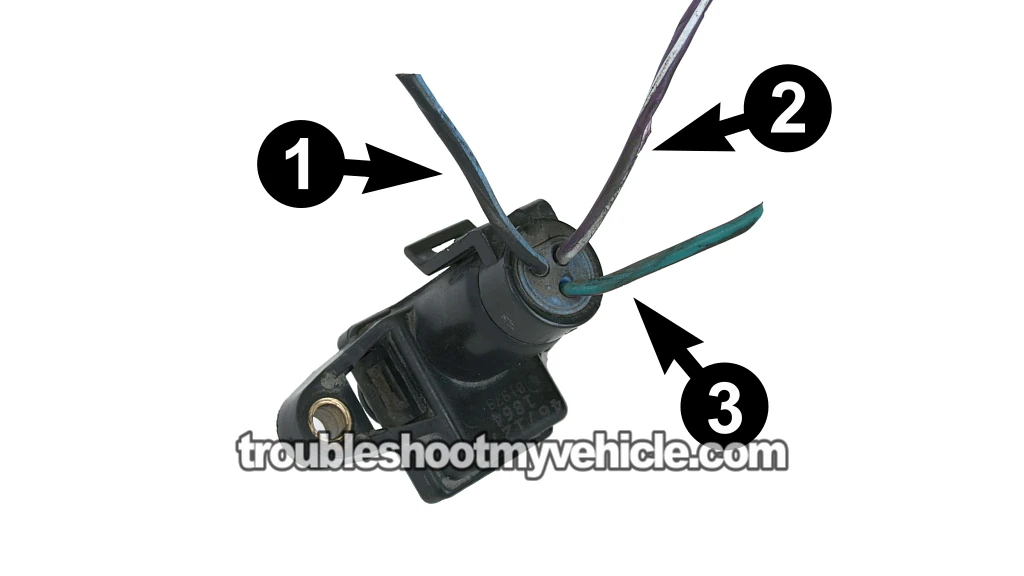
Your car or mini-van's manifold absolute pressure (MAP) sensor needs power and Ground to function and these are fed to the sensor via 2 of the 3 wires that connect to it.
The third wire (which is the middle one) is the one that returns the signal, the MAP sensor creates, to the PCM.
Don't worry, it's nothing too technical and it's all in plain English:
- Wire labeled with the number 1.
- Feeds Ground to the MAP sensor.
- Ground is provided by the PCM (internally).
- Wire labeled with the number 2.
- Supplies power to the MAP sensor.
- In the form of 5 Volts DC and is supplied only with Key On Engine Off (KOEO) or Key On Engine Running (KOER).
- The PCM supplies these 5 Volts DC.
- Wire labeled with the number 3.
- Feeds the MAP voltage signal to the PCM.
- This voltage signal increases or decreases depending on the manifold vacuum that's created by the throttle angle.
- At Key On Engine Off (KOEO), the MAP voltage signal is 4.5 Volts.
- As vacuum increases, MAP signal voltage decreases.
- As vacuum decreases, MAP signal voltage increases.
The 3-wire MAP sensor can be easily and accurately tested with a multimeter. You can find the 3-wire MAP sensor test here: 3-Wire MAP Sensor Diagnostic Test Chrysler, Dodge, Plymouth (a (at: easyautodiagnostics.com).
How The 4-Wire MAP Sensor Works
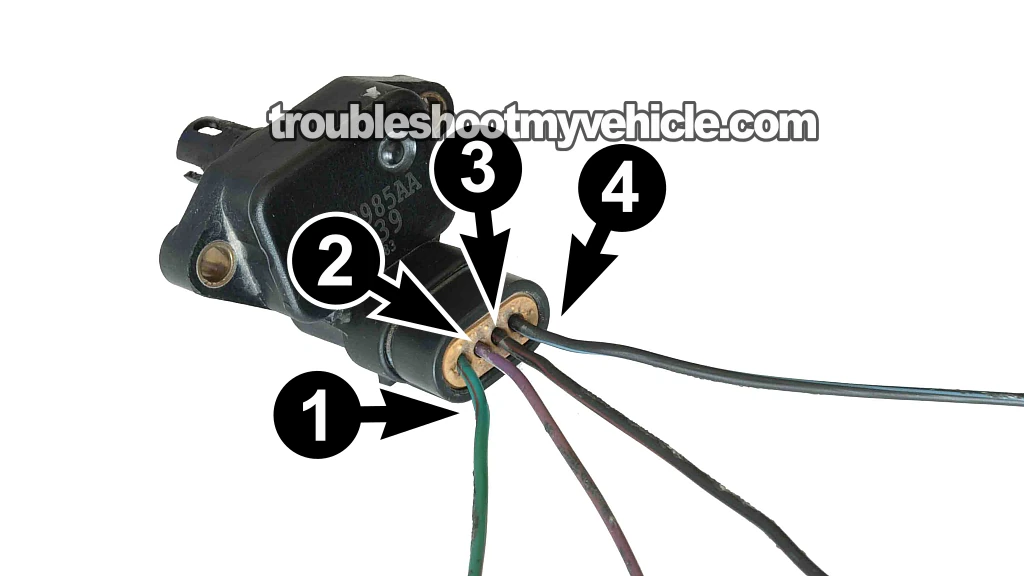
The 4-wire MAP sensor is two sensors in one. One part of the sensor handles the MAP function, the other part handles the intake air temperature (IAT) function.
This type of manifold absolute pressure (MAP) sensor needs power and Ground to function and these are fed to the sensor via 2 of the 4 wires that connect to it.
The other two wires return a MAP and an IAT signal to the PCM.
Don't worry, it's nothing too technical and it's all in plain English:
- Wire labeled with the number 1.
- Feeds Ground to the MAP sensor.
- Ground is provided by the PCM (internally).
- Wire labeled with the number 2.
- IAT sensor 5 Volt Reference Circuit.
- Wire labeled with the number 3.
- Supplies power to the MAP sensor.
- In the form of 5 Volts DC and is supplied only with Key On Engine Off (KOEO) or Key On Engine Running (KOER).
- The PCM supplies these 5 Volts DC.
- Wire labeled with the number 4.
- Feeds the MAP voltage signal to the PCM.
- This voltage signal increases or decreases depending on the manifold vacuum that's created by the throttle angle.
- At Key On Engine Off (KOEO), the MAP voltage signal is 4.5 Volts.
- At Key On Engine Off (KOEO), the MAP voltage signal is 4.5 Volts.
- As vacuum increases, MAP signal voltage decreases.
- As vacuum decreases, MAP signal voltage increases.
The 4-wire MAP sensor can be easily and accurately tested with a multimeter. I've written such a tutorial and you can find it here: Chrysler 4-Wire MAP Sensor Diagnostic Test (at: easyautodiagnostics.com).
Symptoms Of A P0107 Diagnostic Trouble Code
Your vehicle's fuel injection system is a speed density type (which also means it does not use a mass air flow (MAF) sensor).
This type of fuel system depends on engine load and engine speed info to inject the correct amount of fuel into the engine's cylinders.
So when the PCM receives a MAP signal that doesn't square with actual engine operating conditions, you'll feel it in more ways than one.
When the MAP sensor fails, you'll see one or more of the following symptoms:
- Check engine light (CEL) shining nice and bright.
- DTC P0107 is present.
- Your car or mini-van fails the state mandated emissions test.
- Bad gas mileage.
- Hard start and/or extended cranking time (after shut off).
- Black smoke coming out of the tailpipe.
- Hesitation when accelerating your car or mini-van.
Let's find out what are the common causes of a P0107 DTC, in the next subheading.
Common Causes Of A P0107 Trouble Code
The most common causes of trouble code P0107 are:
- A bad manifold absolute pressure (MAP) sensor.
- A broken MAP sensor connector.
- A problem in the sensor 3 or 4 wires. Specifically, a short in one of them.
- Engine with very low or uneven compression (in other words- a worn out engine).
- A fuel pump that's failing and not supplying enough fuel volume.
- A timing belt that's not synchronized correctly.
- A bad PCM.
Although extremely rare for this to happen, a bad PCM can also cause a false P0107 trouble code.
Troubleshooting DTC P0107
The key to diagnosing the P0107 manifold Absolute Pressure (MAP) Circuit Low Voltage OBD II diagnostic trouble code (DTC), that's lighting up your check engine light, is keeping in mind that the manifold absolute pressure (MAP) sensor (MAPS) is stuck producing a low voltage signal.
If you recall, from the previous page:
- The MAP sensor's voltage signal increases when the throttle plate opens and manifold vacuum is lower.
- The MAP sensor's voltage signal decreases when the throttle plate closes and manifold vacuum is higher.
So when a DTC P0107 is registered, the PCM sees the MAP sensor reporting a high intake manifold vacuum pressure (and thus receiving a low voltage MAP signal) when it knows, via other sensor inputs, that it should be reporting a lower vacuum pressure (and thus higher voltage signal).
Confused yet? Don't worry, the MAP sensor test is very, very easy. By manually testing the MAP sensor with a multimeter, you and I can find out if it's truly fried or not.
Here are the links to the MAP sensor multimeter tests I've written:
- 3-wire MAP Sensor Test:
- 3-Wire MAP Sensor Diagnostic Test Chrysler, Dodge, Plymouth (at: easyautodiagnostics.com).
- 4-wire MAP Sensor Test:
- Chrysler 4-Wire MAP Sensor Diagnostic Test (at: easyautodiagnostics.com).

If this info saved the day, buy me a beer!


